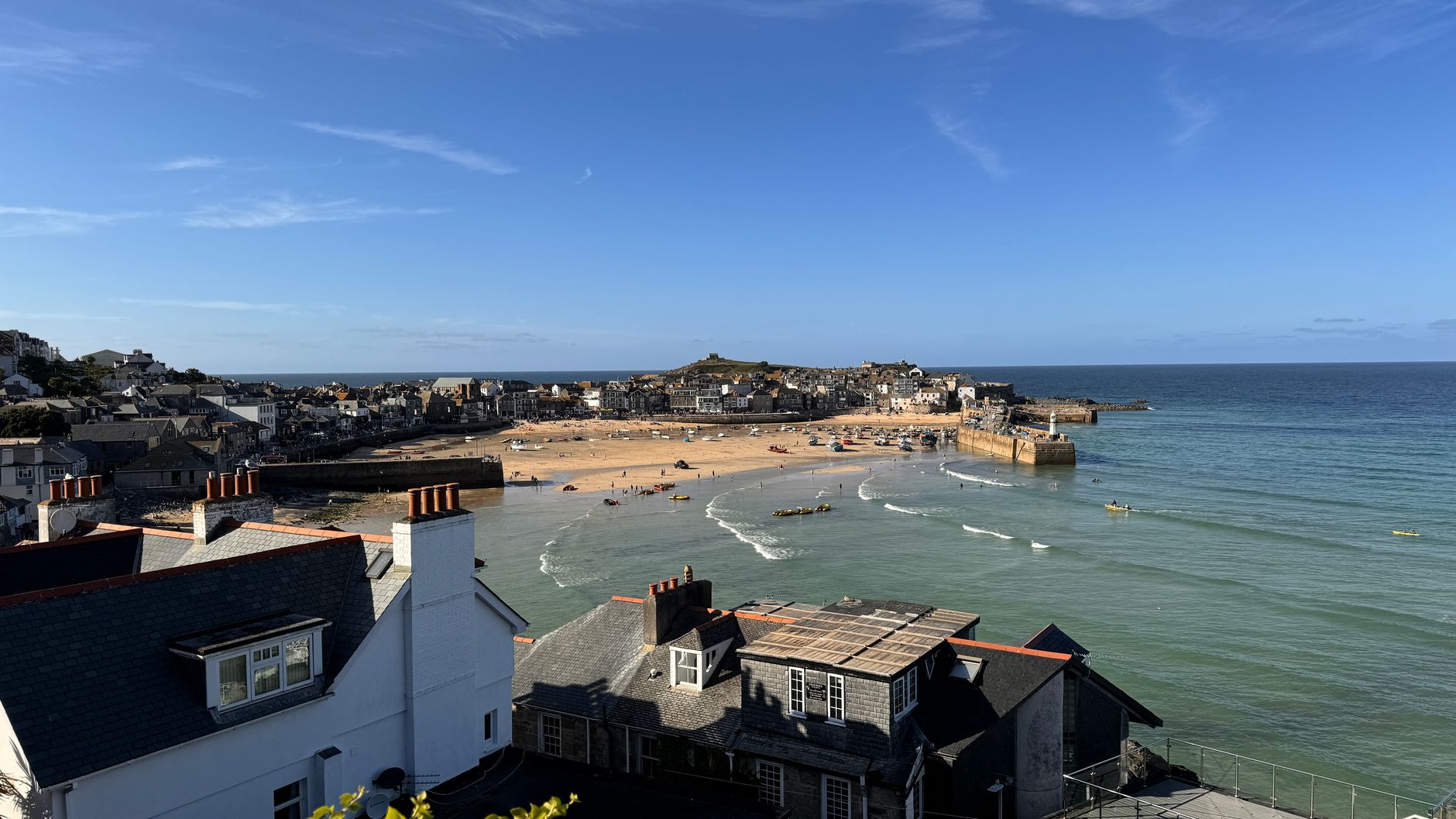
There is a particular quality to the light in St Ives that has drawn artists for well over a century, a clear, luminous brightness bouncing off the sea and the white sand that painters have long said you find nowhere else in Britain. That light, and the community of artists it nurtured, is why this small Cornish fishing town became one of the most important centres of modern art in the country, and why the gleaming Tate gallery overlooking Porthmeor beach feels so right here. This guide to Tate St Ives and Cornwall’s wider art heritage explains what to see, tells the story of the famous St Ives artists, and helps you plan a cultural visit to this most creative corner of Cornwall.
Tate St Ives is not a vast metropolitan gallery; it is an intimate, beautifully sited space deeply rooted in the place around it. Visiting it, along with the unforgettable Barbara Hepworth Museum nearby, is one of the cultural highlights of any trip to Cornwall.
The St Ives Art Story
Artists have worked in St Ives since the late 19th century, drawn by the light, the dramatic landscape and the cheap studios in former fishing lofts. The town’s artistic reputation grew through the early 20th century, but it was the arrival of a remarkable group of modernist artists around the time of the Second World War that made St Ives internationally significant. The sculptor Barbara Hepworth and the painter Ben Nicholson moved here in 1939, and around them gathered a community of avant-garde artists, including the Russian constructivist Naum Gabo, who pushed British modern art in bold new directions.
In the decades that followed, a younger generation, including Peter Lanyon, Patrick Heron, Terry Frost, Roger Hilton and the potter Bernard Leach, made St Ives a byword for innovative, abstract and landscape-inspired art. The naive painter Alfred Wallis, a retired St Ives fisherman who painted on scraps of card, was discovered here and became hugely influential. Together these artists formed what is loosely called the St Ives School, and their work brought international attention to this little Cornish town, attention that endures today.
The Artists Who Made St Ives Famous
It is worth knowing a little about the individuals whose work you will encounter, because their stories are woven into the town. Barbara Hepworth was one of the most important sculptors of the 20th century, whose pierced, organic forms in stone and bronze drew directly on the Cornish landscape; her presence still defines St Ives. Ben Nicholson, her husband for a time, was a leading abstract painter whose spare, geometric works helped define British modernism. Alfred Wallis, the retired fisherman who painted ships and harbours from memory on scraps of card, was discovered by Nicholson and the artist Christopher Wood and became a touchstone of authentic, untrained vision. Bernard Leach founded a pottery that shaped studio ceramics worldwide, fusing Japanese and English traditions. The post-war generation, Peter Lanyon, who took to gliding to capture the landscape from the air, Patrick Heron with his bold colour, Terry Frost and Roger Hilton, carried the town’s reputation into the second half of the century. Seeing their work in the very place that inspired it, with the same sea and light just outside the window, gives it a power no city gallery can match.
The Famous St Ives Light
Ask any artist why St Ives, and the answer is always the light. The town sits on a small peninsula almost surrounded by sea, so daylight reflects off the water on three sides and bounces back from the pale sand and whitewashed cottages, creating a clarity and brilliance that painters describe as unique in Britain. The quality changes constantly with the weather and the time of day, from the sharp sparkle of a clear morning to the soft golden glow of evening over Porthmeor. This luminosity is not a marketing slogan but a genuine physical phenomenon that drew artists here in the first place and keeps them coming. You do not need to be a painter to notice it; spend a day in St Ives and you will see how the light lifts everything, the sea impossibly blue, the sand bright, the colours singing. Understanding this helps explain why a remote fishing town became a capital of modern art, and why its galleries are full of work celebrating sea, sky and shore.
Visiting Tate St Ives
Tate St Ives opened in 1993, built on the site of a former gasworks above Porthmeor beach, and was extended and refurbished in recent years to give it more gallery space while keeping its intimate feel. The building itself is a pleasure, with curving lines echoing the bay and large windows framing the sea, and a rooftop cafe with one of the best views in town. The gallery shows changing exhibitions rather than a fixed permanent collection, typically focusing on modern and contemporary art with a strong connection to St Ives and Cornwall, alongside major figures of international modern art. Because the displays rotate, every visit is different, so it is worth checking what is on when you plan your trip via the Tate website.
The gallery is compact enough to enjoy in an hour or two, making it easy to combine with the beach and the town. After exploring the art, the rooftop cafe is the perfect spot for coffee or lunch overlooking Porthmeor and the surfers below, and the shop is excellent for art books and prints.
The Barbara Hepworth Museum and Sculpture Garden
For many visitors, including me, the real jewel is not the main gallery but the Barbara Hepworth Museum and Sculpture Garden, a short walk away in the heart of the town and run by Tate on the same ticket options. This was Hepworth’s home and studio, Trewyn Studio, from 1949 until her death in a fire here in 1975, and it has been preserved much as she left it. Walking through her workshop, with tools, unfinished works and materials still in place, gives an extraordinarily intimate sense of the artist at work.
The real magic, though, is the sculpture garden, which Hepworth laid out herself with the help of her friend, the composer Priaulx Rainier. Here her powerful bronze and stone sculptures stand among subtropical planting exactly where she placed them, in the setting she intended, a tranquil, green oasis hidden behind the town’s streets. It holds the largest collection of her work anywhere in the world. For anyone with even a passing interest in art, this is an unmissable and deeply moving place, and arguably the single best art experience in Cornwall.
Beyond Tate: St Ives’ Wider Art Scene
The artistic life of St Ives extends far beyond the Tate. The town is packed with independent galleries and working studios, where you can see and buy the work of contemporary Cornish artists, from traditional seascapes to cutting-edge abstract work. The Leach Pottery, founded by Bernard Leach, a giant of 20th-century studio ceramics, is open to visit and still produces pots, telling the story of his hugely influential work blending Eastern and Western traditions. The St Ives Society of Artists, based in a converted church, and numerous smaller galleries continue the town’s creative tradition. Wandering the galleries is one of the great pleasures of St Ives, and you do not need to buy anything to enjoy them.
Cornwall’s Wider Art Heritage
While St Ives is the epicentre, Cornwall’s art heritage spreads across the county. The neighbouring artists’ colony of Newlyn, near Penzance, was hugely important in its own right, home to the Newlyn School of painters who captured fishing life in the late 19th century, and the Newlyn Art Gallery and the Penlee House gallery in Penzance celebrate this legacy. The dramatic Cornish landscape and light continue to inspire artists across the county, and galleries flourish in towns from Falmouth to Padstow. Cornwall’s creative identity, from painting and sculpture to pottery, textiles and contemporary craft, is one of its great cultural strengths, and St Ives is the brightest star in that constellation.
Planning Your Visit: Tickets and Practicalities
Tate St Ives and the Barbara Hepworth Museum each have admission charges, but a combined ticket covering both is available and far better value if you plan to visit both, which I strongly recommend. Tate members and National Art Pass holders enjoy free or discounted entry, so check what you may be eligible for. Both sites are within easy walking distance of the town centre and Porthmeor beach, and opening hours are longer in summer than winter, so check current times before visiting.
St Ives can be very busy and parking is notoriously difficult, so arriving by train on the scenic branch line, or using the St Erth park-and-ride, is by far the most relaxed approach; the gallery is a short walk from the station. For more on this, see our guides to getting around Cornwall without a car and parking in Cornwall. To explore the town itself in depth, our St Ives travel guide covers beaches, restaurants and more.
Making a Day of Art in St Ives
St Ives rewards a full day that blends culture with seaside pleasure. A perfect itinerary might begin with the Barbara Hepworth Museum in the morning when it is quietest, followed by a wander through the town’s galleries and the Leach Pottery, lunch overlooking the harbour or at the Tate rooftop cafe, then Tate St Ives itself in the afternoon, finishing with time on Porthmeor beach watching the surfers as the light turns golden. It is this seamless mix of world-class art and breathtaking coastline, all in one walkable town, that makes St Ives so special, and so beloved of artists and visitors alike. For where to base yourself, our St Ives B&B guide has recommendations.
The Leach Pottery and Cornwall’s Craft Tradition
No account of St Ives art is complete without the Leach Pottery, founded in 1920 by Bernard Leach and the Japanese potter Shoji Hamada, and widely regarded as the birthplace of British studio pottery. Leach blended Eastern and Western ceramic traditions to create work of quiet beauty and integrity, and his influence on potters worldwide is hard to overstate. The pottery is open to visit, with a museum telling its story, displays of historic and contemporary work, and a working studio where you can see pots being made and buy pieces in the Leach tradition. It is a fascinating counterpoint to the painting and sculpture, and it speaks to Cornwall’s broader strength in craft, from ceramics and textiles to jewellery and glass. The county’s makers continue to thrive, and St Ives remains a wonderful place to discover contemporary Cornish craft alongside its modernist heritage. A visit here rounds out the story of why this town matters so much to British art.
Newlyn, Penzance and the Wider Art Trail
If the St Ives story whets your appetite, the far west offers more for art lovers within a short drive. Across the peninsula on the south coast, the fishing port of Newlyn was home to the Newlyn School, a colony of painters who, in the late 19th century, captured the hard, dignified life of the fishing community in atmospheric, realist canvases. The Newlyn Art Gallery, a lively contemporary space, and Penlee House Gallery and Museum in nearby Penzance, which holds a fine collection of Newlyn School works, together tell this important chapter. Combining a St Ives art day with a visit to Newlyn and Penzance makes for a rich cultural mini-tour of the far west, easily linked with the area’s beaches and harbours. Our Penzance guide has more on that side of the peninsula.
St Ives Through the Seasons
The galleries of St Ives are a year-round draw, which makes the town a great destination outside the beach-focused summer. In peak season the town is busy and parking near-impossible, so the relaxed branch-line train is the way to come, but the buzz and the long light are wonderful. The shoulder seasons of spring and autumn are my favourite, with the galleries quiet, the light beautiful and the town breathing more easily. Even winter has its appeal, when many galleries and the Tate stay open, the crowds vanish, and you can enjoy the art and the wild sea with the town almost to yourself, perhaps rewarded with a cream tea by a warm cafe window. Because the cultural attractions are indoors, St Ives is an excellent choice for a day when the weather turns, combining gallery-hopping with the cosy cafes and restaurants that line its streets. Whatever the season, the art and the light are there to enjoy.
Why St Ives Is Cornwall’s Art Capital
The reason St Ives matters so much, and the reason I send every culturally curious guest there, is that here art and place are inseparable. The light that drew Hepworth and Nicholson still floods the same streets and beaches; the sculptures still stand in the garden where the artist set them; the galleries still buzz with work inspired by the same sea and cliffs. To visit Tate St Ives and the Hepworth garden is not just to look at art in a gallery but to understand where it came from, to stand in the landscape that made it. That connection is rare and precious, and it makes St Ives one of the most rewarding cultural destinations not just in Cornwall but in Britain.
Frequently Asked Questions
What can you see at Tate St Ives?
Tate St Ives shows changing exhibitions of modern and contemporary art, with a strong focus on the artists connected to St Ives and Cornwall alongside major international figures. As the displays rotate rather than being a fixed collection, it is worth checking the current exhibition before you visit.
Is the Barbara Hepworth Museum worth visiting?
Absolutely. The museum is the sculptor’s preserved home, studio and garden, holding the largest collection of her work in the world, with sculptures displayed in the subtropical garden exactly where she placed them. For many visitors it is the single best art experience in Cornwall.
Is there a combined ticket for Tate St Ives and the Hepworth Museum?
Yes, a combined ticket covering both Tate St Ives and the Barbara Hepworth Museum is available and offers much better value than separate tickets if you plan to see both, which is highly recommended. Tate members and National Art Pass holders get free or discounted entry.
How do I get to Tate St Ives?
It is a short walk from St Ives town centre, above Porthmeor beach. As parking in St Ives is very difficult, arriving by the scenic branch-line train or using the St Erth park-and-ride is the easiest and most relaxed way to visit.
Is St Ives good for art lovers?
It is arguably the best art destination in Cornwall and one of the finest in Britain. Alongside Tate St Ives and the Barbara Hepworth Museum, the town is full of independent galleries, working studios and the historic Leach Pottery, all set in the luminous coastal landscape that inspired the work. Nearby Newlyn and Penzance add even more.