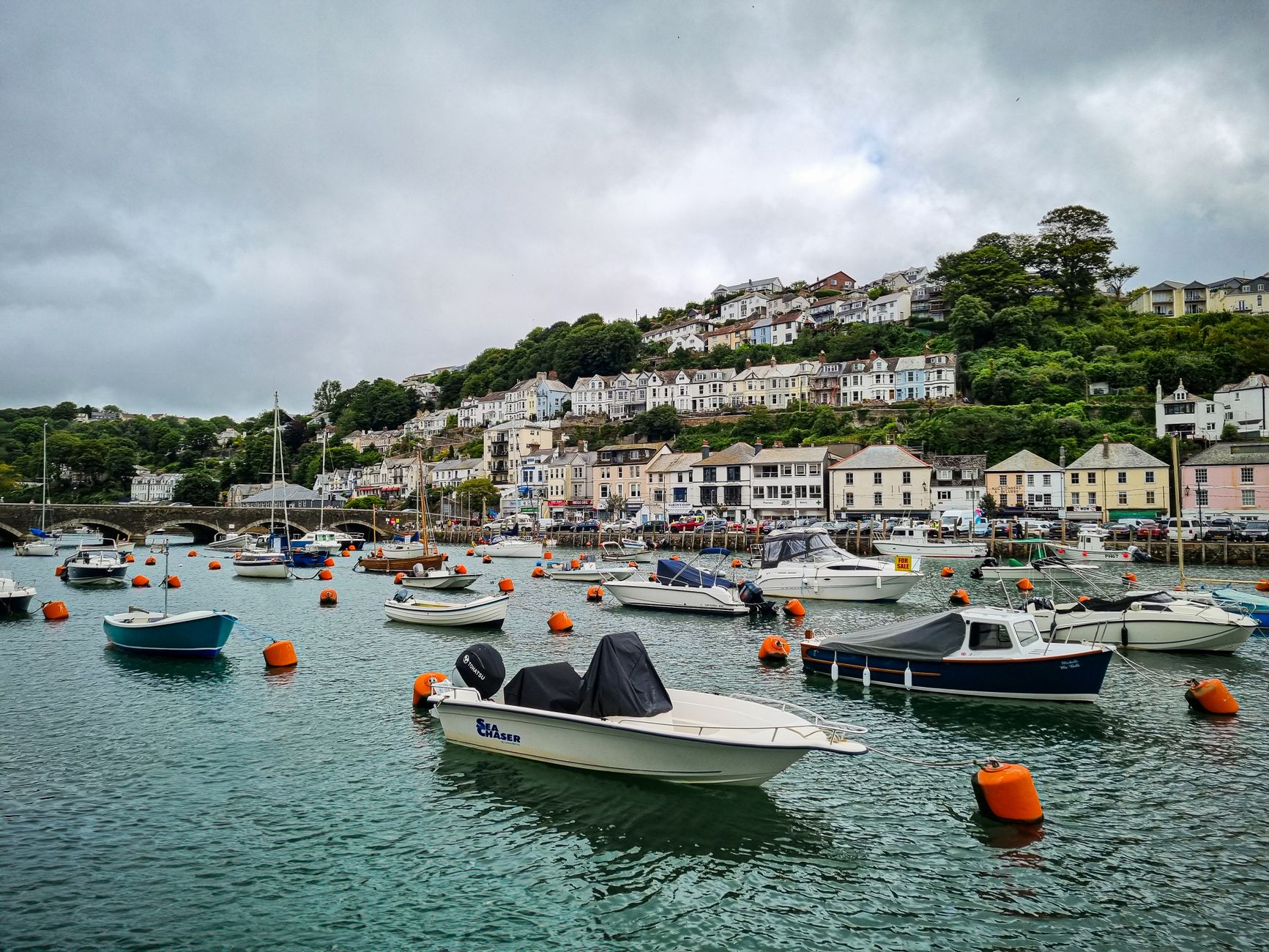
Looe and Polperro are the twin villages of south-east Cornwall, joined by five miles of coast path and one of the best small bus routes in the county. They are also the two villages that most Cornwall guides write up separately, treating them as competing destinations when they’re really a paired walk. If you’re coming to this corner of Cornwall — and you should, because south-east Cornwall is one of the least-visited and most rewarding parts of the county — you should plan to see both, on the same trip, ideally as a single connected day. This Looe Polperro Cornwall guide is the version that joins them up.
The romantic arrival is by train. The Looe Valley Line, an eight-and-three-quarter-mile single-track branch line from Liskeard on the main line, runs through wooded valleys alongside the East Looe River and is one of the loveliest little railways in Britain. It was scheduled to close in 1966 under the Beeching cuts and was saved with two weeks to spare by Barbara Castle, then Minister of Transport, after a campaign by local communities. Forty years on, the line still runs, still feels like a private secret, and is the way locals would tell you to arrive. From Looe you walk the coast path to Polperro, lunch in Polperro, and take the bus back. That’s the day. For the wider context, our Cornwall towns and villages guide sets the picture.
Two Villages, One Coast Path
Looe and Polperro share more than geography. Both were major smuggling ports in the eighteenth century. Both have working fishing fleets today, though smaller than their historical peaks. Both have populations that swell in summer and contract back in winter. Both are visually beautiful in the picture-postcard Cornish way — narrow streets, slate roofs, harbour boats hauled up on the slipway.
What divides them is character. Looe is bigger, busier, more “town” — with shops, restaurants, the only big-name fishing fleet in this corner of Cornwall, and the railway terminus. Polperro is smaller, prettier, and more obviously preserved — cars banned from the village in summer, narrow lanes, the harbour barely changed in two hundred years. Looe is where you stay, eat, shop and arrive. Polperro is where you walk to, photograph, and leave.
Getting to Looe and Polperro
The Looe Valley Line is the recommended approach. Take the main GWR line down to Liskeard (about four hours from London Paddington, three from Bristol). At Liskeard, the branch line platform is across the footbridge from the main station. The branch line runs the eight and three-quarter miles down to Looe in about thirty minutes, alongside the East Looe River through old woodland. The line operates Monday to Saturday year-round, with Sunday services added from April to the end of October. There are typically eight or nine services each way per day.
By car, the A38 from the M5 brings you in, then the A387 south to Looe. The drive from London is around four and a half hours, from Bristol around three. Both Looe and Polperro have car parks — the Polperro Crumplehorn car park is the one you need to know about (covered in detail below).
Between Looe and Polperro: bus 73, operated by Go Cornwall Bus under the Transport for Cornwall network, links Liskeard, Looe and Polperro via Widegates and Pelynt. Several daily services. The 73A variant runs via St Keyne and Looe. Live timetable at transportforcornwall.co.uk. The bus journey from Looe to Polperro takes about twenty minutes. Alternatively, the coast path walk is the same direction and a much better day out (covered below).
East Looe and West Looe: The Two-Town Geography
Looe is, technically, two towns. The Cornish name Logh (“lake” or “pool”) gives East Looe its name; West Looe was originally Porthbyghan (Cornish for “little cove”). They sit on opposite banks of the East Looe River and were administered as separate boroughs until 1898, when they were finally united.
East Looe is the busier, larger side — the harbour, the main shopping street, the fishing fleet, the restaurants, the museum, the beach. This is where most visitors spend their time. West Looe is the quieter side — Hannafore Beach (shingle and rockpools with views across to Looe Island), the Hannafore Point Hotel, residential streets. The two are joined by a seven-arched Victorian bridge opened in 1853. (The original bridge was wooden, dating to 1411; it was replaced with a stone bridge with a chapel of St Anne on it in 1436.)
Banjo Pier: The World’s First
The Banjo Pier on East Looe’s harbour was built in 1897 by the local engineer Joseph Thomas (the construction was carried out by Daniel Taylor) as a prototype harbour structure designed to stop the river mouth silting up. The “banjo” shape — a curved breakwater with a circular head — turned out to be remarkably effective and has since been copied in harbour designs around the world. The Banjo Pier in Looe is the original.
It’s now Grade II listed, about 130 years old, and used for walking, fishing (bass and pollock from the head) and watching the fishing fleet head in and out of the harbour. Free to walk on. Worth ten minutes of any Looe visit.

Looe Island (St George’s Island)
A mile off the coast of Hannafore is Looe Island (also known as St George’s Island), a twenty-two-acre marine nature reserve managed by the Cornwall Wildlife Trust. The island has grey seals, breeding seabirds (oystercatchers and other species), a small flock of Shetland sheep, and a single inhabited building used by the trust’s wardens.
Day-trip boat landings on the island are operated by Looe Sea Safari from the East Looe pontoon. The 2026 season returns in spring. The twenty-minute crossing brings you to the island for around two hours’ visit including a guided walk. 2026 ticket prices (including the landing fee): £22 adult, £12 child (ages 2-15). Sailings are weather and tide dependent; bookings recommended in summer.
The island has a smuggling backstory worth telling. Brother-and-sister smugglers Fyn and “Black Joan” used Looe Island as their base in the eighteenth century, running contraband through to the mainland villages from a secluded landing on the western side. The island’s isolation made it ideal: visible from the mainland but not easily reached by customs officers without a boat.
The Shark Angling Club of Great Britain
One of the genuine pieces of Looe history that almost no guide mentions: the Shark Angling Club of Great Britain was founded in Looe on 4 January 1953 by Brigadier J. L. Caunter CBE MC. The first meeting was held on 25 January 1953 at the Hannafore Point Hotel in West Looe. The first trophy presented was the Mitchell-Hedges Shark Trophy.
For about thirty years from the 1950s through to the early 1980s, Looe was the UK’s shark-angling capital, with charter boats running daily trips out into the Western Approaches for blue shark, porbeagle and (occasionally) mako. The sport was at its peak in the 1960s, when commercial pressure on stocks was still light. Modern shark angling out of Looe is now a conservation-led, catch-and-tag operation — the Club’s surviving members work with Cefas (the government’s fisheries agency) on the long-running Blue Shark Tagging Programme. You can book a tagging trip on one of the Looe charter boats from May to October.
Smuggling Heritage: The Authentic Version
Both Looe and Polperro made serious money from smuggling in the eighteenth and early nineteenth centuries. Unlike some Cornish villages where the smuggling history has been Disneyfied into a tourist theme, the heritage here is unforced.
In Looe, the Old Guildhall Museum and Gaol on Higher Market Street is the place to learn the story. The Guildhall dates from the fifteenth century and includes the old town gaol — small, low-ceilinged cells where prisoners were held. Free or low-cost admission.
In Polperro, the smuggling story has more central figures. Zephaniah Job (1749-1822) was the village schoolteacher who became “The Smuggler’s Banker” — managing the finances of the local smuggling operations on a scale that would now be a substantial small business. Job kept ledgers, paid for ships, arranged credit lines and effectively ran the village’s contraband economy. The Polperro Heritage Museum has Job’s own papers in its collection. Willy Wilcox was a smuggler who drowned in the cave that bears his name, hiding from customs officers. “Battling Billy” Pruddyn allegedly smuggled French brandy from the mainland by hiding it in a horse-drawn hearse, on the basis that mourning carriages were rarely searched.
Our Cornwall history and heritage guide separates the documented history from the tourist-board version.
The Looe to Polperro Coast Walk
The South West Coast Path from Looe to Polperro is around five and a half miles (different sources cite 5.4 to 6 miles), taking two and a half to three hours at an average pace. It’s not technically difficult but uneven — one long steep climb out of Looe to start, several smaller climbs along the way, a long sandy descent into Talland Bay halfway along, and then the climb back up and around to Polperro. The path can be boggy in winter.
The best approach is to walk it from Looe to Polperro, have lunch in Polperro, and take the bus back. This is for a couple of reasons. The walking direction means the steeper climbs come in the cooler first half. Polperro is the natural lunch destination at the end of the walk. And the bus back from Polperro is more reliable than from Looe (the 73 service stops centrally in both villages).
Talland Bay is the highlight of the walk. Sitting roughly halfway between the two villages, it’s a secluded twin-cove beach (Talland Sands and Rotterdam Beach), shingle with rockpools, with a small café that hires kayaks in summer, a car park (if you’re coming by car as a beach destination), and toilets. It’s the secret beach of south-east Cornwall — most visitors to Looe and Polperro never see it because they take the bus or drive between the villages. Walking, you can’t miss it.
Our South West Coast Path guide covers the wider route, and the best circular walks in Cornwall the loop options nearby.
Polperro: Crumplehorn, the Walk Down, and the Harbour
The village proper is closed to vehicles in summer. You park at Crumplehorn Car Park, at the top of the village just off the A387, then walk fifteen to twenty minutes down through the village to the harbour. Crumplehorn Mill (the old water-driven mill at the entrance) has been converted to a restaurant and small hotel.
Crumplehorn parking is a minimum £7 for three hours, up to £40 weekly, coins only with a change machine on site for notes. Motorhomes are charged at a £12 minimum. From 1 November to 31 March there’s an “out of season” 10% discount scheme with local businesses. The Easter to October tuk-tuk service seats six and runs people up and down between Crumplehorn and the harbour for those who don’t want to walk the hill. It’s a few pounds per person each way, much-loved by older visitors and families with small children, and operates roughly hourly in season.
The walk down through the village is part of the Polperro experience. Narrow streets, slate-roofed cottages, the small mill leat running alongside, occasional glimpses of the harbour through gaps in the buildings. You arrive at the harbour suddenly — the path opens into the harbour-front and the boats and the sea are right in front of you.
The House on the Props is Polperro’s most photographed building. A Grade II listed cottage built on oak posts over the village stream, with a jettied upper storey, the building is possibly eighteenth century in its current form, with some claims that elements go back to the sixteenth century. The dining-room beams are said to come from the wreck of a vessel called the Maverine, lost off Polperro around 1700. It’s now a small restaurant and B&B.
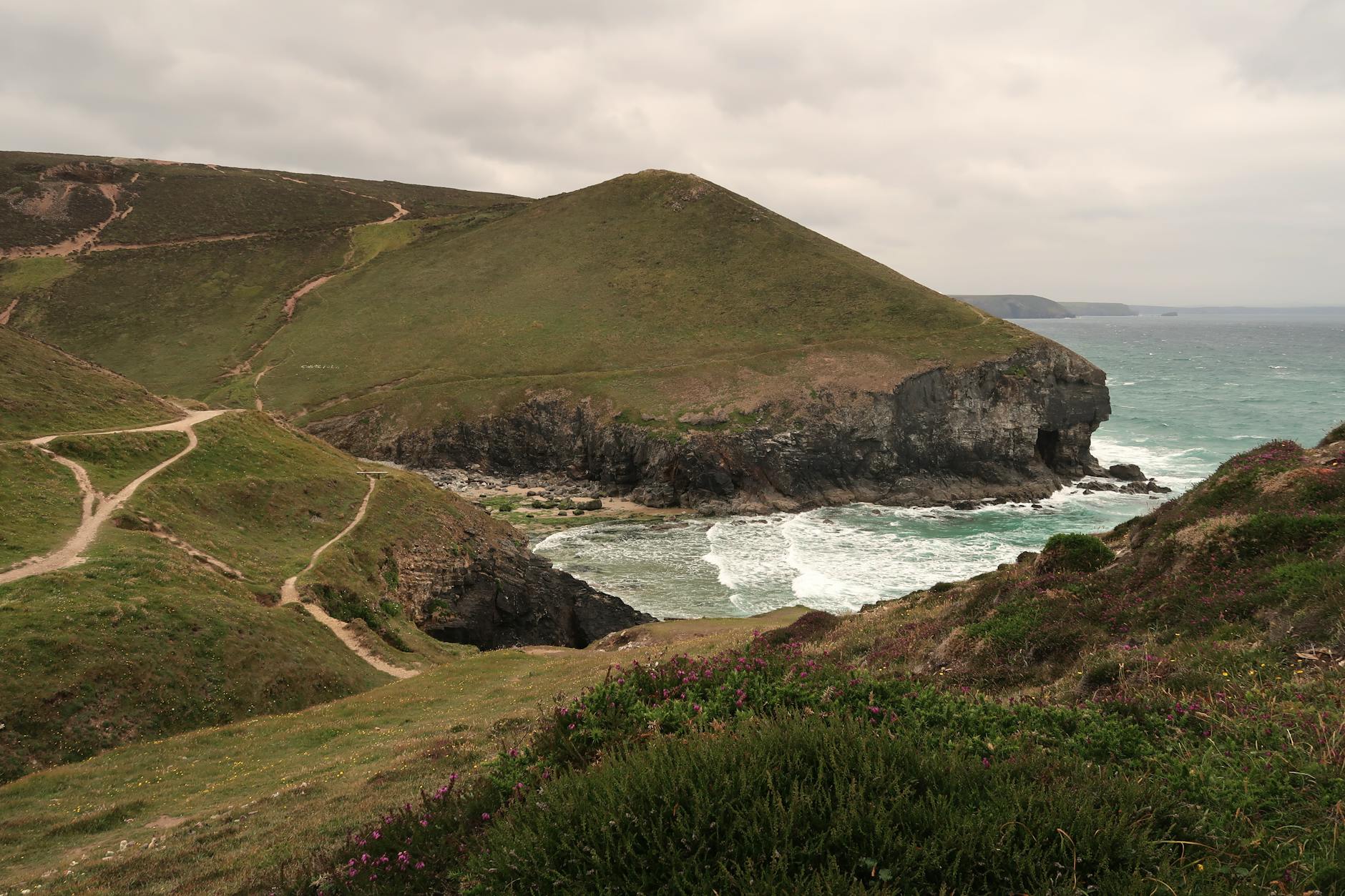
Polperro makes most lists of the prettiest fishing villages in Cornwall — and the others are worth the detour too.
Polperro’s Attractions
The Polperro Heritage Museum of Smuggling and Fishing sits in The Warren overlooking the harbour, housed in an old pilchard factory that operated until the early twentieth century. The Zephaniah Job papers, smuggling artefacts, fishing equipment, photographs of the village in earlier eras. Open Easter to end October, daily 10am-4pm; closed November to April. Around £3 adult, under-16s free.
The Polperro Model Village and Land of Legend has been running for over sixty years. A scale model of the village with a small Land of Legend exhibit and a model railway. £3 adult, £2 child, £2 senior — one ticket covers everything. Open Easter to October, Sunday to Friday 10.30am-6pm.
Boat trips run from Polperro Harbour in summer — thirty-minute coastal cruises along the cliffs, one-way trips to Looe (a nice way to get back to your car), and half-day trips to Fowey with time to explore the harbour town.
Eating in Polperro
The Three Pilchards is the oldest pub in Polperro, with exposed beams, a log stove, and a menu that runs from pub-classic fish-and-chips through to seafood platters. Crowd-friendly, family-friendly, almost always busy in summer. The Blue Peter Inn is built into two former smugglers’ cottages and has been a pub since the 1960s — the seafood platters are the headline dish, the atmosphere is the best of Polperro’s pubs. Couch’s Great House Restaurant is the fine-dining destination, with set menus and head chef Richard McGeown, whose CV includes Gordon Ramsay, Marco Pierre White and Raymond Blanc. The Smuggler’s Rest and Nelson’s are the other harbour-front options. Polperro Tea Room for cream teas.
Eating in Looe
Sarah’s Pasty Shop on Buller Street is the local favourite for traditional handmade pasties — high ratings, often a queue. The Old Sail Loft Restaurant is a 450-year-old quayside warehouse converted to a seafood restaurant; the whole Looe Bay lobster is the headline dish. The Sardine Factory, in a refurbished old sardine factory with a heritage centre on the ground floor, does all-day modern Cornish food. Larsson’s and The Trawlers are the other harbour-front seafood options.
Looe’s Festivals: Kernowfornia and Polperro Festival
The festival formerly known as Looe Music Festival has rebranded for 2026 as Kernowfornia Festival, running 4-6 September 2026 on East Looe Beach. The Wave 1 line-up includes James Morrison, Starsailor, Seth Lakeman, Kalandra and This is The Kit, with further headliners to be announced. Weekend tickets, day tickets, camping options. The festival has been one of Looe’s biggest annual draws since the late 2000s.
The Looe Weekender, 18-20 September 2026, is the free fringe event around the music festival — eighty-plus live performances across pubs and pop-up venues across East and West Looe.
The Polperro Festival runs 13-21 June 2026, a nine-day village-wide arts, crafts and music festival. Pubs run sessions, the village hall hosts daytime crafts and gallery events, evening concerts. Smaller and more community-focused than Kernowfornia, but a great time to visit if you want to see Polperro at its liveliest.
The Forgotten Corner: South-East Cornwall
Looe and Polperro sit in what locals call “The Forgotten Corner of Cornwall” — the stretch from Looe east through the Rame Peninsula to Torpoint, the river-side villages of Antony, Downderry, Polbathic, Portwrinkle and Widegates. The corner is forgotten because it’s bypassed by visitors heading west to the better-known Cornish destinations, but it has its own pleasures.
Whitsand Bay, just east of Looe, is three-plus miles of golden sand backed by cliffs, with four named beaches between Rame Head and Portwrinkle. The bay is reached by steep cliff paths down from the road above, which keeps the crowds thin. The water is excellent for surfing.
Kingsand and Cawsand are the twin seventeenth-century fishing villages on the Rame Peninsula, separated by a small creek that until 1844 was the Devon-Cornwall border (a boundary change moved Kingsand from Devon to Cornwall). Strong smuggling heritage. The Halfway House and the Ship Inn are the pubs.
Mount Edgcumbe, on the southern tip of the Rame Peninsula, is the former seat of the Earls of Mount Edgcumbe and now an eight-hundred-and-sixty-five-acre country park with Grade I gardens and a Tudor house. The Cremyll Ferry from Plymouth lands here.
Rame Head, the rocky headland dividing Cawsand Bay from Whitsand Bay, has a medieval chapel on the summit and views back across to Plymouth and out into the Channel.
Where to Stay in Looe and Polperro
Looe has the broader accommodation choice. The Hannafore Point Hotel in West Looe is the grand traditional option with views across to Looe Island. The Commonwood and similar smaller hotels in town centre give you walking access to everything. Numerous B&Bs across both East and West Looe. Self-catering apartments in the harbour-front buildings.
Polperro is smaller and more boutique. The Crumplehorn Mill at the top, the Old Mill House by the harbour, the House on the Props with its few rooms, plus self-catering cottages tucked into the village. Polperro books up first because there are fewer rooms.
For wider Cornwall B&B options, our Cornwall B&B guide covers the county.
The Perfect Day in Looe and Polperro
Here’s the day I’d plan if I were doing this trip for the first time. Train to Looe on the Looe Valley Line from Liskeard. Walk the East Looe harbour and the Banjo Pier. Coffee or breakfast at one of the East Looe cafés. Walk the South West Coast Path to Polperro (with a swim at Talland Bay if the weather is right). Lunch at the Blue Peter Inn or Couch’s Great House in Polperro. Walk around the harbour and the House on Props. Visit the Heritage Museum if you have an hour. Bus 73 back to Looe. Late afternoon at the Old Guildhall Museum or just on the beach. Dinner at the Old Sail Loft. Train back to Liskeard.
That’s a six-mile walk, two villages, three significant museums, two harbours, a beach, two excellent meals and one of Britain’s most scenic short branch lines, in a single Cornish day.
Frequently Asked Questions
Is Looe worth visiting? Yes — particularly as part of a paired trip with Polperro and the wider south-east Cornwall corner.
How do you get from Looe to Polperro? Bus 73 (twenty minutes), the coast path walk (five and a half miles, three hours), or seasonal boat trips from the harbour.
How long does the Looe to Polperro walk take? Two and a half to three hours at average pace.
Can you walk between Looe and Polperro? Yes — five and a half miles via the South West Coast Path, with Talland Bay as a halfway stop.
Is Polperro worth visiting? Yes — one of Cornwall’s prettiest small villages, ideally combined with Looe rather than visited alone.
How long do you need in Polperro? Half a day to a full day, depending on whether you’re walking from Looe or arriving by car.
What is the best time to visit Looe and Polperro? May, June and September for quieter villages and good weather. Polperro Festival (mid-June) and Kernowfornia (early September) are highlights.
Where do you park in Polperro? Crumplehorn car park at the top of the village, £7 minimum for three hours, with the Easter-October tuk-tuk service to the harbour for those who don’t want to walk down.
Can you drive into Polperro village? No — cars effectively banned from the village in summer.
How do you get to Looe Island? Looe Sea Safari from East Looe pontoon, twenty-minute crossing, £22 adult / £12 child, weather dependent.
Is the Looe Valley Line scenic? Yes — one of Britain’s prettiest short branch lines, alongside the East Looe River through woodland.
What’s the difference between East Looe and West Looe? East Looe has the harbour, fishing fleet and main shopping. West Looe is quieter with Hannafore Beach and the views across to Looe Island.
Where can I see seals near Looe? Looe Island — grey seals around the rocks year-round. Visible from the boat-trip landings.
What’s the best beach near Polperro? Talland Bay, halfway along the coast path between Looe and Polperro.
Looe and Polperro are the south-east Cornwall pair that locals quietly love and visitors keep underrating. Take the Looe Valley Line down. Walk the coast path from one to the other. Lunch on the Polperro harbour. Catch the 73 back. You’ll wonder why this corner of Cornwall doesn’t make every shortlist — and you’ll have a small selfish reason for hoping it stays that way.