Accommodation on Scilly works differently to the mainland in one important respect: there simply isn’t very much of it. Five small islands with a combined population in the low thousands were never going to support the sprawl of chain hotels and holiday parks that lines the Cornish coast, and that scarcity shapes everything about where to stay Isles of Scilly travellers need to think through before they book — leave it later than you would for a mainland trip and you may not be choosing between options so much as taking whatever’s left.
The reward for planning ahead is real, though. Nowhere else in this part of the country can you wake up on an island with fewer than a hundred neighbours, walk to a beach that would be a national landmark anywhere else, and be back at St Mary’s quay for dinner if you fancied a change of scene.
How far ahead to book
Start looking six months to a year ahead for a summer holiday week, especially if you want a specific off-island or a particular type of accommodation. Scilly’s bed stock is small enough that the best-known hotels and the more characterful self-catering cottages sell out for the school summer holidays well before spring half term. Shoulder season — late May, June and September — is both the pleasantest time to visit and slightly easier to book at short notice, though “easier” is relative on islands this small.
It helps to think of Scilly booking less like a mainland city break and more like booking a wedding venue: the good places take bookings a year out, repeat visitors often rebook the same week for the following year before they’ve even left, and a cancellation is usually snapped up within days rather than sitting unbooked. If your travel dates are flexible, that flexibility is worth more here than almost anywhere else in the country — a week that starts on a Tuesday instead of a Saturday can be the difference between finding nothing and finding exactly what you wanted.
It’s also worth deciding early whether you’re flying or sailing, since that affects which island suits you logistically. Anyone arriving by Skybus lands at St Mary’s Airport regardless of where they’re eventually staying, while the Scillonian docks at Hugh Town quay — both mean a short onward boat trip if your accommodation is on an off-island, so build that transfer into your first and last day rather than assuming you’ll walk straight in.
Hotels
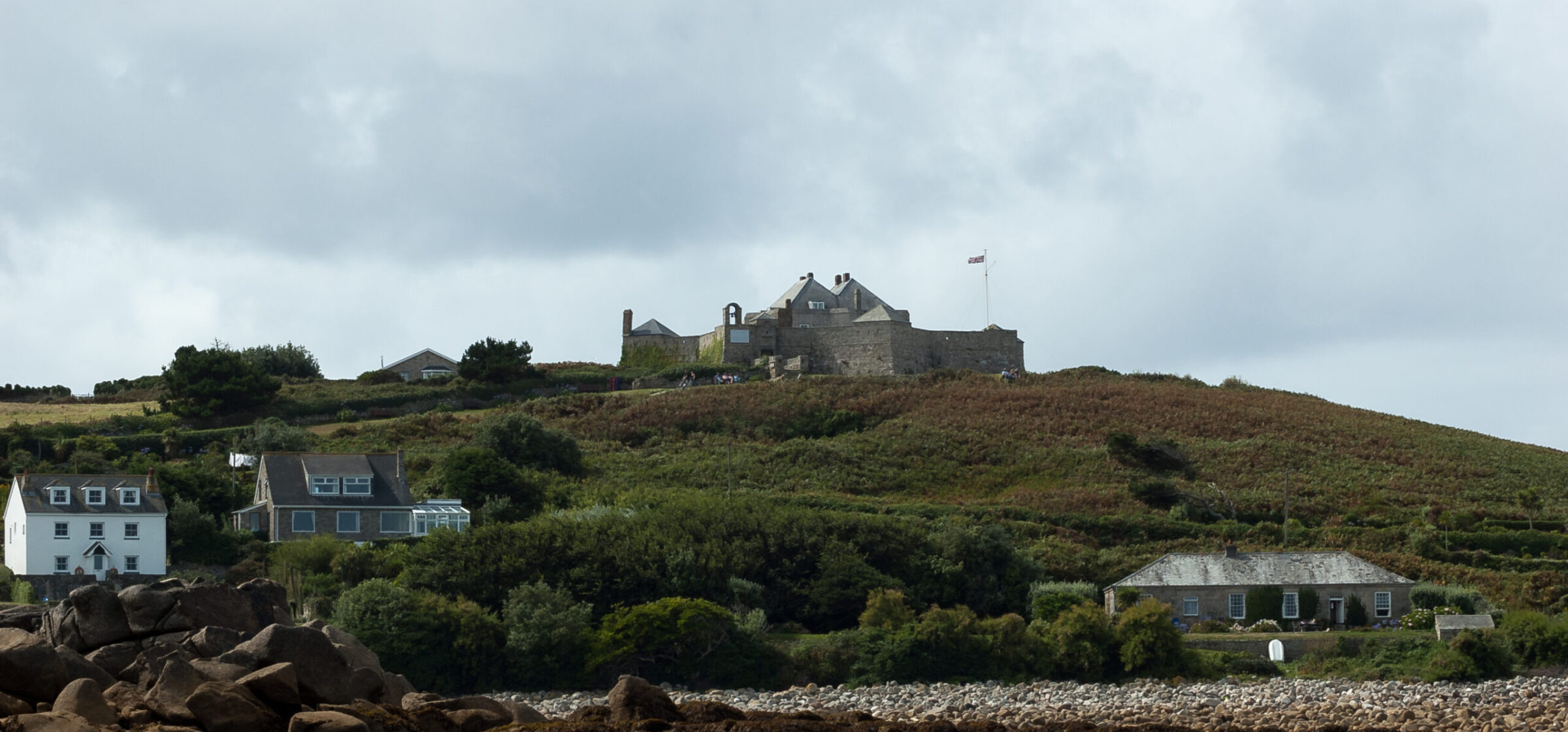
Scilly’s hotel scene is compact and mostly clustered on St Mary’s, with a couple of notable exceptions on the off-islands. Star Castle Hotel, built into the walls of an Elizabethan fort on the Garrison above Hugh Town, is the best-known option on St Mary’s — a genuine slice of history to sleep in, with a swimming pool and among the more comfortable rooms on the islands. Tregarthen’s Hotel, down by the harbour in Hugh Town, is another long-established choice, and also runs a set of self-catering cottages for anyone who wants hotel-adjacent convenience without a full board arrangement.
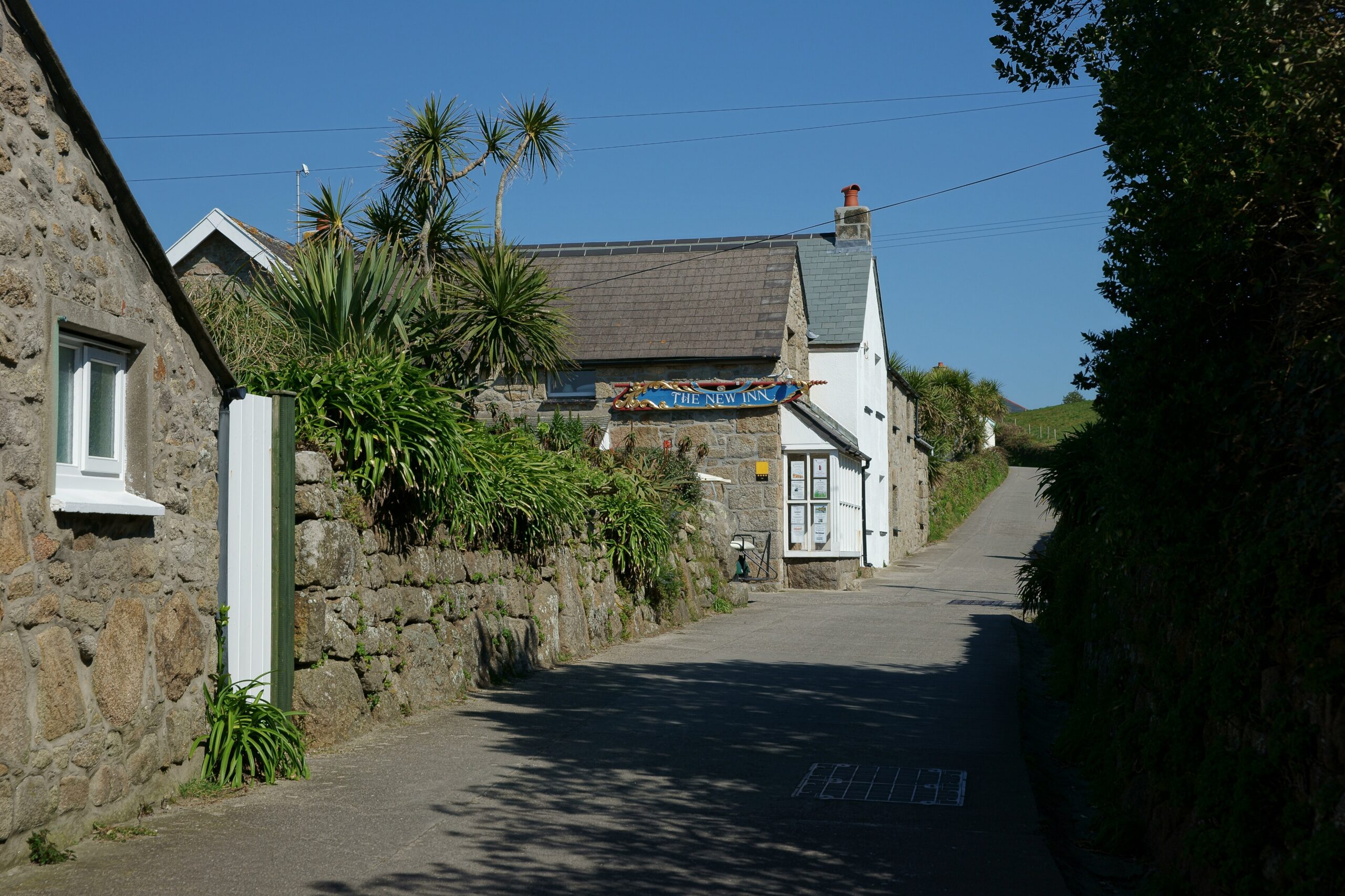
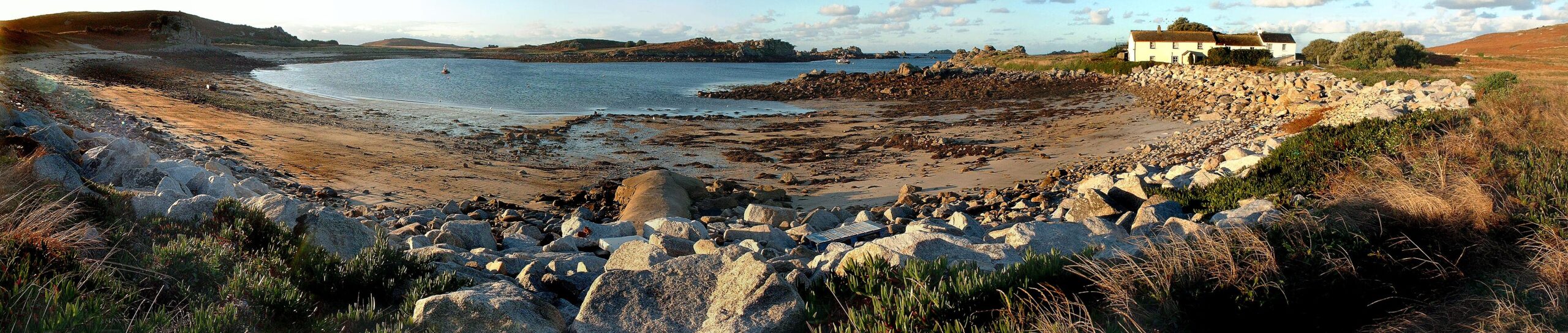
On Bryher, the Hell Bay Hotel is Scilly’s most talked-about off-island stay — sea views over the Atlantic-facing coast the hotel takes its name from, a mini-golf course, and a setting about as far from a typical seaside hotel as it’s possible to get while still being in England. Tresco’s only hotel is the New Inn, a 19th-century building with an attached pub, garden and ice-cream counter that doubles as the island’s social hub as much as its accommodation.
What all of Scilly’s hotels share, regardless of price point, is a sense of place that a lot of mainland equivalents have lost — nobody’s rebuilt one of these as a corporate box in the last few decades, and the age and individuality of the buildings shows. Expect creaking floorboards, sea views that a mainland hotel would charge triple for, and a dining room that’s often the best restaurant on the island rather than an afterthought. Book dinner alongside your room if you’re staying at one of the smaller hotels in peak season; the islands’ limited restaurant capacity means a hotel’s own kitchen is sometimes the only realistic option on a given night.
Bed and breakfasts and guesthouses
Smaller, family-run B&Bs and guesthouses fill in the gaps between the headline hotels, mostly on St Mary’s where the population and the visitor numbers both concentrate. These tend to be the best value option for a short stay, and often the most personal — hosts who’ve lived on the islands for decades and can point you towards the right beach for the day’s weather or the boat you didn’t know was running. A cooked breakfast at a good Scilly B&B, using eggs and produce that in some cases came from the next field over, is a genuinely different experience from the same meal on the mainland — the food miles here are measured in hundreds of yards rather than hundreds of motorway miles. For a wider sense of what a good Cornish B&B stay looks like, the Cornwall bed and breakfast guide covers the mainland equivalent in detail; Scilly’s own B&Bs follow the same spirit on a much smaller scale.
Self-catering cottages
Self-catering is arguably the most popular way to stay on Scilly for a week or longer, and it’s available across every inhabited island — from granite fishermen’s cottages in Hugh Town to modern retreats on the off-islands and traditional farmhouses that come with a genuine working farm attached. Booking your own kitchen matters more here than on the mainland, too: eating out every night on a small island with a handful of restaurants gets old fast, and grocery shopping (limited as it is) is part of the rhythm of a longer Scilly stay rather than an inconvenience.
Tresco has one of the largest concentrations of quality self-catering on the islands, ranging from one-bedroom seafront cottages to larger family homes, many of them within easy reach of the Abbey Garden and Pentle Bay. St Mary’s has the widest overall choice simply by virtue of being the largest and most populated island.
Off-island self-catering on Bryher, St Martin’s or St Agnes suits anyone whose idea of a good holiday is genuinely switching off — no passing traffic, no late-opening pub round the corner, just whatever you’ve brought with you and the island itself. It’s worth being honest about whether that appeals before booking a week in one; a family used to a bit more bustle in the evenings might find four or five nights on Bryher longer than they expected, however beautiful the view from the kitchen window.
Camping
There are four campsites across the archipelago, one on each of St Mary’s, Bryher, St Agnes and St Martin’s, and camping is genuinely one of the best-value and most memorable ways to experience Scilly if you don’t mind trading a few creature comforts for a view most hotels can’t match. The Garrison Campsite on St Mary’s sits on 9.5 acres of the historic Garrison headland above Hugh Town — bring your own tent or take one of the ready-pitched options if you’d rather travel light. On Bryher, the island’s small campsite sits in fields looking out across the Tresco Channel towards the Atlantic, about as close to camping on the edge of England as it’s possible to get.
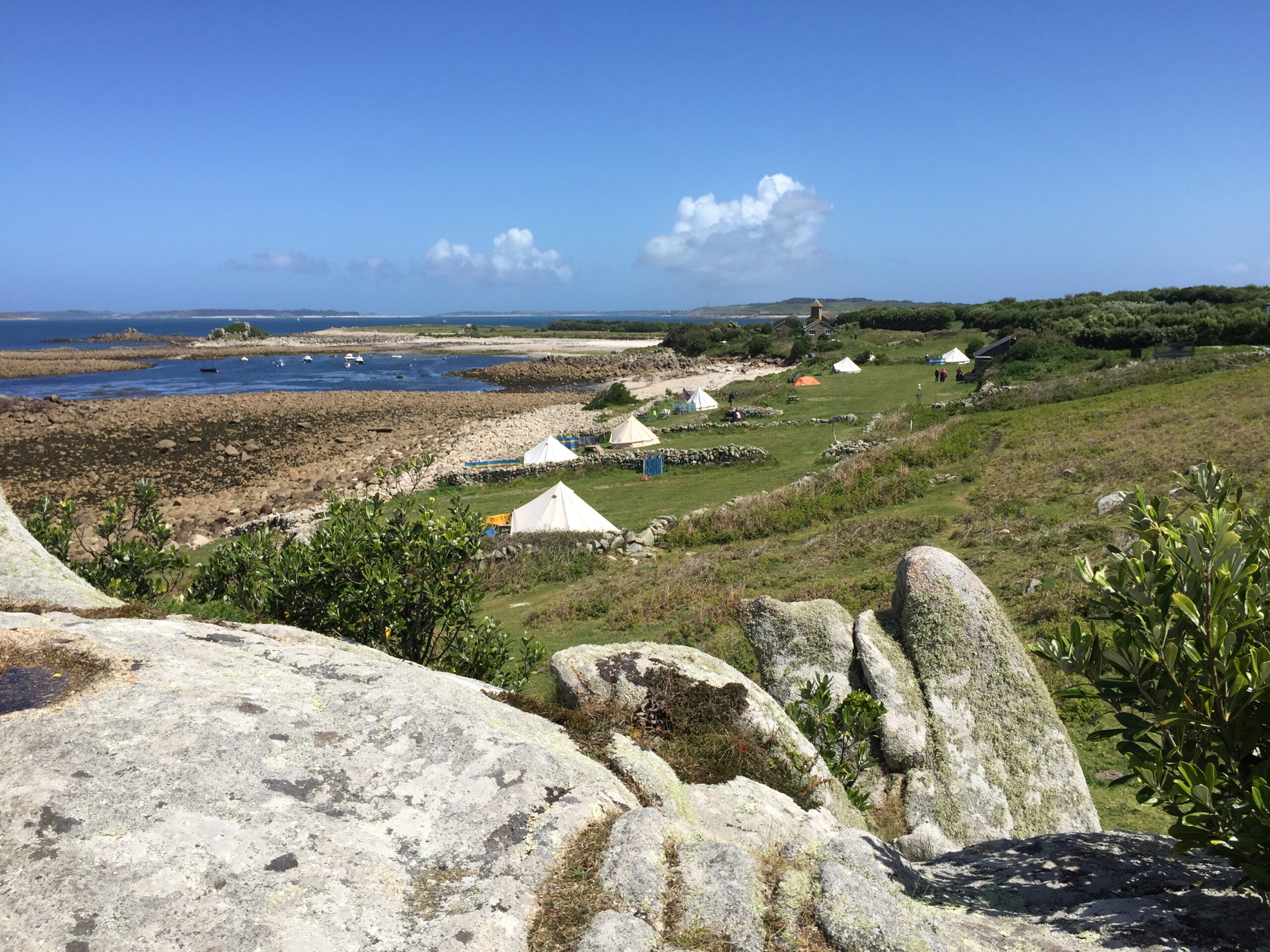
Troytown Farm Campsite on St Agnes has its own beach and views out to Bishop Rock lighthouse and the uninhabited island of Annet — genuinely England’s most westerly campsite, reachable only by boat or plane, and popular precisely because of how remote it feels. St Martin’s also has a small campsite, a good base for anyone whose main goal is spending every day on the island’s beaches rather than moving around much.
All four sites take bookings well ahead of the summer season and, like the rest of Scilly’s accommodation, fill up fastest for the weeks either side of the school summer holidays. None of them are the kind of place you turn up to on spec — book a pitch the same way you’d book a room, and expect basic facilities rather than a mainland holiday park’s full amenity list. What you’re paying for is the setting, and on these four sites in particular, that setting does most of the work.
Choosing which island to stay on
St Mary’s is the practical choice for a first visit or a shorter stay: the widest accommodation range, the most restaurants, and the easiest connections both to the mainland and to day trips on the tripper boats — see our guide to island hopping the Isles of Scilly for how those work. Staying on an off-island instead — Tresco, Bryher, St Martin’s or St Agnes — means fewer amenities on your own doorstep but a far quieter evening once the day-trip boats have gone home, since none of the off-islands see overnight visitor numbers anywhere close to St Mary’s.
A sensible middle ground for a week-long trip is to split the stay: a few nights on St Mary’s for convenience and the arrival/departure logistics, and a few nights on an off-island for the version of Scilly that doesn’t come with a day-tripper crowd at all. It costs a bit more in transferring luggage between islands, but it’s the closest thing to seeing two different holidays in one trip.
What suits families, couples and groups
Families with younger children generally do best on St Mary’s or St Martin’s — St Mary’s for the shorter distances between accommodation, beaches and somewhere to eat if a day goes sideways, and St Martin’s for the sheer amount of safe, shallow, empty sand within a short walk of most of its accommodation. Self-catering suits families better than a hotel for anything longer than a long weekend, if only because it removes the pressure of getting young children through a formal dinner every evening.
Couples looking for something quieter and slightly more indulgent tend to gravitate towards Hell Bay on Bryher or one of the smaller, more characterful self-catering cottages on Tresco — both islands trade a bit of convenience for a setting that feels genuinely removed from everything else. Groups of friends or extended family sharing a larger self-catering property will find the widest choice on St Mary’s and Tresco, where the bigger houses tend to be concentrated.
Anyone travelling with mobility needs should ask directly about access before booking — Scilly’s older buildings and its uneven, sometimes sandy or cobbled paths are not always straightforward, and what counts as accessible varies far more between individual properties here than it would across a chain hotel brand on the mainland.
Practical booking notes
Very little Scilly accommodation appears on the big mainland booking platforms in the way you might expect; a good number of the best places, especially self-catering cottages and the smaller B&Bs, are booked directly through the owner’s own website or by phone. Build that into your planning time — it’s a slower process than a few clicks on a comparison site, but it usually means talking to someone who knows the islands well enough to steer you towards the right choice for what you actually want from the trip.
Whatever you book, confirm how your luggage gets from the Scillonian or the airport to your accommodation, particularly if you’re staying on an off-island — some places arrange it as part of the booking, others expect you to sort it yourself via the quay.
Deposits and cancellation policies also tend to be stricter than mainland norms, reflecting how far in advance these small operators need certainty to plan their season. Read the terms before you pay anything, ask directly if anything is unclear, and don’t assume a policy you’re used to from a big booking platform will apply — a lot of Scilly’s best places are family businesses running their own terms rather than a franchise following a corporate playbook.
Frequently Asked Questions
How far ahead should you book where to stay on the Isles of Scilly?
Six months to a year for a summer week, especially for hotels and the more sought-after self-catering cottages. Shoulder season (late May, June, September) is more forgiving but still worth booking well ahead.
Is it cheaper to stay on St Mary’s than the off-islands?
Not necessarily — prices vary more by property type and season than by island. St Mary’s simply has the widest range, so it’s easier to find something at most budgets.
Can you camp on every island in Scilly?
No — there are four campsites, one each on St Mary’s, Bryher, St Agnes and St Martin’s. Tresco has no campsite.
Do Scilly hotels and cottages take dogs?
Many do, though policies vary by property — check directly when booking rather than assuming, since Scilly’s smaller, more personally run places set their own rules.
Is self-catering or a hotel better for a first trip to Scilly?
Either works, but self-catering suits longer stays better given the limited number of restaurants on the smaller islands. A hotel or B&B with breakfast included takes some of the planning off a short first visit.
What happens if bad weather cancels your ferry or flight on the day you’re due to arrive?
Build a spare day into the trip either side if you can, since Scilly’s transport links do get disrupted by fog and rough seas often enough to matter. Most accommodation providers are used to this and will try to be flexible about a late arrival caused by weather, but it’s worth asking about their policy when you book rather than finding out on the day.
Booking Scilly accommodation takes more patience than a mainland Cornwall trip, and rewards it in kind: fewer options, but nearly all of them genuinely worth the effort of finding and securing early. Get the booking done, and the rest of the planning — which islands to see, which beaches to prioritise, which boat to catch on which morning — is the easy, enjoyable part.
Photo credits: Star Castle Hotel, St Mary’s: Isles of Scilly, St Mary’s – Star Castle Battery hotel – geograph.org.uk – 8024772.jpg by Chris Gorringe, CC BY-SA 2.0 (licence). The New Inn, Tresco: The New Inn, Tresco – geograph.org.uk – 3394298.jpg by Peter Trimming, CC BY-SA 2.0 (licence). Hell’s Bay, Bryher: Hell’s Bay, Bryher, Scilly Isles.jpg by Hugh Mason, CC BY-SA 3.0 (licence). Troytown Farm, St Agnes: Troytown Farm campsite – geograph.org.uk – 5391517.jpg by Andrew Abbott, CC BY-SA 2.0 (licence).