Ten small open launches, working out of St Mary’s quay, are the entire public transport network of the Isles of Scilly’s off-islands. There’s no bridge, no causeway open at all states of tide, and — beyond St Mary’s itself — barely a road worth the name. If you want to see Bryher, St Martin’s, Tresco or St Agnes, you get there the way islanders have got there for a couple of hundred years: by boat, at a time the boat chooses to run.
Isles of Scilly island hopping is the single activity that defines a Scilly holiday longer than a couple of days, and it rewards a bit of planning far more than it punishes spontaneity. Once you understand the rhythm of the boats, hopping between four or five islands over the course of a week becomes straightforward — genuinely one of the best ways to spend a holiday in the whole of the Isles of Scilly.
How the boats work
The St Mary’s Boatmen’s Association, a cooperative of ten independently owned launches that’s operated out of the quay since 1958, runs the whole inter-island network. There’s no central timetable app and no online booking system in the way you might expect on the mainland — you turn up at the quay, read the boards, and buy your ticket from whichever skipper is running the crossing you want. Boats to the off-islands leave from around 10am most days, Easter to the end of October, with departures to each island clustering through the late morning and a return sailing typically in the mid-to-late afternoon.
Fares aren’t published online, which surprises visitors used to booking everything in advance — check the board at the quay on the day, and budget a little more than you would for an equivalent mainland ferry crossing. Dogs travel, prams and pushchairs travel, and the crews are used to loading beach gear, shopping and the odd bicycle without much ceremony.
The crossings themselves are short — most runs between St Mary’s and an off-island take somewhere between fifteen and thirty minutes, depending on which island and which quay is in use that day — but they’re rarely dull. The boatmen know the channels, the rocks and the seal colonies better than anyone, and it’s common for a skipper to slow down and point out something worth seeing on the way rather than just running a straight line. Ask questions; most of them have been doing this crossing since childhood and are happy to talk about the islands they grew up on.
Outside the Easter-to-October season, the off-island boat network shrinks considerably. Some islands keep a reduced winter service for residents and the occasional determined visitor, but this isn’t the time of year to plan a multi-island hopping trip — the accommodation on the off-islands themselves also reduces or closes, and a good number of businesses take the winter off entirely.
Planning a day of island hopping
The classic Scilly day is one island out, one island back, with lunch somewhere in between if the timings allow — trying to fit three off-islands into a single day is possible on paper but tends to feel like a itinerary rather than a holiday. A more relaxed approach is to pick one island a day for three or four days of a week-long stay, leaving the rest for St Mary’s itself and at least one day with no plan at all, which on Scilly is not wasted time.
Tide matters more here than on most of the Cornish coast you’ll have come from. Landing points shift with the tide on some islands, a couple of the best beaches are only fully exposed at low water, and the causeway to Gugh from St Agnes disappears completely at high tide. Check tide times before you set out for the day, not after you’ve missed the crossing back.
Weather changes the plan more often than most visitors expect, too. A crossing that’s perfectly manageable in a light breeze can be cancelled or delayed in stronger wind, particularly to the more exposed islands, and the boatmen won’t run a service they consider unsafe regardless of how disappointed a queue of holidaymakers looks on the quay. Build a spare day into any itinerary that depends on reaching a particular island, and treat a cancelled crossing as Scilly doing what Scilly does rather than a failure of planning on your part.
A useful rule for a first visit: don’t try to see everything. Four islands properly explored beats six seen at a jog, and the appeal of Scilly is largely the opposite of ticking off a list — it’s the slow walk along an empty beach, the wait for a boat with nothing to do but watch the water, the afternoon that runs long because nobody was in a hurry to catch the next crossing.
Tresco: the garden island
Tresco is Scilly’s most visited off-island, mostly on the strength of one attraction: the sub-tropical Abbey Garden, planted from the 1830s onwards around the ruins of a medieval priory and now home to around two thousand exotic species that have no business surviving this far north, plus the Valhalla figurehead collection salvaged from ships wrecked on Scilly’s rocks. Boats land at New Grimsby, Old Grimsby or Carn Near depending on the tide, and the island is easily walkable end to end in a day, with beaches on both the Grimsby side and the wilder northern tip.
Tresco is also the one off-island where Scilly’s more polished side shows: a golf course, a handful of holiday cottages and one genuinely upmarket hotel, and a general sense of a place that’s been deliberately looked after rather than left to itself. That’s not a criticism — the Abbey Garden alone is worth the crossing — but it does mean Tresco feels a little different from Bryher or St Agnes, and worth pairing with one of the wilder islands on a longer trip rather than treating as representative of Scilly as a whole.
Bryher: the wild one
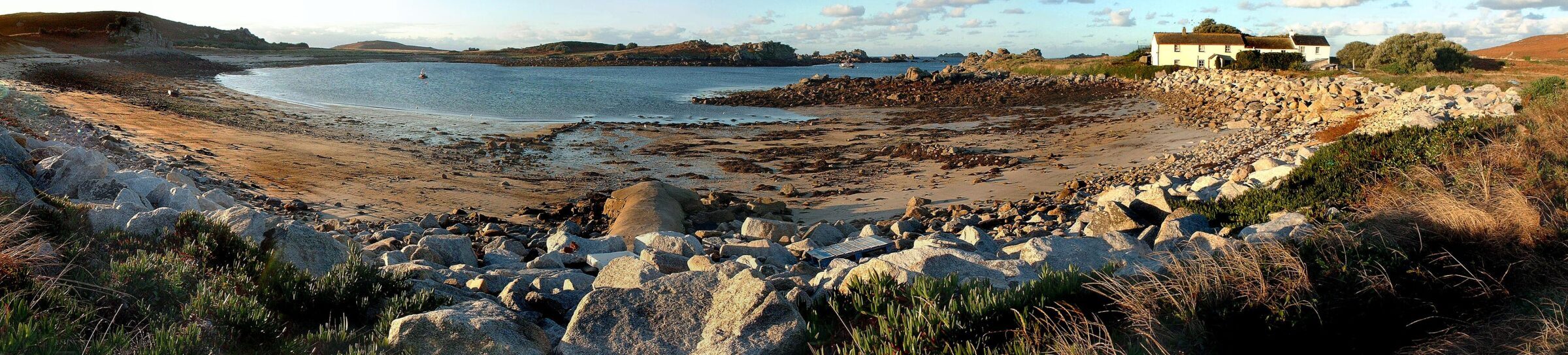
Bryher is the smallest of the inhabited off-islands and the one most people mean when they talk about Scilly’s “wild” side. On the Atlantic-facing northwest coast, Hell Bay earns its name in any kind of weather — huge breakers even on a moderate day, and genuinely dramatic in a storm. Turn to the sheltered south and east side and the character flips completely: Rushy Bay is a calm white-sand beach looking across to the uninhabited island of Samson, and Green Bay is placid enough that a beachside outfit called Hut 62 rents transparent-bottomed kayaks to paddle over the sandy shallows.
Watch Hill, the island’s high point, gives a panoramic view over the whole archipelago and is worth the short climb on a clear day. Down at the channel between Bryher and Tresco stands Cromwell’s Castle, a squat 17th-century gun tower built in 1651 to cover the anchorage — one of several fortifications scattered across Scilly from a time when a French or Spanish landing was taken seriously. For food, the Hell Bay Hotel and its Fraggle Rock Bar are the island’s best-known stops, unpretentious given the setting.
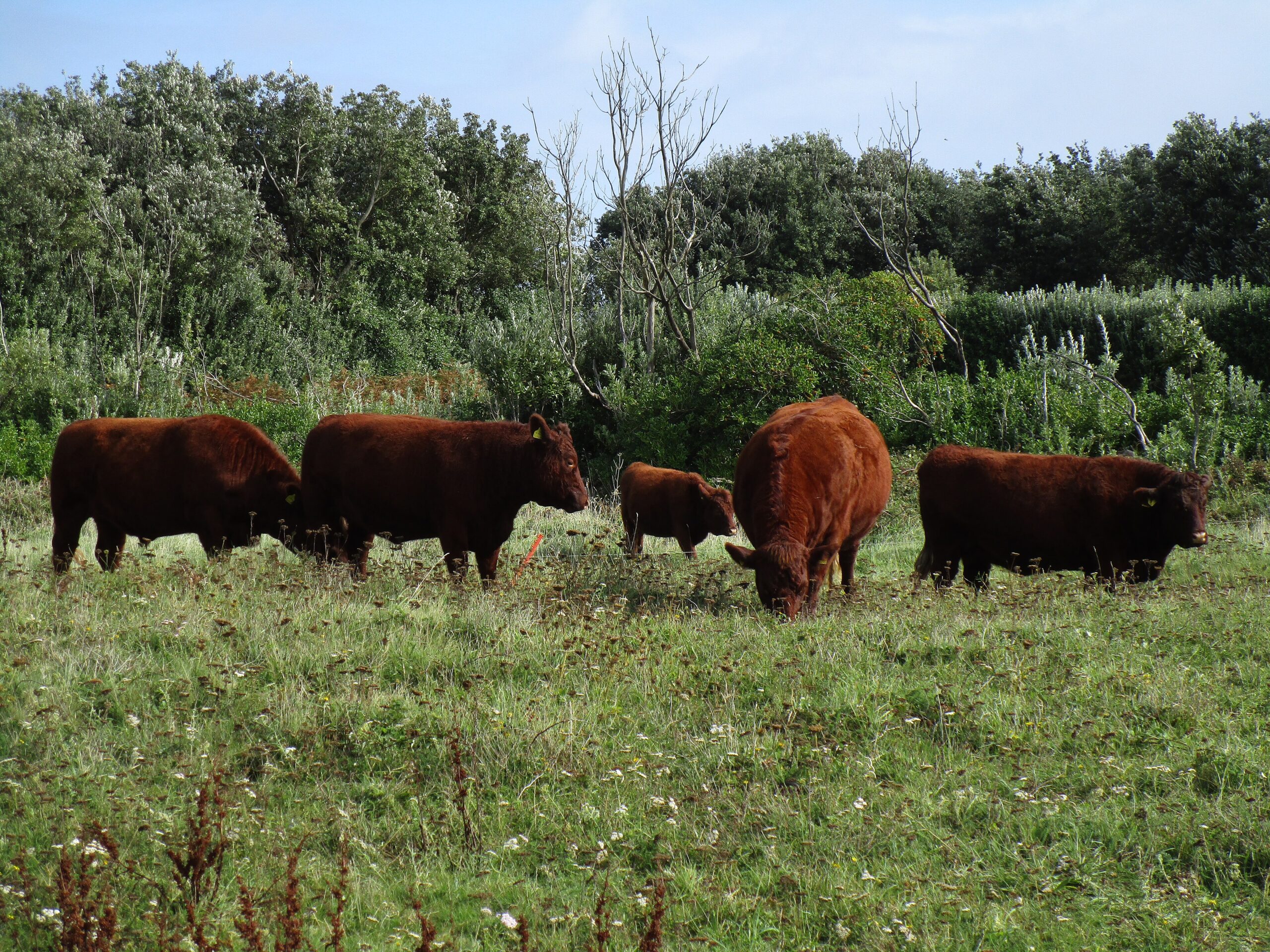
Bryher has fewer than a hundred permanent residents, its fields grazed by small herds of cattle, and it shows in the pace of the place — a scatter of farms and cottages, a couple of small shops, and long stretches where you’ll see nobody at all. It’s the off-island most repeat visitors name as their favourite precisely because so little has been done to it, and it rewards a full day rather than a quick look on the way to somewhere else. There’s a small campsite too, for anyone who wants to fall asleep to the sound of the Atlantic on Hell Bay’s doorstep.
St Martin’s: the beach island
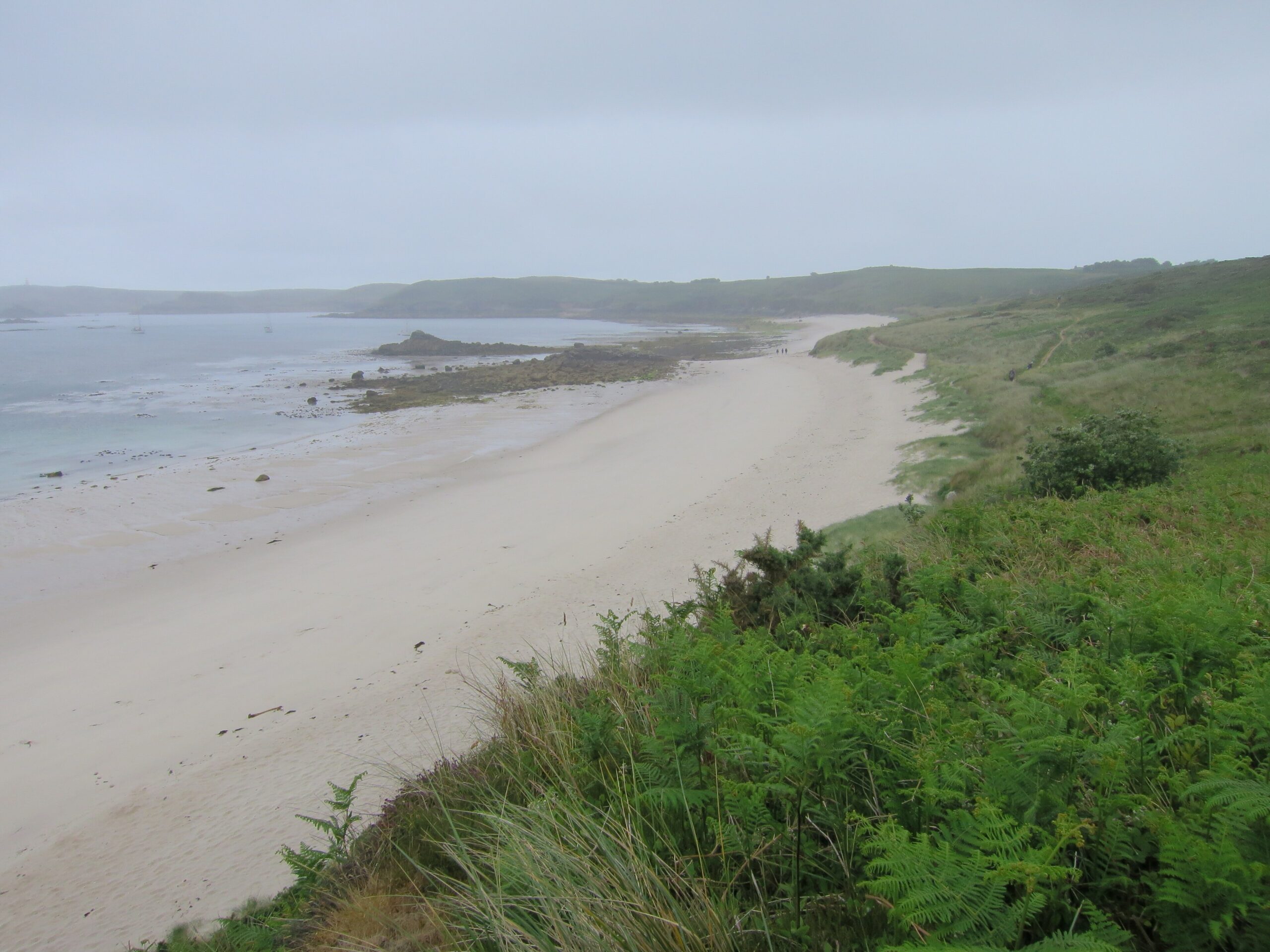
If you’ve come to Scilly for the beaches specifically, St Martin’s is the island to prioritise. Great Bay, on the north coast, has been ranked among the best beaches in the UK — a genuinely enormous stretch of pale sand backed by dunes, usually close to empty even in August because so few visitors make it this far. Lawrence’s Bay runs almost the length of the island from Lower Town to Higher Town, and Par Beach, the crescent you see as the boat comes in at Higher Town, is the first sand most visitors touch.
St Martin’s also has a working vineyard, with tastings and a short trail through elm woodland — an unlikely thing to find on a Scilly island, and worth the detour if wine is your thing. The water around St Martin’s is good for snorkelling, and it’s one of the more reliable places in Scilly to see seals close to shore — a real draw for anyone already keen on Cornish wildlife watching. There’s a well-regarded bakery in the main settlement, useful for provisioning before a day on the beach rather than relying on packed lunches from St Mary’s.
The island splits loosely into Higher Town, near the quay most boats use, and Lower Town, a walk of a mile or so along the spine of the island. Neither is much more than a cluster of houses, a shop and a place to eat, but the distance between them is exactly the point: it forces the kind of unhurried walk past dunes and open farmland that most mainland beach trips don’t offer. Families with younger children tend to gravitate here precisely because the sand is so extensive that nobody ever feels crowded, even when the island’s modest accommodation is fully booked.
St Agnes and Gugh: the quiet one
St Agnes is the most southwesterly inhabited point in England, and it feels like it — more rugged than the other off-islands, with granite outcrops and rock formations that reward slow walking rather than a quick circuit. The tiny island of Gugh sits just off St Agnes, connected by a sand bar that’s walkable at low tide and completely submerged at high water; check the tide before you cross, and don’t plan on it being there when you want to come back.
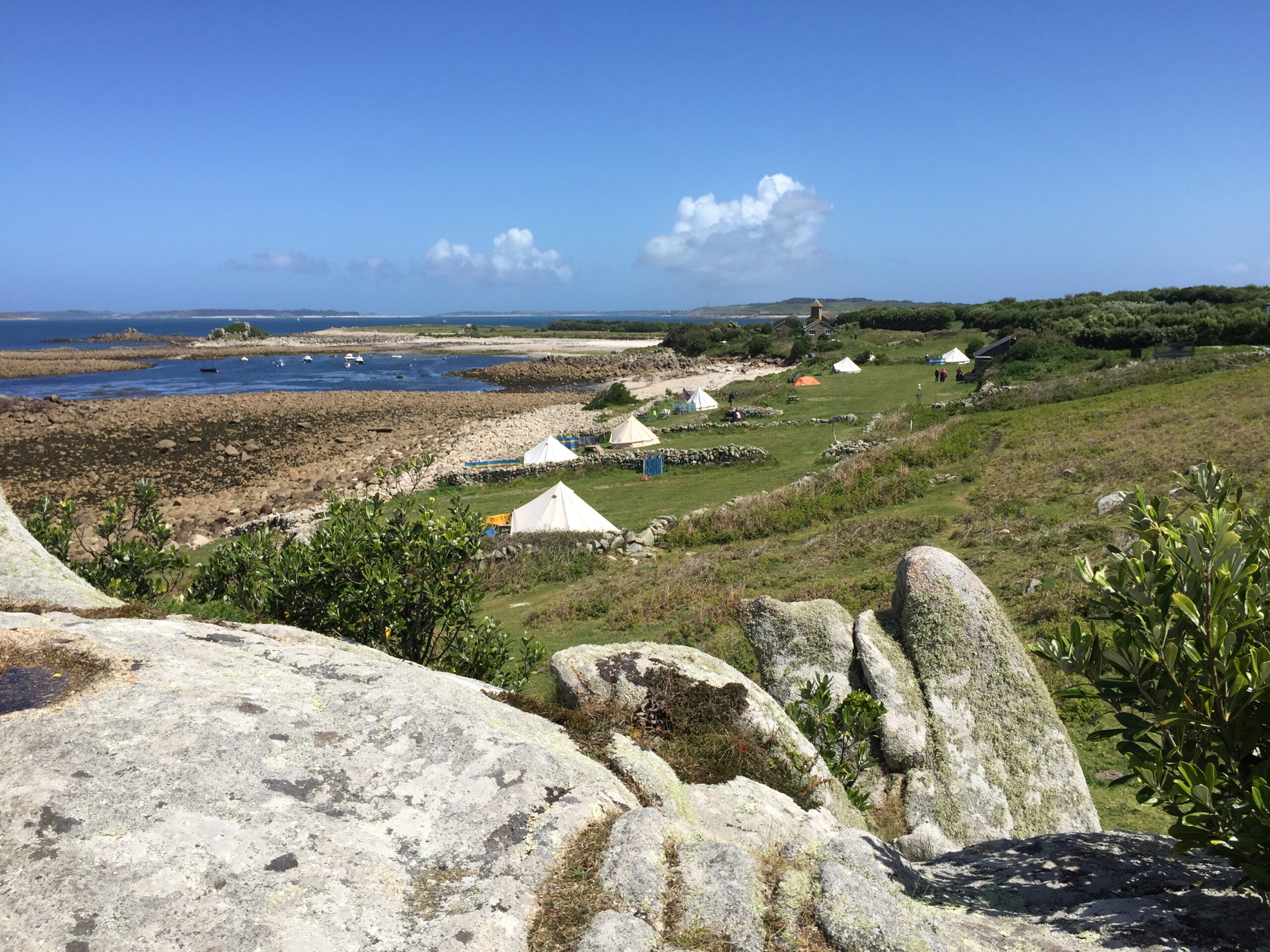
Troytown Farm, at the western end of the island, makes an ice cream that’s become something of a Scilly institution — a good reward for the walk out. The beaches occasionally turn up beads from a 17th-century shipwreck, which is either a nice bit of local colour or a genuine reason to go rockpooling with your eyes open, depending on how much you believe the story.
St Agnes and its handful of neighbours mark the very edge of England, and the sense of remoteness is real rather than marketed. There’s a working lighthouse, decommissioned as a manned station decades ago but still a landmark from the water, and a coastline of coves and granite stacks that most visitors have entirely to themselves outside the busiest weeks of August. If Bryher is Scilly’s wild island, St Agnes is its furthest edge — the place people go when they want to say they’ve genuinely got away from it all, rather than just away from the mainland.
A sample week of island hopping
There’s no single correct itinerary, but a shape that works well for a first week based on St Mary’s runs roughly like this. Day one, settle in and walk St Mary’s itself — there’s more than enough on the largest island to fill a day without touching a boat. Day two, Tresco for the Abbey Garden, timed so you’re not rushing the last hour before the garden closes. Day three, a rest day, or a shorter trip to one of the beaches nearer to Hugh Town. Day four, St Martin’s, with a full day allowed for the walk between Higher Town and Lower Town and a proper stretch of time on Great Bay. Day five, Bryher, for Hell Bay and Watch Hill. Day six, St Agnes and Gugh, timed around the tide so the causeway is open both ways. Day seven, whatever the week has shown you was worth a second visit — for most people, that turns out to be whichever island had the emptiest beach.
Shorter stays should drop the rest day and pick two off-islands rather than four; longer stays can slow the whole thing down further, adding a second day on Bryher or St Agnes rather than trying to add a fifth island. The boats run the same timetable either way — it’s simply a question of how much you want to fit in against how much you want to just sit on a beach with nowhere particular to be.
What to pack for a day of hopping
Layers, regardless of the forecast — the crossing between islands is often breezier than either shore, and Scilly’s weather changes faster than mainland Cornwall’s. Cash for the boat fare and for anywhere that doesn’t take cards (some of the smaller island cafes still don’t). Sturdy shoes rather than flip-flops if you’re planning to walk any distance, since island paths run over grass, sand and granite in the space of a few hundred metres. And a tide table, or at least the habit of asking the boatman what time the tide turns — it’s the one piece of local knowledge that actually changes your plans.
Frequently Asked Questions
How many islands can you visit in one day of Isles of Scilly island hopping?
Realistically one, with time to explore it properly. Two is possible if the boat timetable lines up and you’re happy to move fast; three turns the day into logistics rather than a holiday.
Do you need to book inter-island boats in advance?
No — tickets are bought at the quay on the day from the operating boatman. Turn up in good time for the sailing you want, especially in peak summer weeks.
Which off-island is best for a first visit?
Tresco if you want one clear headline attraction in the Abbey Garden; St Martin’s if beaches are the priority; Bryher or St Agnes if you want the quietest, wildest version of Scilly.
Can you take a dog on the inter-island boats?
Yes, dogs are carried on the tripper boats, as they are on the Scillonian and on Skybus flights from Land’s End and Newquay.
Is it possible to stay overnight on the off-islands rather than St Mary’s?
Yes, and many repeat visitors prefer it — Tresco, Bryher, St Martin’s and St Agnes all have accommodation, though the choice is smaller than on St Mary’s and books up further ahead.
Island hopping is what turns a trip to Scilly from “a very nice beach holiday” into something closer to an expedition, in miniature — four or five islands, each with a completely different character, all within a few minutes of each other by boat, and none of them crowded even in the busiest part of the summer.
Beaches are one of the best reasons to pick a particular island for the day. Our round-up of the best beaches on the Isles of Scilly breaks down Pentle Bay, Rushy Bay, Great Bay and the rest, island by island.
Photo credits: Hell’s Bay, Bryher: Hell’s Bay, Bryher, Scilly Isles.jpg by Hugh Mason, CC BY-SA 3.0 (licence). Great Bay, St Martin’s: Beach at Great Bay – geograph.org.uk – 5446282.jpg by Oast House Archive, CC BY-SA 2.0 (licence). Troytown Farm, St Agnes: Troytown Farm campsite – geograph.org.uk – 5391517.jpg by Andrew Abbott, CC BY-SA 2.0 (licence). Cattle on Bryher: Ruby Red Devon cattle on Bryher.jpg by Topo122, CC BY-SA 4.0 (licence).