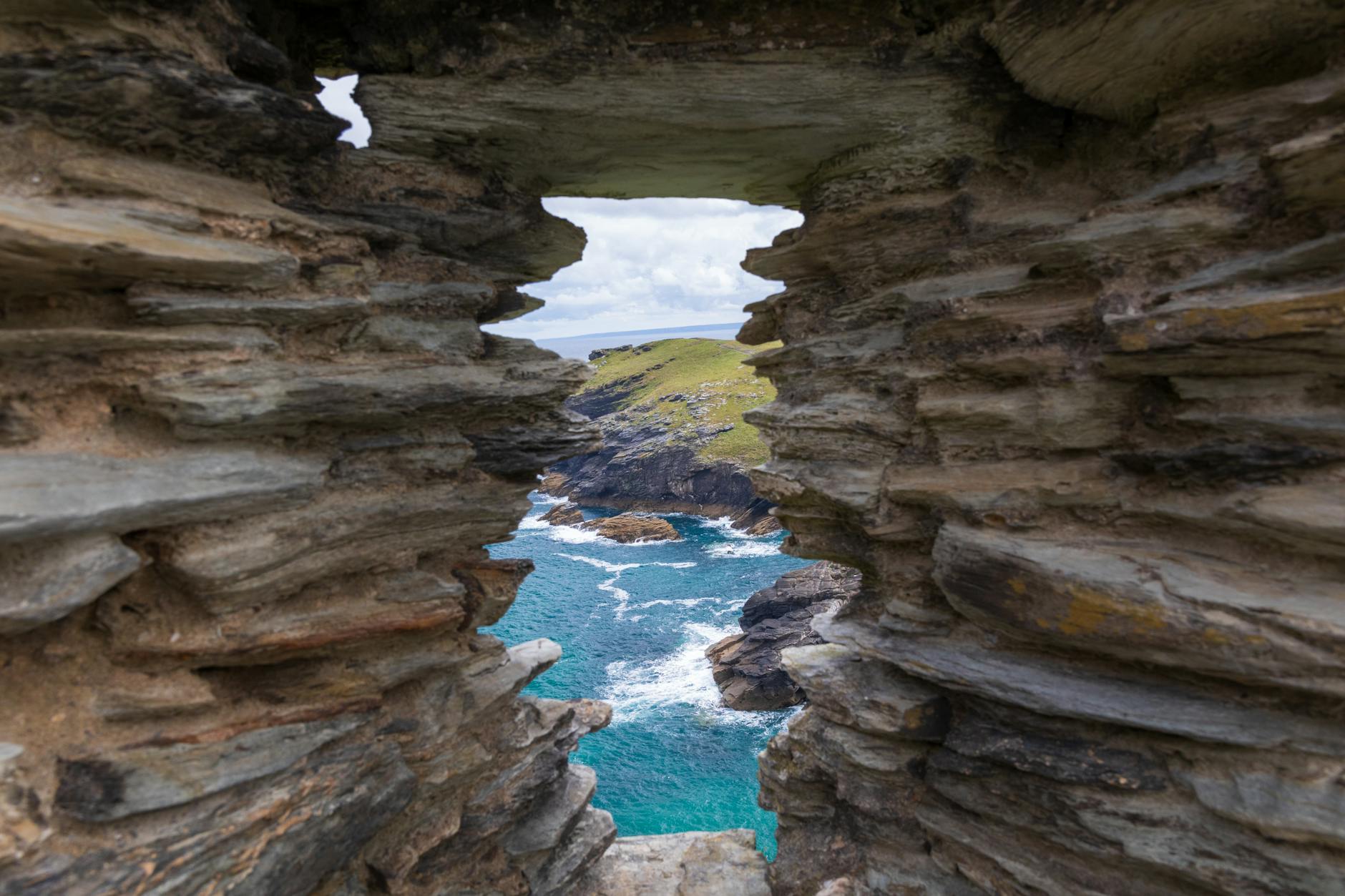
There are few places in Cornwall where the line between history and legend blurs as thoroughly as it does at Tintagel. I have sent countless guests up the north coast to this wild, half-ruined headland, and they almost all come back changed by it, talking less about the dates and the archaeology and more about the feeling of the place: the wind, the crashing Atlantic far below, and the sense that something ancient and important once happened here. This guide to Tintagel Castle Cornwall tells you everything you need to know to visit well, from the truth behind the King Arthur legend to the practicalities of the dramatic new footbridge, the tides, the tickets and the best times to go.
Tintagel is not a tidy fairytale castle with turrets and a moat. It is something far more atmospheric: the fragmentary remains of a medieval stronghold scattered across a near-island headland, layered on top of a much older and even more significant early-medieval settlement, all wrapped in eight centuries of Arthurian myth. Understanding those layers is the key to appreciating what you are looking at.
The King Arthur Legend: Where Myth Began
The Arthurian connection is what draws most people, so let us start there and be honest about it. Tintagel’s fame as the birthplace of King Arthur dates not from the Dark Ages but from the 12th century, when the writer Geoffrey of Monmouth, in his wildly popular and largely invented History of the Kings of Britain, named Tintagel as the place where Arthur was conceived. The story he told was a dramatic one of magic and deception, with the wizard Merlin disguising King Uther Pendragon so that he could deceive his way to Arthur’s mother, Igraine, within the castle walls.
It is a tale, not a record, but it caught the imagination of medieval Europe and never let go. Crucially, those Arthurian associations seem to have directly inspired the castle you see today, because the fabulously wealthy Richard, Earl of Cornwall, built his castle here in the 1230s, almost certainly because of the legend’s prestige rather than for any military purpose. In other words, the myth literally built the place. The legend lives on everywhere here, from the haunting bronze sculpture known as Gallos standing on the island to Merlin’s Cave beneath the headland, and the village below trades happily on all things Arthurian.
The Real History: Older and Arguably More Important
Strip away the myth and Tintagel becomes, if anything, more fascinating. Long before Earl Richard built his castle, this headland was one of the most important places in post-Roman Britain. Archaeology has revealed that in the 5th to 7th centuries, the era of the real Arthur if he existed at all, Tintagel was a high-status settlement, almost certainly a seasonal residence of the rulers of the Cornish kingdom of Dumnonia. Excavations have uncovered the remains of scores of buildings and, most tellingly, vast quantities of imported Mediterranean pottery, fine tableware and amphorae that once held wine and olive oil from the eastern Roman world.
This is extraordinary: it means that at a time when much of Britain had slid into obscurity after the Roman withdrawal, the rulers of Tintagel were trading directly with the Byzantine Mediterranean, importing luxuries from thousands of miles away. Whoever lived here was wealthy, powerful and connected to a wider world. A carved stone found on the site, the so-called Artognou stone, even tantalised researchers with a name faintly echoing Arthur, though scholars are careful not to over-read it. The point is that the real history of Tintagel as a seat of Cornish kings is remarkable in its own right, and it is this deep significance, as much as the myth, that makes the headland feel so charged.
The Footbridge: A Modern Marvel
For centuries, reaching the island half of Tintagel meant a steep scramble down and up again, which put off many visitors and was impossible for some. That changed in 2019 with the opening of a striking new footbridge, one of the most talked-about pieces of heritage engineering in Britain. The bridge spans the gorge between the mainland and the island, reuniting the two halves of the castle that were once joined by a natural land bridge long since collapsed. It is a feat of design, with two cantilevered halves that almost touch in the middle, leaving a deliberate narrow gap underfoot that lets you peer down to the sea far below.
Crossing it is a genuine thrill and, for many, the highlight of the visit. It has also transformed access, making the island far easier to reach than at any time in living memory, though there are still many steps once you are on the island itself. If you would rather not cross the bridge, the mainland courtyards and the visitor centre still offer plenty, and the views of the island from the mainland are superb.
What You Will See on a Visit
A full visit takes in both the mainland and the island. On the mainland you will find the remains of Earl Richard’s great hall and courtyards, clinging to the cliff with dizzying views. Crossing the bridge to the island, you can explore more of the medieval ruins, the foundations of those early-medieval buildings, the remains of a small medieval chapel, and a walled garden. The Gallos sculpture, a spectral, crowned figure inspired by the Arthurian legend, stands near the highest point and has become one of Cornwall’s most photographed artworks.
Down at sea level, when the tide is out, you can reach the small sandy beach in the cove below and explore the dramatic Merlin’s Cave, which runs right through the base of the headland. Always check the tide before venturing in, as the cave floods at high water. The whole site is managed by English Heritage, and the modern visitor centre, shop and exhibition help bring the layered story to life.
Tides, Merlin’s Cave and Timing Your Visit
The tide matters at Tintagel, but mainly for the beach and Merlin’s Cave rather than for reaching the castle itself, which the footbridge has made tide-independent. If exploring the cave and the cove is on your list, check the tide times and aim to arrive in the few hours either side of low tide, when the cave is safely accessible. High tide cuts off the beach entirely and the cave fills with churning water, so never linger as the tide turns.
For the castle, the best timing is about crowds and weather rather than tides. Tintagel is hugely popular, so arrive early in the day or later in the afternoon to avoid the busiest hours, especially in summer. The headland is gloriously exposed, which means spectacular on a clear day and genuinely wild in a storm, so check the forecast and dress for far more wind than you expect. For a sense of which months suit you best, see our guide to the best time to visit Cornwall.
Tickets, Opening Times and Practicalities
Tintagel Castle is an English Heritage site, so members enter free while non-members pay for admission, and booking a timed ticket online in advance is strongly recommended in peak season to guarantee entry and often save a little. Opening hours follow the usual heritage pattern of longer days in summer and reduced winter hours, with the site sometimes closing in severe weather for safety, so always check the official English Heritage website before travelling.
Be prepared for a physically demanding visit. From the village it is a steep walk down to the castle entrance, then many steps up onto the island, with uneven ground throughout. A Land Rover shuttle service usually runs between the village and the castle entrance for those who need it, which helps with the steepest stretch, though the island steps remain a challenge. Wear sturdy footwear, bring layers and a waterproof, and allow two to three hours to do the site justice. Facilities including a shop and refreshments are available, and the village above has plenty of cafes and pubs.
Tintagel Village and the Wider Area
The village of Tintagel itself is worth a wander, with its Arthurian-themed shops, the medieval Old Post Office in the care of the National Trust, and a scattering of good places to eat. Nearby, the King Arthur’s Great Halls is a curious 1930s monument to the legend, and the coast in either direction is sublime. The headland sits directly on the South West Coast Path, so combining your castle visit with a clifftop walk is one of the best things you can do here; the stretch towards Boscastle to the north is particularly dramatic. See our guide to the South West Coast Path in Cornwall for routes.
Tintagel makes a natural highlight of any north Cornwall itinerary, and it pairs beautifully with the harbour village of Boscastle, the surf and sands around Bude, and the foodie town of Padstow further south. If you are touring the county, it slots neatly into a wider route as described in our Cornwall 7-day itinerary.
Tintagel in Books, Film and the Imagination
Part of what makes Tintagel so resonant is how deeply it has soaked into our culture. Geoffrey of Monmouth lit the fuse in the 12th century, but the romance was carried on by medieval writers across Europe who wove Tintagel into the tales of Arthur, Tristan and Iseult, and the knights of the Round Table. In the Victorian age, Tennyson visited and drew on the place for his hugely influential Idylls of the King, cementing Tintagel’s status as the spiritual home of Arthurian Britain in the popular mind. Artists, poets and, more recently, film-makers have all been drawn to the headland’s brooding drama. Knowing this as you stand on the island adds another layer to the experience: you are not only looking at stones and sea, but at a landscape that has shaped the British imagination for the best part of a thousand years. It is, in a very real sense, the birthplace not of Arthur the man but of Arthur the legend, and that is arguably more powerful.
Combining Tintagel With Boscastle and the North Coast
If you are making the trip to this corner of Cornwall, it would be a shame to see Tintagel in isolation, because the surrounding north coast is some of the finest in the county. Just a few miles north lies Boscastle, a beautiful National Trust harbour village tucked into a steep valley, home to the fascinating Museum of Witchcraft and Magic and a lovely walk out to the harbour mouth. The coast path between Tintagel and Boscastle is a spectacular half-day walk past dramatic cliffs and the curious folly of Willapark. To the south, the timeless fishing village of Port Isaac, familiar to many as the setting of a long-running television series, is well worth a visit, as is the foodie harbour of Padstow a little further on. Inland, the wild expanse of Bodmin Moor and its legends are within easy reach, as covered in our Bodmin Moor walking guide.
Where to Stay Near Tintagel
Tintagel and the surrounding villages have a good range of accommodation, from characterful inns and bed and breakfasts in the village itself to coastal guesthouses in Boscastle, Port Isaac and the wider north coast. Staying overnight in the area lets you visit the castle early or late, when the day-trippers have gone and the headland is at its most atmospheric, and it puts the rest of the dramatic north coast within easy reach the next day. For options across the county and advice on choosing the right base, see our Cornwall bed and breakfast guide. Many visitors find that a night or two on the north coast, with Tintagel as the centrepiece, is one of the most memorable parts of a Cornish holiday.
Making the Most of Your Visit
My advice to guests heading to Tintagel is to give it time and let the atmosphere work on you. Do not rush across the bridge, snap the Gallos statue and leave; instead, sit a while on the island, look out at the Atlantic, and imagine both the Cornish kings trading with Byzantium and the medieval earl building his castle to bask in Arthur’s glory. Read the panels, explore Merlin’s Cave if the tide allows, and walk a stretch of the coast path to see the headland from outside. Visited that way, Tintagel is not just a ruin but a place where the whole long, strange story of Cornwall, real and legendary, comes together in one unforgettable spot.
Visiting Tintagel With Children
Tintagel is a wonderful place to fire a child’s imagination, with its tales of wizards, kings and a real cave to explore, and the footbridge is an adventure in itself. That said, it is a steep, exposed site with sheer drops and many steps, so children need close supervision throughout, particularly near the cliff edges on the island. The Land Rover shuttle helps tired little legs with the steepest stretch up from the village, and the beach and Merlin’s Cave at low tide are a highlight for families. Bring layers, snacks and water, time your visit around the tide if the cave is on your list, and allow plenty of time so nobody is rushed on the steps. Older children fascinated by the Arthur stories will get the most from it, especially if you read them the legend beforehand. For more family-friendly heritage and attractions across the county, see our Cornwall family holiday guide.
Frequently Asked Questions
Was King Arthur really born at Tintagel?
There is no historical evidence that King Arthur existed, let alone was born here. The connection comes from Geoffrey of Monmouth’s 12th-century book, which named Tintagel as the place of Arthur’s conception. However, the headland was genuinely an important seat of Cornish kings in the 5th to 7th centuries, which is remarkable history in its own right.
Do you have to cross the footbridge to visit Tintagel Castle?
No. The mainland courtyards, visitor centre and views can be enjoyed without crossing, but the footbridge gives access to the island half of the castle, the Gallos sculpture and the best of the ruins. The bridge itself is a highlight and has made the island far easier to reach.
How long do you need at Tintagel Castle?
Allow two to three hours to explore both the mainland and island, walk down from the village, and take in Merlin’s Cave if the tide is out. It is a steep, step-heavy site, so factor in time to take it at a comfortable pace.
Do I need to book tickets for Tintagel Castle?
Booking a timed ticket online in advance is strongly recommended, especially in summer, to guarantee entry. English Heritage members enter free but should still check opening times, as the site can close in severe weather.
Is Tintagel Castle worth visiting?
Absolutely. Few places combine such dramatic coastal scenery, genuinely significant Dark Age history and world-famous legend in one spot. The footbridge, the island ruins, the Gallos sculpture and Merlin’s Cave make it one of Cornwall’s most rewarding heritage days out, well worth the steep climb and the steps.
Can you walk to Tintagel on the coast path?
Give yourself time for the villages too. Our Tintagel and Boscastle guide covers the medieval Old Post Office, St Materiana’s Church, Rocky Valley and St Nectan’s Glen, Boscastle’s Elizabethan harbour and the Museum of Witchcraft and Magic, plus the coast path between the two and where to park.
Yes. Tintagel sits directly on the South West Coast Path, and walking in from Boscastle to the north or along the coast to the south is one of the best ways to appreciate the headland, with spectacular cliff views in both directions.