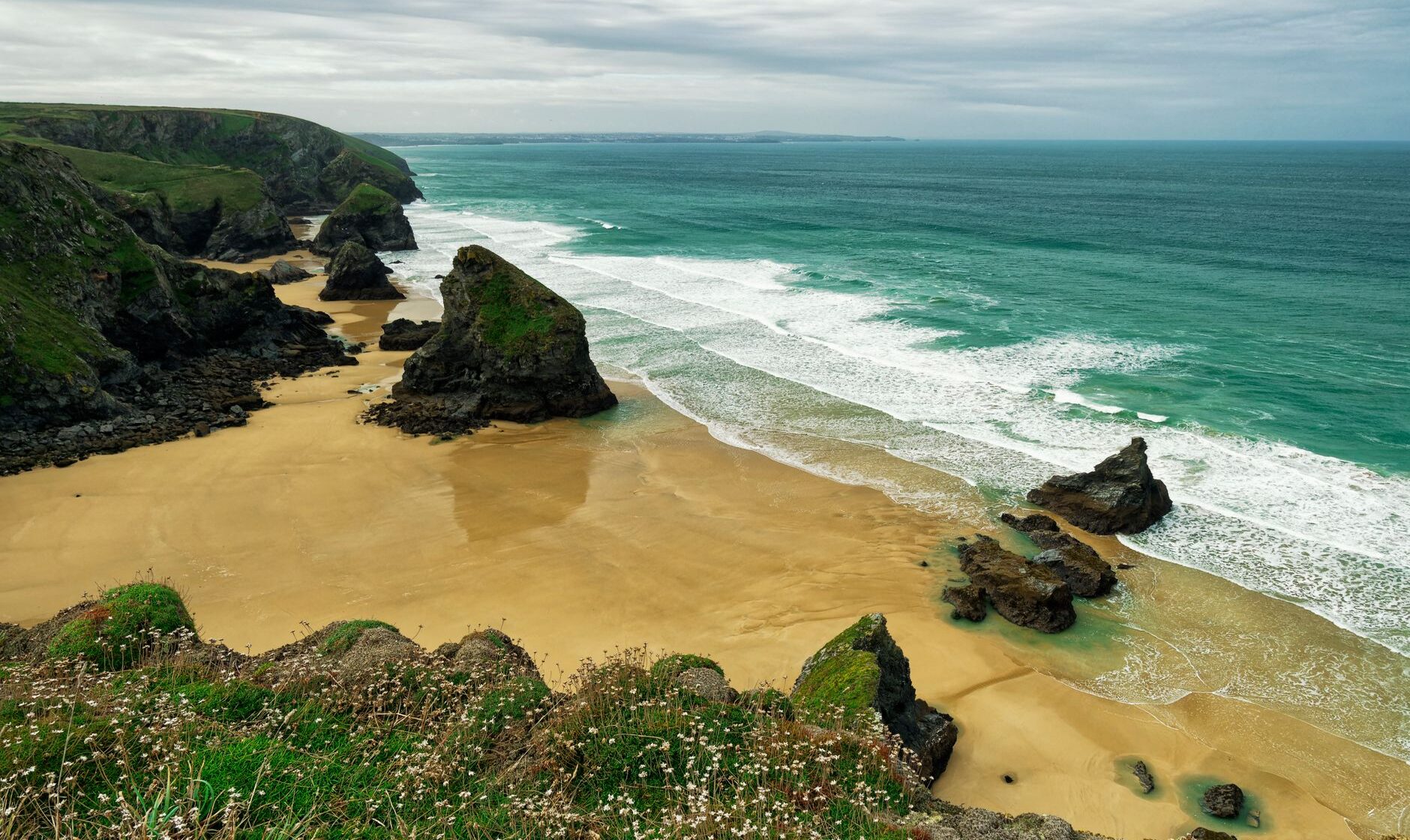
From the clifftop at Carnewas, the view does all the work. Far below, a mile of pale sand runs north between slate cliffs, and marching up it, one after another, are the great dark stacks that gave the place its name: rock islands the size of churches, their tops green with thrift and grass, the surf breaking white around their feet. On a sunny evening, with the light coming in low off the Atlantic, it’s one of the most spectacular sights on the north coast.
What most visitors want to know before they come, though, is whether they can get down there. The honest answer, at the time of writing, is no. The cliff staircase that once took visitors down to the beach at Bedruthan Steps is closed after a rockfall, and there’s no safe public route to the sand. That changes the visit, but it doesn’t spoil it: this is now a clifftop place, and a very fine one. This guide covers the closure and what it means, the National Trust car park at Carnewas, the best viewpoints and walks, the stories behind the stacks, the tea room, safety, and the nearby beaches you can actually get onto.
Bedruthan Steps at a glance
- Where: on the B3276 coast road between Newquay and Padstow, on the north Cornwall coast.
- Who runs it: the National Trust manages the clifftop, car park and viewpoints as Carnewas at Bedruthan. The beach itself isn’t National Trust land.
- Beach access: the cliff staircase is closed following a rockfall, with no safe public access to the sand. Check the National Trust’s Carnewas page for updates before you travel.
- Parking: National Trust car park; members free, pay-and-display for everyone else.
- Food: the Carnewas Tea Room by the car park, with reduced opening in winter.
- Best for: clifftop views, photography, sunset, and a stretch of the coast path.
Can you get down to the beach at Bedruthan Steps?
For generations, the great attraction of Bedruthan was the descent: a steep staircase cut into the cliff, down which visitors picked their way to a beach that felt like the end of the world. Following a rockfall, the staircase has been closed, and at the time of writing there is no safe public access to the beach. The National Trust has been looking at the options for repairs, but there’s no confirmed reopening date. Check its Carnewas page for the latest before you set off, and treat any older guide, blog or video showing people on the beach as out of date.
You’ll probably hear about, and may even see, people climbing round the gate. Don’t. These cliffs are made of soft, fractured slate that falls without warning — that’s why the staircase closed in the first place — and a fall here means a long, difficult rescue for the coastguard. Even when the staircase was open, the beach came with serious hazards of its own: it floods to the foot of the cliffs at high tide, it’s easy to get cut off among the stacks as the water comes in, and the currents make swimming dangerous at any time, with no lifeguards to help.
If standing on the sand is the whole point of your trip, go to one of the neighbouring beaches instead (see below). If you’re happy with one of the best views in Cornwall, Bedruthan is still very much worth the stop.
Bedruthan Steps parking at Carnewas
The National Trust car park at Carnewas sits right beside the clifftop, just off the B3276, and it’s where every visit starts. At the time of writing, non-members pay £2.50 for up to an hour or £5 for longer; National Trust members park free. Prices do change, so check the machine when you arrive. In summer the car park gets busy in the middle of the day, especially on fine evenings when people come for the sunset, but turnover is quick because most visits last an hour or two.
If you’re walking the coast path, you can of course arrive on foot from Mawgan Porth or Porthcothan instead, and there are buses along the coast road between Newquay and Padstow; check Transport for Cornwall for current routes and times.
The clifftop walk and the best viewpoints
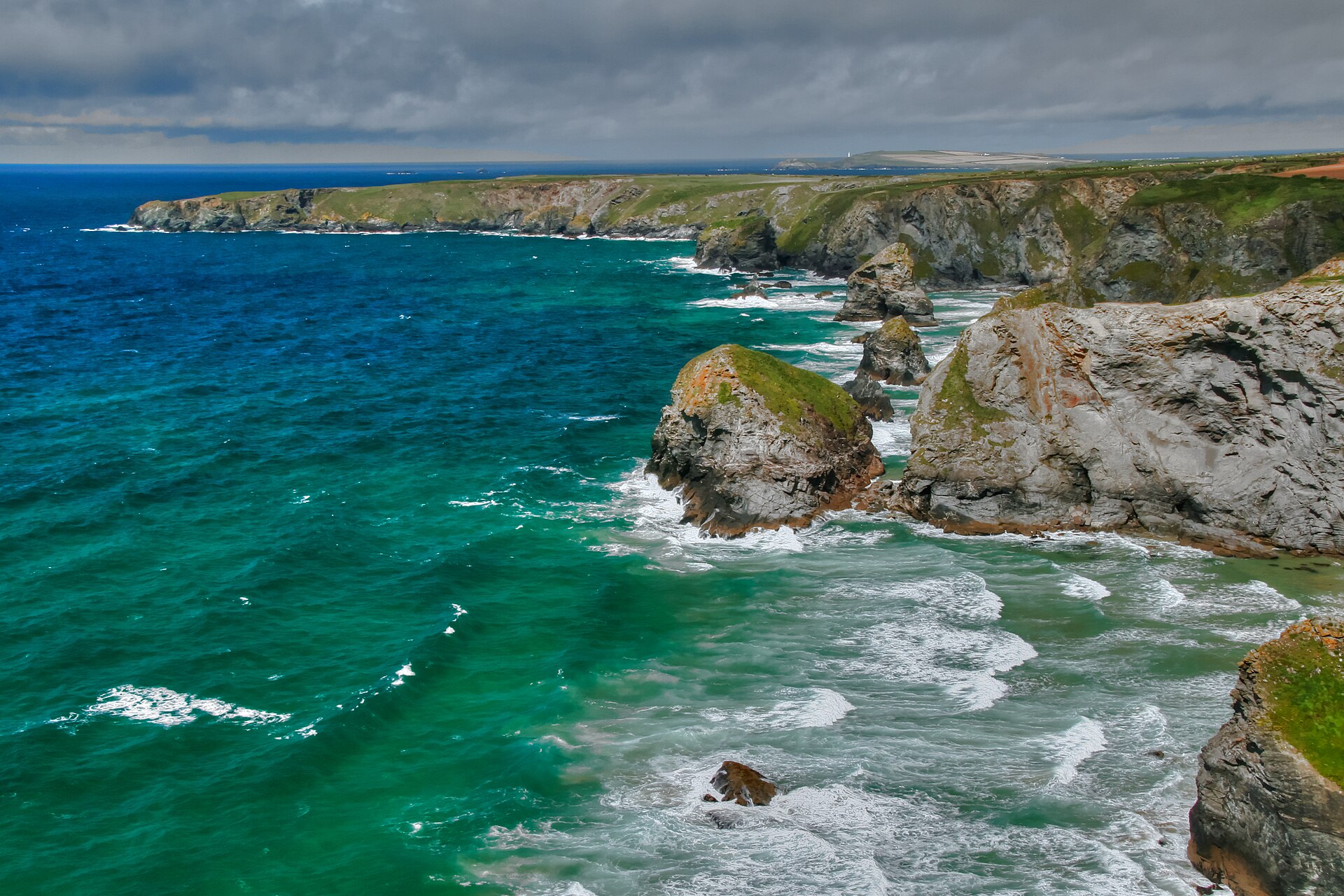
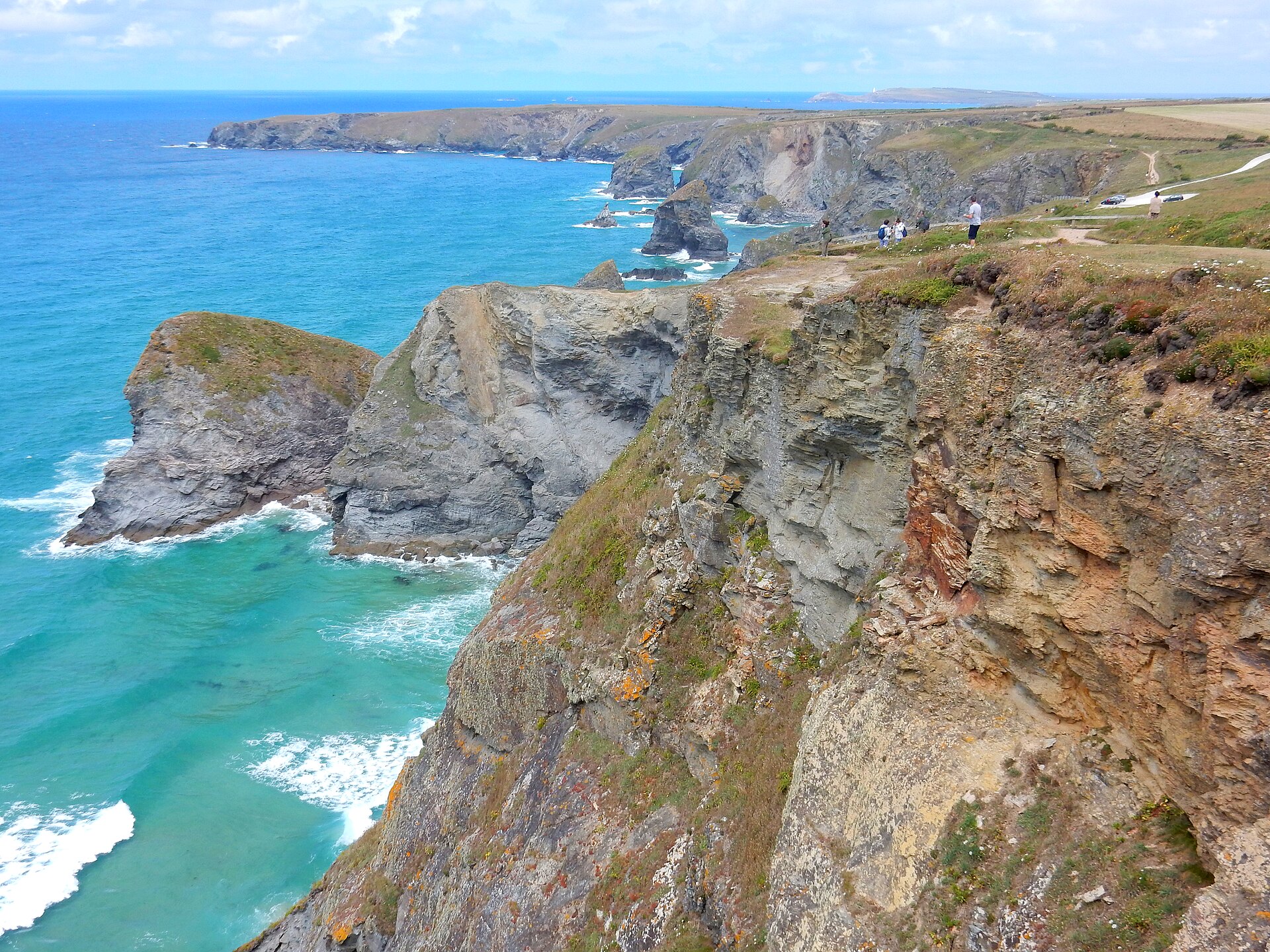
From the car park, it’s a short, easy walk to the main viewpoint above the beach, and the clifftop path runs north and south from there. Close to the car park the path is wide and firm, making this one of the more accessible spots on the north coast for a big coastal view, and there’s a recognised easy-access walk along this stretch of the South West Coast Path. The views change with every hundred metres: south towards Newquay and its headlands, north along the line of stacks to Park Head and, beyond it, the lighthouse on Trevose Head.
Walk north along the clifftop towards Park Head for the classic view down the length of the beach, with the stacks lined up one behind another. It’s easy walking over short turf, but the cliff edges are sheer, crumbling and in places overhanging. Stay on the path, keep well back from the edge, and keep children and dogs close. The cliffs here look solid and aren’t.
The stacks and their stories
The name Bedruthan Steps is a lot younger than it sounds. It dates from Victorian times, when the story was put about that the stacks were stepping stones used by a giant called Bedruthan to cross the bay — a legend that seems to have been invented largely to bring visitors to what was then a remote stretch of coast. It worked. The stacks have their own names, and some have better stories than the giant:
- Queen Bess Rock was said to resemble the profile of Elizabeth I. The sea has long since taken her head, and she’s a lot harder to spot these days.
- Samaritan Island is named after the Samaritan, a ship wrecked here in the 1840s. Her cargo included fine cloth, and local people are said to have been dressed in unexpectedly good silks and cottons for some time afterwards.
- Redcove Island, Diggory’s Island and Pendarves Island make up the rest of the line, along with a scatter of smaller rocks that appear and disappear with the tide.
The Samaritan was far from the only ship to come to grief on this coast, and wrecks like hers are woven through Cornish folklore. Our guide to Cornwall’s smuggling history and tales has more on the wreckers, the salvagers and the stories in between.
Tides, cliffs and safety
Even from the top, it’s worth understanding what the sea does here. At low tide the beach is huge, up to around 800 feet wide and nearly a mile long, backed by cliffs up to 200 feet high. At high tide the sea comes right to the foot of those cliffs and there is no beach at all. The tide comes in quickly around the stacks, and on the open Atlantic coast the currents are strong. That combination is why, even when the staircase was open, Bedruthan was never a swimming beach, and why it has no lifeguard patrol.
For clifftop visitors, the main hazard is the edge itself. The slate here is layered and fractured, and pieces fall away regularly, as the staircase closure shows. Stay on the paths, respect the fences and warning signs, and don’t go near the edge for a photograph. Our Cornwall beach safety guide covers tides and cliffs across the county.
The Carnewas Tea Room and the old mine
The Carnewas Tea Room by the car park serves cream teas, cakes and light lunches, with tables outside in good weather. It stands on the site of the old Carnewas Mine, which worked lead and iron ore here between 1855 and 1874; the mine is long gone, but it’s a reminder that this coast earned its living long before the tourists came. In winter, opening is cut back — in recent years to weekends only from November to March — so check before you plan lunch around it.
Photographing Bedruthan Steps
Bedruthan faces west, which makes late afternoon and evening the best times for photographs, when the low sun lights the faces of the stacks and the sand glows. Low tide gives you the full sweep of the beach, with the stacks standing on sand and the tide pools catching the light; high tide on a big swell gives you drama instead, with the surf exploding around their bases. The classic composition is from the clifftop looking north along the line of stacks, with Trevose Head on the horizon. Spring brings thrift and wildflowers along the clifftop for a foreground. For more locations like it, see our guide to the best photography spots in Cornwall.
Walking the coast path from Carnewas
Carnewas sits on one of the finest stretches of the South West Coast Path in north Cornwall, and it’s a great place to join it for a few hours. Head south and within a mile or two you drop down to Mawgan Porth, a sandy surf beach with a small village, cafés and a pub, then carry on towards Watergate Bay if you have the legs. Head north past Park Head, and the path winds above a series of coves to Porthcothan, a sheltered sandy inlet a few miles away. Either way, the clifftop walking is easy by coast path standards, with open views most of the way.

Bedruthan through the year
Spring is arguably the loveliest time to come. From April into June the clifftops fill with thrift, sea campion and gorse, seabirds wheel around the stacks, and the car park is rarely under pressure. Summer brings the crowds in the middle of the day and the best evenings of the year, when you can stay until the sun drops into the sea behind the stacks and still find a table outside at a pub in Mawgan Porth afterwards. Autumn is the season for swell: the first big Atlantic storms send lines of surf crashing around the stacks, and the light is soft and golden from mid-afternoon. Winter is wild, windy and nearly empty, and on a clear, cold day between storms the view is as good as it gets; just remember the tea room’s reduced hours and dress for a clifftop wind that finds every gap in your coat.
A half day at Bedruthan
The best way to see Bedruthan is to arrive on foot. Park at Mawgan Porth, have a coffee by the beach, and take the coast path north up onto the cliffs; within a mile or two, the stacks start to appear below you, each view better than the last. Stop at the Carnewas viewpoint, then carry on towards Park Head for the classic view back down the length of the beach. Walk back to Carnewas for a cream tea in the tea room garden, then retrace your steps south to Mawgan Porth, timing it so you’re back on the sand for a swim or a paddle between the lifeguard flags in the late afternoon. Allow three to four hours with stops. If you’re short of time, the Carnewas car park and viewpoint alone take an hour, including a slow wander along the clifftop.
Beaches nearby that you can actually get onto
If you came for sand as well as views, the good news is that this stretch of coast is full of it:
- Mawgan Porth, just south of Carnewas, is a broad, sandy surf beach with a stream running across it, a village behind and lifeguard cover in the summer season.
- Porthcothan, to the north, is a narrow, sheltered sandy inlet between the cliffs, good for families and rock pools.
- Treyarnon and Constantine Bay, further north towards Trevose Head, have wide sands and rock pools, and Constantine is a popular surf beach.
- Fistral, on the edge of Newquay, is Cornwall’s most famous surf beach, with lifeguards through the season and dogs welcome all year. Our Fistral Beach guide has the details.
For the full picture across both coasts, see our guide to the best beaches in Cornwall.
Dogs at Bedruthan Steps
Dogs are welcome on the clifftop paths at Carnewas, but keep them on a short lead. The edges are sheer and unfenced in places, and dogs chasing a rabbit or a gull are a regular cause of cliff rescues on this coast. There may be livestock grazing along the clifftops too. With no beach access at present, there’s nowhere for a dog to run on the sand here; Mawgan Porth and Porthcothan are the nearest options for that, subject to their own seasonal rules.
Where to stay near Bedruthan Steps
Bedruthan sits roughly halfway between Newquay and Padstow, so you can base yourself in either and be here in well under half an hour. Padstow is the smaller, foodier choice, with harbourside restaurants and the Camel Trail on the doorstep; our Padstow guide covers the town and where to stay. Newquay has the bigger choice of accommodation and the beaches of Fistral and Watergate. For something quieter, the villages and hotels around Mawgan Porth and along the coast road put you within walking distance of Carnewas, which means you can have the clifftop almost to yourself at sunset once the day visitors have gone. The National Trust looks after much more of this coast, too; our complete guide to the National Trust in Cornwall covers its other beaches, houses and gardens.
Frequently Asked Questions
Can you walk down to the beach at Bedruthan Steps?
Not at the time of writing. The cliff staircase is closed following a rockfall, and there’s no safe public access to the beach. Check the National Trust’s Carnewas at Bedruthan page for updates before you visit, and don’t attempt to climb down any other way.
Is Bedruthan Steps worth visiting if you can’t get onto the beach?
Yes. The clifftop view over the stacks and the long beach is one of the finest on the north Cornwall coast, the walking is easy, and there’s a tea room by the car park. Plan to combine it with a nearby beach such as Mawgan Porth if you want sand as well.
How much is parking at Bedruthan Steps?
At the National Trust car park at Carnewas, non-members currently pay £2.50 for up to an hour or £5 for longer. National Trust members park free. Check the machine for current prices.
Can you swim at Bedruthan Steps?
No. Even before the staircase closed, the beach was considered unsafe for swimming because of strong currents and the fast-rising tide, and it has no lifeguard cover. For a swim, head to a lifeguarded beach nearby, such as Mawgan Porth in the summer season.
Why is it called Bedruthan Steps?
The name dates from Victorian times, when a story spread that the stacks were stepping stones used by a giant called Bedruthan. The legend appears to have been invented largely to attract visitors to this stretch of coast.
Is there a café at Bedruthan Steps?
Yes, the Carnewas Tea Room beside the car park serves cream teas, cakes and light lunches. In recent winters it has opened at weekends only between November and March.
Are dogs allowed at Bedruthan Steps?
Yes, on the clifftop paths, but keep them on a short lead because the cliff edges are sheer and unstable and livestock may be grazing.
Bedruthan Steps has changed from a beach you climb down to into a view you stand and stare at, and it’s still one of the great stops on the north coast. Come at low tide in the evening, walk the clifftop towards Park Head as the sun drops, finish with a cream tea at Carnewas, and save the swimming for Mawgan Porth down the road.
If it’s a long beach you’re after, drive twenty-odd miles down the coast to Perranporth. Our Perranporth beach guide covers its two miles of sand and dunes, the surf, the dog rules and the Watering Hole bar on the sand.
Photo credits: Bedruthan Steps at high tide: Bedruthan Steps – geograph.org.uk – 3390699.jpg by David Boness, CC BY-SA 2.0 (licence). The clifftop at Carnewas: Bedruthan Steps, Carnewas, Cornwall (NT) July 2019 (48267194571).jpg by CharmaineZoe’s Marvelous Melange, CC BY 2.0 (licence).