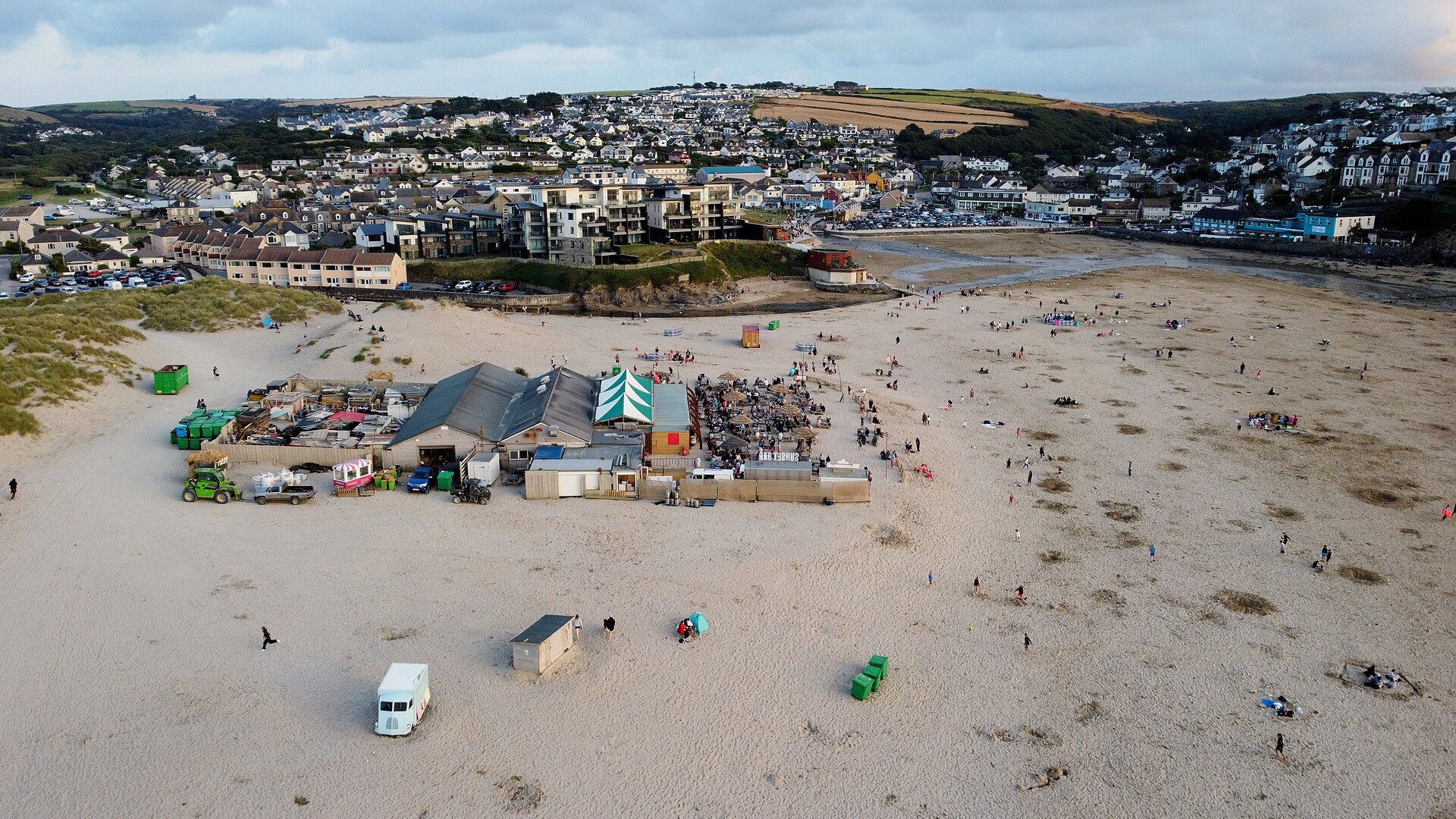
There’s a bar on the beach at Perranporth. Not above it, not behind it on the promenade: on it, sitting on the sand in the middle of the bay, with its terrace facing the Atlantic and the surfers coming in on the last waves of the evening. On a summer night, with the sun going down into the sea, the whole of Perranporth seems to end up there, sandy-footed, and it’s hard to think of a more Cornish way to finish a beach day.
The Watering Hole is the famous bit, but it’s only one reason to come. Perranporth beach is one of the great sweeps of sand on the north coast, running for around two miles from the town to Ligger Point and backed by the huge dunes of Penhale Sands, and at low tide it feels far bigger than that. There’s surf for beginners and old hands, dogs are welcome all year, and the town end has arches, caves and Chapel Rock standing in the surf. Here’s how to get the best of it: parking, lifeguards, the dog rules, surfing, the bar, the history hidden in the dunes, and the walks either side.
Perranporth beach at a glance
- Where: on the north coast between Newquay and St Agnes, with the village right behind the beach.
- Size: around two miles of sand from the town to Ligger Point, backed by the dunes of Penhale Sands; vast at low tide.
- Lifeguards: RNLI patrols at the main Perranporth beach and at Perran Sands, the northern end, through the season.
- Dogs: allowed all year. In July and August they must be on a lead from 10am to 5pm on the main beach, but can run free in the dunes and beyond Flat Rocks.
- Parking: a large car park on the seafront and others in the village; summer 2026 charges from £1 for an hour.
- Food and drink: the Watering Hole on the sand, plus cafés, pubs and takeaways in the village.
The beach, end to end
Perranporth has three distinct characters depending on where you put your towel.
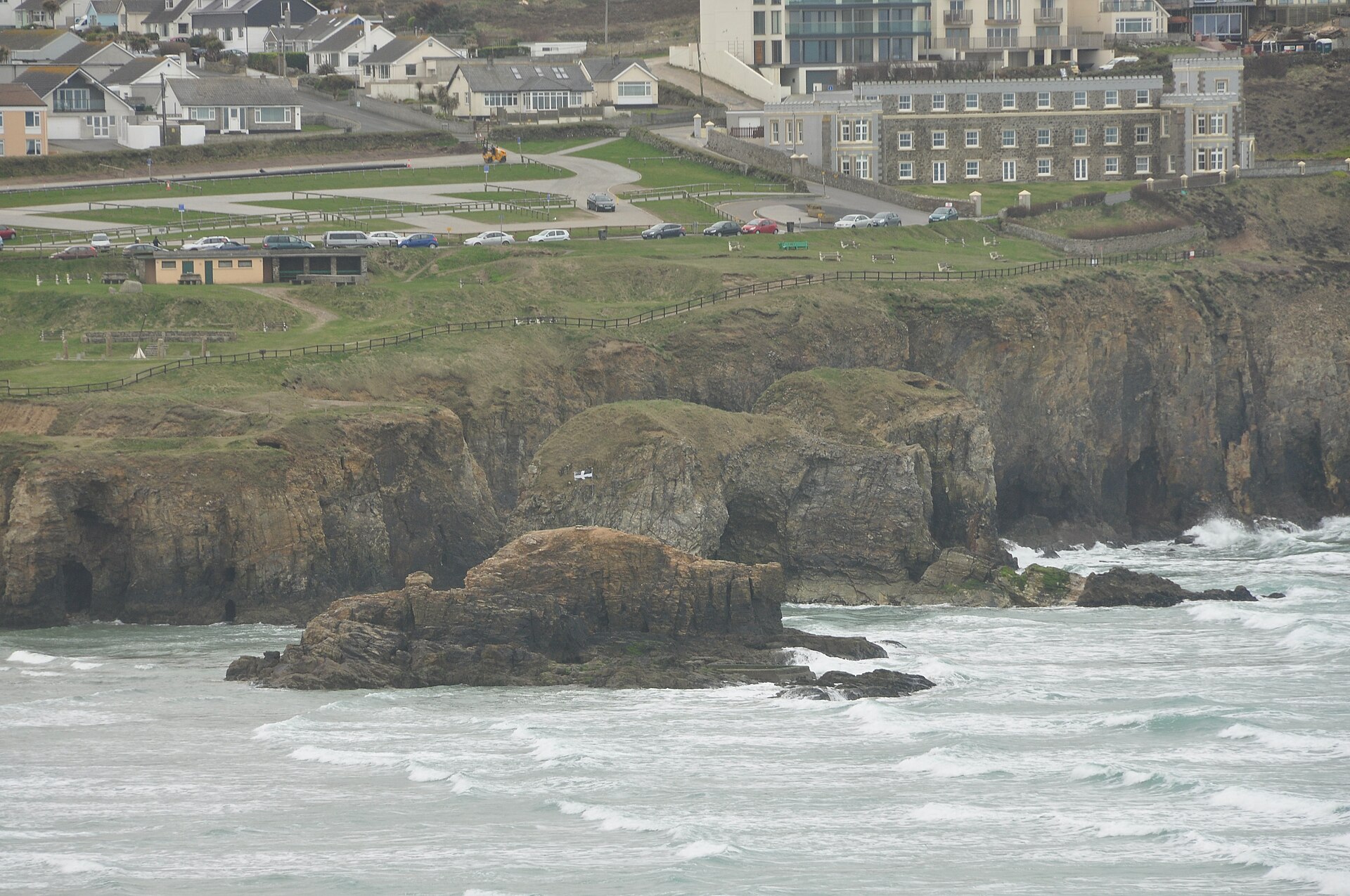
The town end, in the south, is the busiest and the most interesting. The village runs right down to the sand, a stream winds across the beach to the sea, and at the southern corner the cliffs are riddled with caves, arches and the square-cut entrances of old tin-mining adits. Standing off the cliffs is Chapel Rock, and the black-and-white St Piran’s flag is usually flying from the rocks nearby. This end has the car parks, the shops and the lifeguard hut, and it’s where most families settle.
The middle of the bay, around the Watering Hole, is where the beach opens up. The dunes rise behind, the sand stretches away in both directions, and even on a busy August afternoon you can find space by walking ten minutes north.
The northern end, towards Perran Sands and Ligger Point, is wilder and quieter, backed by the tallest of the dunes and patrolled by its own lifeguard team in summer. The big holiday park on the clifftop above means it’s far from deserted in the school holidays, but on an autumn weekday you can walk for half an hour and meet nobody but dog walkers.
Chapel Rock and the town end
At low tide you can walk out to Chapel Rock, scramble around its base and explore the rock pools, and then head for the cliffs at the southern end of the beach, where arches and caves open up in the rock and old mining adits disappear into the headland. It’s the best rock-pooling on the beach and a fascinating place for children, with the usual caveats: go on a falling tide, keep an eye on the water, and don’t go deep into the caves or adits.
Chapel Rock has a darker side, too. On the ebb tide, strong rip currents run out alongside it, and it’s one of the places the lifeguards watch most closely. If you’re swimming or bodyboarding at the town end, stay between the flags and well away from the rock. Above it all, on Droskyn Point, the castellated building is Droskyn Castle, a 19th-century folly long since converted into apartments; the youth hostel on the clifftop nearby has one of the best-value sea views in Cornwall.
Surfing and water sports
Perranporth faces west-north-west into the Atlantic and picks up plenty of swell, with a long, gently shelving beach that produces waves across the whole bay. That makes it a good place to learn: plenty of room, gentle whitewater close in on smaller days, and surf schools and hire on the beach through the season. More experienced surfers spread along the bay looking for the best sandbanks, and on the bigger days the northern end often has the best shape. Our guide to learning to surf in Cornwall compares it with the county’s other beginner beaches.
With the wind blowing across such a long, open beach, Perranporth is also popular with kitesurfers and windsurfers, who tend to launch well away from the swimmers and surf schools. If you fancy trying, our guide to kitesurfing and windsurfing in Cornwall explains where to learn. Bodyboarding in the whitewater between the red and yellow flags is the easiest way for younger children to get a taste of the surf, and you can buy or hire a board in the village.

The Watering Hole
Billing itself as the UK’s only live music bar on the beach, the Watering Hole sits right on the sand in the middle of the bay, with a big terrace facing the sea. It serves food and drinks through the day and puts on live music, and on a warm evening it’s the social centre of Perranporth: surfers still in their wetsuits, families with sandy toddlers, and a crowd of people who have come purely to watch the sun go down with a drink in hand.
The honest verdict? You’re paying for the setting rather than the food, and at peak times you’ll queue. But there’s nowhere else quite like it, and a drink on that terrace at sunset, with the tide out and the whole bay glowing, is one of those things you’ll remember from a Cornish holiday long after you’ve forgotten what you had to eat. Arrive early on summer evenings if you want a table.
Perranporth parking
There’s a large car park on the seafront, right behind the beach, and further car parks around the village. The summer 2026 tariff for the beach car parks starts at £1 for up to an hour, rising to £3 for two hours, £7 for four hours, £9 for six hours, £12 for eight hours and £16 for 24 hours, and overnight camping in the car parks isn’t allowed. Charges differ between car parks and change outside the summer season, so check the board before you pay.
On sunny days in July and August, the seafront car park fills by mid-morning. Arrive early, or come later in the afternoon when the first wave of day visitors starts to leave; the evening light is better anyway, and you’ll be in position for sunset at the Watering Hole.
Dogs at Perranporth
Perranporth is one of the most dog-friendly big beaches in Cornwall. Dogs are allowed all year round. The only restriction is in July and August, when they must be kept on a lead between 10am and 5pm on the main beach. Even then, they can run free in the dunes and on the rest of the beach beyond Flat Rocks, towards the northern end, where there’s more than enough space for a proper run. Outside those hours and months, the whole beach is theirs. Check the signs at the beach entrances in case the rules change, and keep dogs well away from the surf schools and the dunes’ nesting birds in spring. For more beaches where your dog is welcome all summer, see our guide to dog-friendly beaches in Cornwall.
Lifeguards and safety
Perranporth is patrolled by RNLI lifeguards through the season, at both the main beach and Perran Sands to the north. Swim and bodyboard between the red and yellow flags, keep surfboards in the black-and-white chequered zones, and stay out of the water when the red flag is flying. The two things to watch here are the rip currents, particularly around Chapel Rock on the ebb tide, and the size of the beach itself: on a long beach it’s easy to wander far from the patrolled area, where there’s no one watching. If you’re walking north towards Ligger Point at low tide, check the tide times so you don’t end up cut off below the cliffs as the water returns.
Parts of the dunes at Penhale are Ministry of Defence land, so stick to the marked paths and follow any signs. The dunes themselves are fragile and protected, too; walk on the paths rather than sliding down the faces, however tempting it is for the children.
Perranporth with children
For families, Perranporth has almost everything in one place. The stream that meanders across the sand at the town end is a magnet for small children with buckets and spades, and on a warm day you’ll see whole engineering projects of dams and channels taking shape. The rock pools around Chapel Rock and the southern cliffs are the next stop on a falling tide, followed by bodyboarding in the whitewater between the lifeguard flags once they’re a bit older. The dunes are perfect for a picnic out of the wind, the village shops are a two-minute walk for forgotten suncream and ice creams, and the toilets and car park are close by.
The main things to plan around are the crowds in the school holidays, when the town end gets packed by late morning, and the size of the beach, which makes it easy for a small child to wander off. Agree a meeting point, such as the lifeguard hut, and on busy days set up camp a little north of the stream, where there’s more room and you can still see the flags.
St Piran and the dunes
Perranporth’s name comes from the Cornish Porth Peran, the cove of St Piran, and this is the heart of Piran country. Cornwall’s patron saint is said to have landed on these sands, and in the dunes behind the beach are the remains of St Piran’s Oratory, one of the earliest Christian sites in Britain, founded in the early medieval period. Swallowed by the shifting sand for centuries, it was uncovered in 1835, and the walk out across the dunes to the site and the old church nearby is a fascinating hour’s detour from the beach.
Every year around St Piran’s Day, 5 March, crowds gather in the dunes for a procession to mark the saint’s day, with the black-and-white St Piran’s flag everywhere. If you’re in Cornwall in early March, it’s a wonderful thing to see.
Winston Graham and Poldark
Perranporth has a strong claim to be the home of Poldark. Winston Graham, who wrote the novels, lived here for 34 years, and the books draw heavily on this stretch of coast: the cliffs, the mines, the coves and the beaches. The television adaptations were filmed at other locations around the county, but walking the clifftops here, it’s easy to see where the stories came from. Our guide to Cornwall’s filming locations covers where the series was actually shot.
Walks from Perranporth
Perranporth sits on a spectacular stretch of the South West Coast Path. Head south, up past Droskyn Point, and the path climbs onto the clifftops towards Cligga Head, with its old mine workings, and on to the village of St Agnes, a lovely half-day walk with a bus or taxi back. On the way you pass Perranporth Airfield, built as an RAF fighter station in the Second World War and now used for civil flying. Head north, and the path crosses the dunes of Penhale Sands towards Holywell Bay, a wilder walk through a very different landscape of marram grass and sand hills.

When to visit Perranporth
Summer is busy, lively and at its best in the evenings, when the beach empties a little and the Watering Hole fills up. Late spring and September are the sweet spot: lifeguards on duty, warm-ish water (the sea is at its warmest in September, at around 16°C), space on the sand and much less pressure on parking. Autumn and winter bring the biggest surf and long, empty dog walks, and with the dunes to shelter behind, Perranporth is a good beach for a blustery winter day. Any time of year, check the tide: at low water the beach is enormous and the rock pools are open; at high tide the town end in particular narrows considerably.
Where to stay and nearby beaches
Perranporth village has hotels, B&Bs, guesthouses and self-catering right behind the beach, as well as large holiday parks on the clifftops, and it’s a good base for exploring the north coast between Newquay and St Agnes. For more beaches nearby, Holywell Bay to the north has its own dunes and a famous offshore rock, while Trevaunance Cove at St Agnes, to the south, is a smaller, sheltered cove below the cliffs. Head up the coast and Fistral Beach in Newquay is Cornwall’s surfing headquarters, and beyond it the clifftop viewpoints of Bedruthan Steps. For the full county round-up, see our guide to the best beaches in Cornwall.
Frequently Asked Questions
Are dogs allowed on Perranporth beach?
Yes, all year round. In July and August, dogs must be on a lead between 10am and 5pm on the main beach, but can run off the lead in the dunes and beyond Flat Rocks. At all other times there are no restrictions.
How long is Perranporth beach?
Around two miles from the town to Ligger Point, backed by the dunes of Penhale Sands. At low tide the beach is very wide as well as long, and it’s often described as three miles of sand.
Is Perranporth beach lifeguarded?
Yes, RNLI lifeguards patrol both the main beach and Perran Sands at the northern end during the season. Swim between the red and yellow flags and take care around Chapel Rock, where rip currents run on the ebb tide.
How much is parking at Perranporth?
Summer 2026 charges at the beach car parks start at £1 for an hour and rise to £16 for 24 hours, with no overnight camping. Check the board at each car park, as prices vary between car parks and seasons.
What is the Watering Hole in Perranporth?
It’s a bar and restaurant built right on the sand in the middle of the beach, billed as the UK’s only live music bar on the beach. It’s especially popular at sunset, so arrive early on summer evenings.
Is Perranporth good for beginner surfers?
Yes. The long, gently shelving beach produces manageable whitewater on smaller days, and surf schools and board hire operate on the beach through the season.
What is Chapel Rock?
A rock standing off the southern end of the beach that you can walk out to at low tide. Strong rip currents run alongside it on the ebb tide, so don’t swim near it.
Perranporth is the kind of beach that fills a whole day without trying: a surf in the morning, rock pools at low tide, a long walk with the dog, a wander into the dunes to find St Piran, and a drink on the sand as the sun goes down. Pick your end of the beach, watch the flags and the tide, and let the bay do the rest.
For another long, dog-friendly north coast beach with room to spread out, head up past Newquay to Watergate Bay. Our Watergate Bay guide covers the surf, the restaurants on the sand and how to plan around its fast-moving tide.
A few miles south-west along the coast path, past Cligga Head and Trevellas, the mining village of St Agnes has two smaller, wilder coves and the cliffside engine houses of Wheal Coates. Our St Agnes guide covers Trevaunance Cove, Chapel Porth and the Beacon.
Photo credits: The Watering Hole from the air: Perranporth Beach watering hole pub from air Fossick.jpg by Fossick OU, CC BY-SA 3.0 (licence). Chapel Rock: Chapel Rock and cliffs at Perranporth (3934).jpg by Nilfanion, CC BY-SA 4.0 (licence).