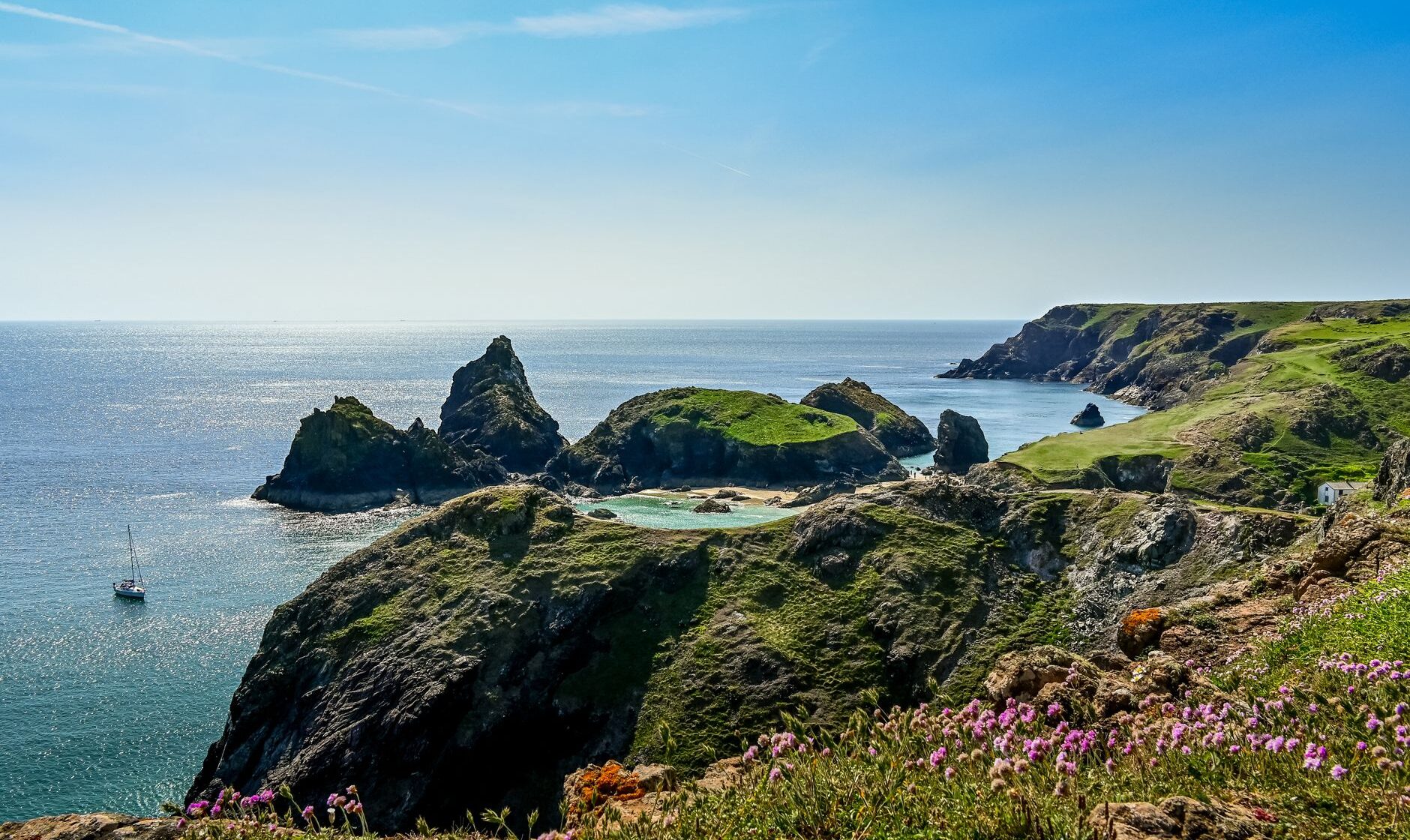
At low tide on a still summer morning, Kynance looks like somewhere that shouldn’t be in Britain at all: a fan of pale sand between dark, glossy rock stacks, water so clear and green it looks lit from underneath, and caves opening off the back of the beach. Come back four hours later and much of it has gone. The sand is under water, the islands are cut off, and the people who arrived at high tide are perched on the rocks beside the café wondering what the fuss was about.
That’s the single most important thing to know about Kynance Cove, and the reason this guide spends more time on tides than on anything else. Get the timing right and it’s one of the most beautiful places on the British coast. Get it wrong and you’ve paid for parking to look at the sea. Below: when to go, what the parking costs, the walk down, the café, the caves and blowholes, swimming, dogs, and where to go instead when the car park is full by ten.
Why Kynance Cove is worth the fuss
Kynance sits on the western side of the Lizard, the peninsula that forms the southern tip of mainland Britain, and it owes its looks to geology you won’t find anywhere else in Cornwall. The cliffs and stacks are serpentine, a rock that began life around 10km below the surface some 375 million years ago, and it comes in deep greens, reds and near-blacks, polished smooth by the sea. Set that against white sand and shallow water over a pale seabed and you get the colours that have made Kynance one of the most photographed beaches in the country.
People have been coming to stare at it for a long time. The cove became fashionable in the early Victorian era, when Queen Victoria and Prince Albert visited, followed by the poets Alfred Tennyson and Algernon Swinburne. The name comes from the Cornish for a ravine or steep-sided valley, which is exactly what you walk down to reach it. More recently it’s been a filming location for Poldark and House of the Dragon — our guide to Cornwall’s filming locations has the rest of the county’s screen credits.
The honest verdict? It lives up to the pictures, but only at the right state of the tide, and only if you can cope with crowds in high summer. Visit in May, June or September, on a falling tide, early or late in the day, and it’s unforgettable. Arrive at noon on an August Saturday at high water and you may wonder why you bothered.
Kynance Cove tides: when to go
The beach at Kynance almost completely disappears at high tide. At low water it opens into a wide spread of sand linking the mainland to the stacks, with caves you can walk into and rock pools everywhere. At high water there’s little more than a strip of rocks at the back of the cove, and Asparagus Island, the largest of the islands, is cut off on almost every tide.
A few rules of thumb:
- Arrive on a falling tide. Aim to be on the beach two to three hours before low water. You’ll watch the sand appear, get the full low-tide spread at its best, and have time to explore before the water starts coming back.
- Check a tide table for the Lizard before you set off, not when you get there. Tide times shift by roughly 50 minutes a day, so yesterday’s perfect timing will be wrong tomorrow.
- Spring tides give you the most beach. Around new and full moon the low tides are lowest, uncovering the most sand and the deepest caves — but the high tides are highest too, and the water comes in faster.
- Watch the islands. Asparagus Island and the other stacks are easy to walk out to at low tide and easy to get stranded on as it turns. If you’re exploring beyond the main beach, keep checking behind you.
There are no lifeguards at Kynance, and the National Trust specifically warns about the risk of being cut off by the tide. The caves are the classic trap: easy to wander into at low water, and the entrances are the first thing the sea reclaims. Our Cornwall beach safety guide covers tides, rips and cut-off risks in more detail, and it’s worth ten minutes before any visit to an unguarded beach.
Kynance Cove parking
There’s one car park for the cove, run by the National Trust on the clifftop above (postcode TR12 7PJ), and there’s no vehicle access to the beach itself. Current charges for non-members are:
| Stay | Charge |
|---|---|
| Up to 1 hour | £2 |
| Up to 4 hours | £5 |
| Over 4 hours | £10 |
| National Trust members | Free (scan your card at the machine) |
You can pay with coins at the machine or through the JustPark app, using location code 80599 — useful, because phone signal on the Lizard isn’t something to rely on at the last moment. The car park is not suitable for coaches, and there’s an accessible toilet and designated parking for blue badge holders.
The catch is capacity. The National Trust describes the car park as extremely busy, with limited space, right through July, August and September, and on fine days it fills early. If you’re coming in the summer holidays, be through the gate before 10am or come after about 4pm, when the day-trippers start leaving and the evening light is at its best anyway. Four hours is plenty for most visits, which makes the £5 ticket the sensible buy. For more on parking across the county, see our guide to parking in Cornwall.
If the car park is full
Don’t circle. The lanes round here are narrow, and there’s nowhere legal to leave a car on the verge. Instead, head for Lizard village, park there, and walk: Kynance is roughly 2 to 2.5 miles along the South West Coast Path from Lizard Point, a spectacular clifftop walk in its own right. Buses also run from Helston to Lizard village; routes and timetables change, so check Transport for Cornwall for the current service before you rely on it.
The walk down to the beach
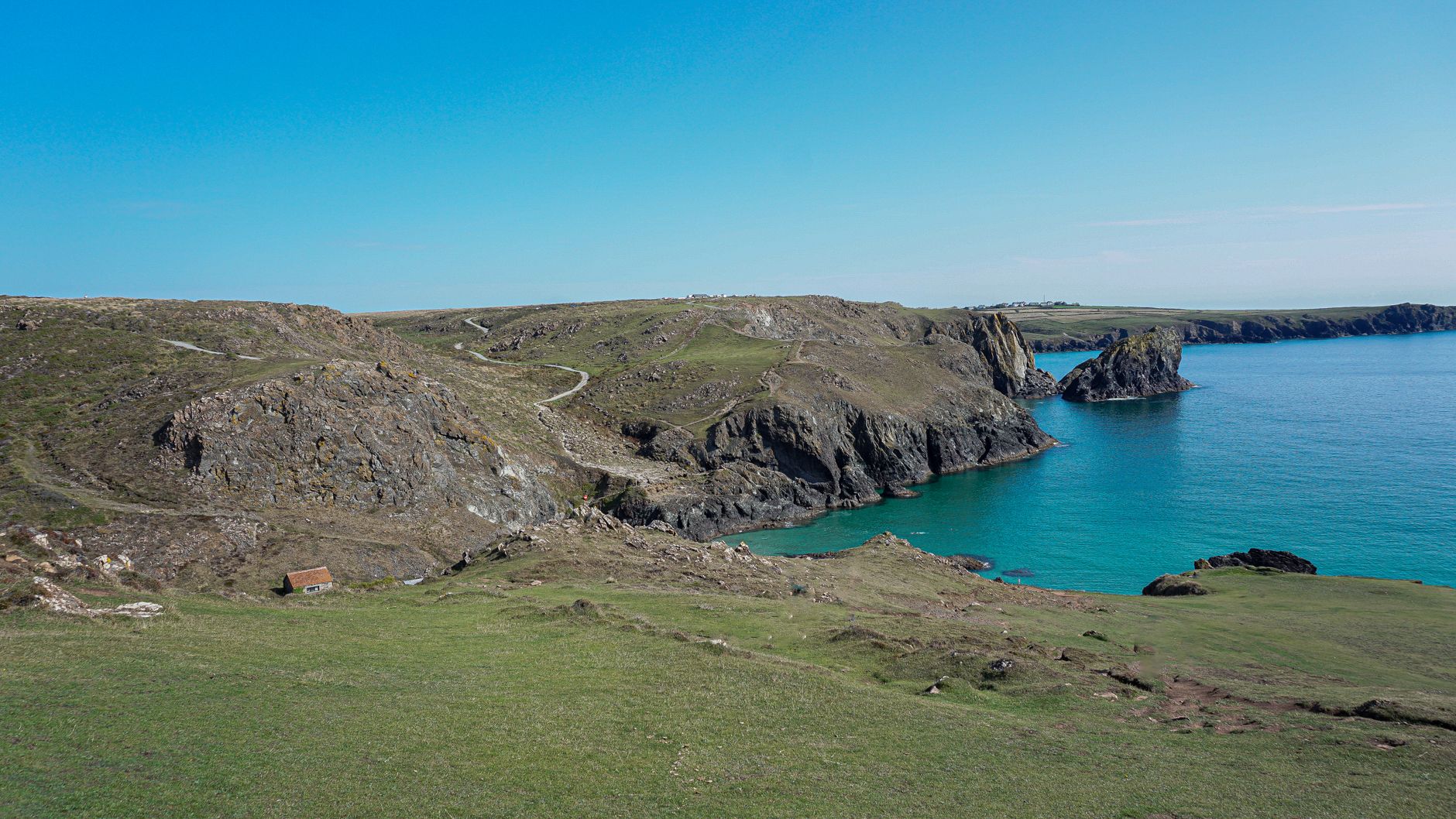
From the car park it’s about a 10-minute walk down to the cove, steep in places, with steps onto the beach at the bottom. It’s fine for most people in decent shoes, but it isn’t suitable for wheelchairs, awkward with a pushchair, and — the part everyone forgets — just as steep on the way back up, usually at the end of a hot afternoon carrying a wet bag and a tired child. Allow twice as long for the return.
If the path is beyond you, the clifftop near the car park still gives you the famous view over the stacks, and on a clear low-tide day it’s arguably the best way to see the whole cove at once.
Exploring the cove: stacks, blowholes and caves
Kynance repays a slow wander at low tide. The four largest stacks are the Bishop, Gull Rock, Asparagus Island and Steeple Rock, and the sand and rocks between them change shape with every winter’s storms. Asparagus Island was once linked to the beach by a sand bar that winter storms stripped away, exposing an older rocky ridge beneath.
Listen out for the blowholes. The Devil’s Bellows on Asparagus Island snorts and booms as the sea surges through it around half-tide, and the Post Office blowhole earned its name because, as the story goes, there’s enough suction to post a letter into it. Please don’t test that with anything you want back.
The caves at the back of the beach are only reachable at low tide and are the best part of a visit for most children, but treat them with respect: go in on a falling tide, come out well before it turns, and never let children explore them alone. The rock pools around the stacks are excellent too, full of anemones, small fish and crabs in the clear water.
Swimming and snorkelling at Kynance
On a calm day the swimming is some of the most beautiful in Cornwall: clear, green water over pale sand, sheltered by the stacks. It’s also a place to be sensible. There are no lifeguards, the water deepens quickly off the rocks, and conditions around the islands can be very different from the shallows by the beach, especially when there’s a swell running in from the Atlantic. Stay in your depth unless you’re an experienced sea swimmer, don’t try swimming out to the islands on a rising tide, and give it a miss when the waves are up.
The clarity makes it a lovely spot for snorkelling in settled weather, with wrasse and pollack around the rocks. The sea off Cornwall is at its warmest in late summer and early autumn, around 16°C in September, which is still cold enough that a wetsuit makes a long snorkel far more pleasant. If you’re keen to swim somewhere quieter and wilder, our guide to wild swimming in Cornwall has plenty more ideas.
The Kynance Cove Café
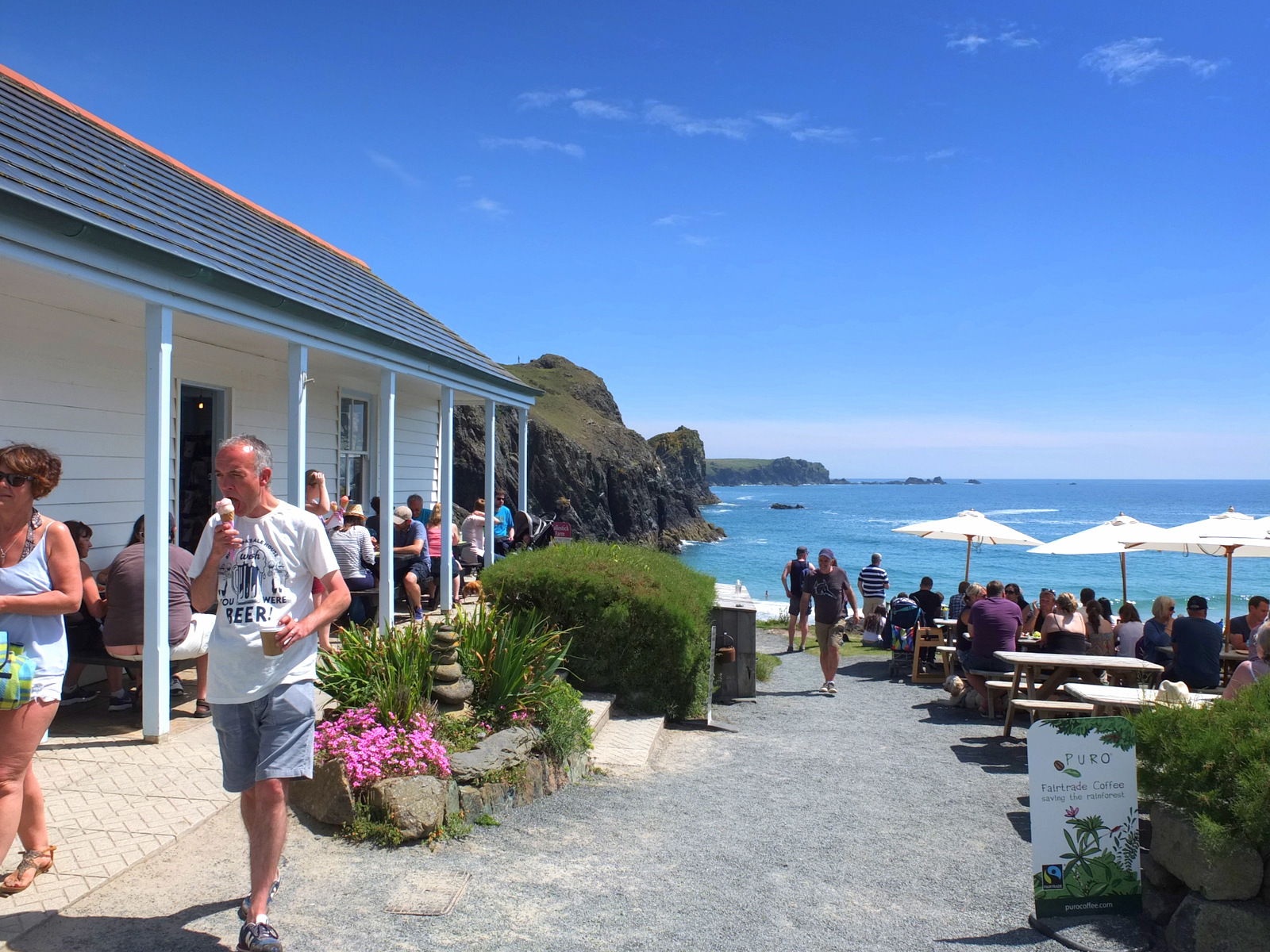
Right at the bottom of the path, the Kynance Cove Café has been serving visitors since 1929 and has belonged to the National Trust since 1999, which is when it finally got mains water and electricity. It’s run as a concession and opens year-round, weather permitting, with tables looking straight out over the cove. There are toilets down at the cove as well as up at the car park.
In summer the queue can be long, and when the tide is in the terrace is where most people end up, so bring water and snacks of your own if you’re planning a long stay on the beach. Out of season, a hot drink on the terrace watching the swell break over Asparagus Island is one of the best things you can do on the Lizard.
Dogs at Kynance Cove
Kynance has a council-enforced seasonal dog ban from 1 July to 31 August, between 10am and 6pm. Outside those hours, and from September through to June, dogs are welcome on the beach. The coast path above is open to dogs all year, but keep them on a lead near the cliff edges and around grazing livestock on the Lizard. For beaches where dogs can run all summer, see our guide to dog-friendly beaches in Cornwall.
Walking to Kynance
Arriving on foot is the best way to see Kynance for the first time, and it neatly avoids the parking problem. The classic approach is the coast path from Lizard Point, about 2 to 2.5 miles of open clifftop, turf and heath with the stacks appearing below you as you round the last headland. In May and June the clifftops are pink with thrift and bright with gorse, and the Lizard is home to the Cornish heath, a heather that grows wild almost nowhere else in Britain.
Make it a circular walk by returning inland through Lizard village, or keep going north along the coast towards Mullion for a longer day. Our guide to walking the Lizard Peninsula has the full routes, with distances and where to stop for lunch.
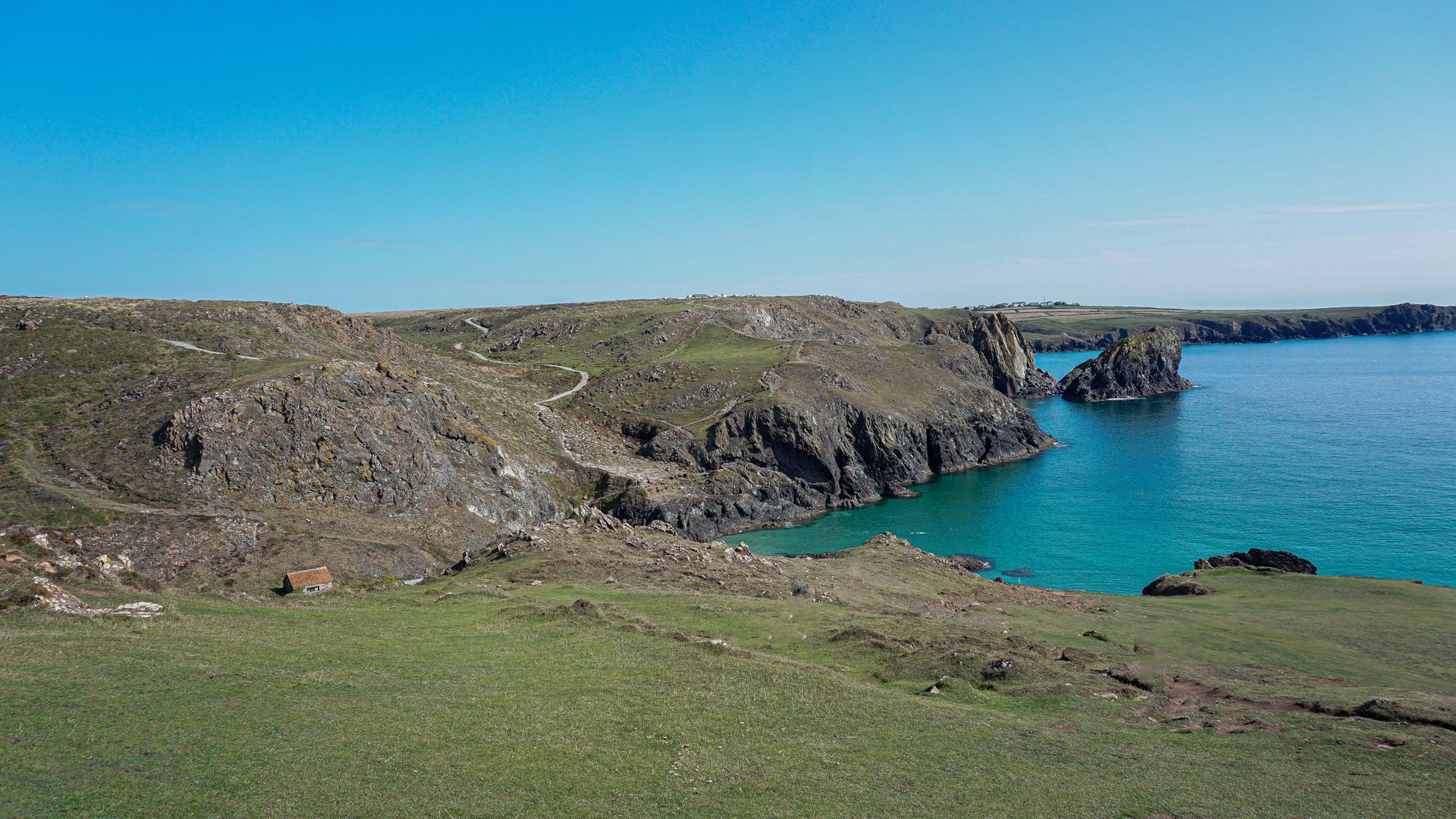
Photographing Kynance Cove
The classic shot is from the clifftop path above the café, looking down across the beach to the stacks. It’s at its best at low tide, when the sand bars form curving lines between the islands, and in the early morning or evening, when the light is softer and the crowds are thinner. Midday summer sun flattens the colours of the serpentine; a bright, clear morning in May, with thrift in the foreground, is hard to beat. Please stay on the path at the cliff edge — the turf overhangs in places, and the ground here is fragile. For more locations around the county, see our guide to the best photography spots in Cornwall.
A low-tide day at Kynance
The best Kynance days are planned the night before around a single number: the time of low water. Say it falls at 2pm. Spend the morning at Lizard Point, where the lighthouse stands above the old lifeboat station and seals often haul out on the rocks below. Around 11am, set off along the coast path towards Kynance, arriving at the top of the cove at about midday, just as the sand starts to open up beneath you. Take the steps down, explore the caves and the stacks while the tide is still falling, swim or snorkel over the low-water slack, and stop at the café for tea as the water starts to come back in. By the time the beach is shrinking again you’re walking home along the clifftops in the afternoon light, having never needed the car park at all.
If low tide falls early in the morning or in the evening, even better: those are the quietest hours at the cove, and the light on the serpentine is at its most beautiful.
Where to stay near Kynance Cove
The single biggest advantage of staying on the Lizard is being able to visit Kynance when everyone else can’t: first thing in the morning before the day-trippers arrive, or in the long summer evenings after they’ve gone. Lizard village and Mullion both have B&Bs, guesthouses and cottages within a few minutes’ drive of the cove, and Lizard village is close enough to walk. For a wider choice of places to eat and sleep, Helston and the harbour town of Porthleven are around 20 to 30 minutes away by car. Book early for the summer holidays; the Lizard has far fewer beds than the north coast resorts, and the best-placed ones go first.
Other Lizard beaches nearby
If Kynance is full, or the tide is wrong, the Lizard beaches around it are the obvious alternatives, and several are far quieter:
- Mullion Cove, a few miles north, is a tiny working harbour tucked behind its sturdy harbour walls, beautiful at any state of the tide and better for a look and a coffee than for a beach day.
- Poldhu Cove and Church Cove, Gunwalloe, further up the west coast, are sandy family beaches; Church Cove has a little church almost on the sand.
- Housel Bay, just east of Lizard Point, is a small, sheltered cove below the cliffs, reached on foot.
- Kennack Sands, on the east side of the peninsula, is a broad sandy beach that suits families and rock-poolers.
- Cadgwith and Coverack are working fishing coves rather than big beaches, but both are lovely places to spend an afternoon.
For the county-wide picture, our guide to the best beaches in Cornwall covers the pick of both coasts.
Frequently Asked Questions
Is Kynance Cove worth visiting?
Yes, if you time it right. At low tide it’s one of the most beautiful beaches in Britain, with white sand, turquoise water and serpentine stacks. At high tide most of the beach disappears, so check the tide table before you go and aim to arrive two to three hours before low water.
How much is parking at Kynance Cove?
The National Trust car park charges non-members £2 for up to an hour, £5 for up to four hours and £10 for longer. National Trust members park free. You can pay with coins or through the JustPark app using location code 80599.
What time should you go to Kynance Cove?
On a falling tide, ideally two to three hours before low water, and early or late in the day in summer, when the car park is less likely to be full. Tide times change daily, so check them for the day you’re going.
Can you swim at Kynance Cove?
Yes, and in calm weather it’s glorious, but there are no lifeguards. Stay within your depth, avoid swimming out to the islands on a rising tide, and don’t go in when there’s a swell running.
Are dogs allowed at Kynance Cove?
Dogs are banned from the beach between 10am and 6pm from 1 July to 31 August. Outside those times, and from September to June, they’re allowed.
How long is the walk down to Kynance Cove?
About 10 minutes from the National Trust car park, steep in places with steps at the bottom. The walk back up takes longer, so leave yourself time and energy for it.
Is there a café at Kynance Cove?
Yes. The Kynance Cove Café sits just above the beach and opens year-round, weather permitting. There are toilets at the cove and in the car park.
Can you get to Kynance Cove by bus?
Not directly. Buses run from Helston to Lizard village, and from there it’s a walk to the cove; the coast path from Lizard Point is about 2 to 2.5 miles. Check Transport for Cornwall for current routes and times.
Kynance rewards the people who plan: the right tide, an early start, a pair of shoes that can manage the steps, and a little patience with the crowds. Do that, and the first sight of those green stacks and that impossible water will stay with you long after the sand on your towel has gone.
Kynance’s rival for the bluest water in Cornwall is Porthcurno, an hour’s drive west below the Minack Theatre. Our Porthcurno beach guide has the parking, tides and lifeguard details.
If Kynance’s rock stacks are what drew you, the north coast has its own spectacular line of them. Our Bedruthan Steps guide covers the clifftop walk, the stories behind the stacks and the current beach access closure.
Kynance is only one of the Lizard’s highlights. Our guide to Helston and the Lizard villages covers Lizard Point and the lighthouse, Cadgwith’s working cove, Coverack, Mullion Cove and Porthleven, with tips on parking and getting around.
Photo credits: Kynance Cove Café: Beach Cafe at Kynance Cove – geograph.org.uk – 5468610.jpg by Gary Rogers, CC BY-SA 2.0 (licence).