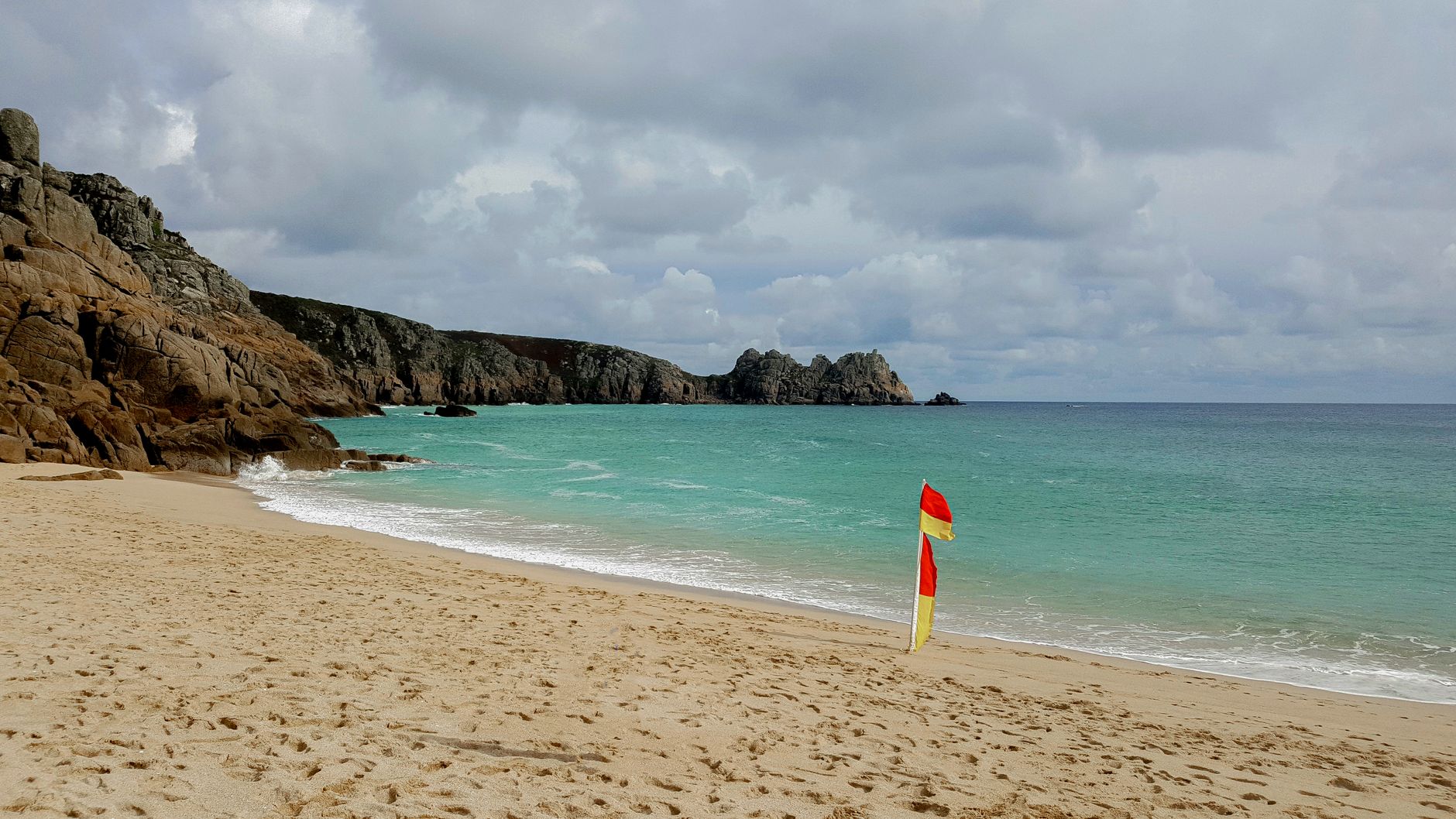
Pick up a handful of sand at Porthcurno and look closely. It isn’t really sand in the usual sense: it’s crushed shell, ground down by the sea into pale gold grains that squeak underfoot and reflect the light back up through the water. That’s why the sea here looks the colour it does — a clear, improbable turquoise that has people checking their phone to make sure they’re still in England.
Porthcurno beach sits at the bottom of a steep granite valley on the south coast of the Penwith peninsula, a few miles east of Land’s End and about nine miles from Penzance. It’s small, it’s busy in summer, and it’s surrounded by an unusual amount to do: the Minack Theatre carved into the cliff above, the famous low-tide lagoon at Pedn Vounder round the corner, the rocking stone of Logan Rock on the headland beyond, and a museum telling the story of how this tiny cove became the hub of the world’s telegraph network. This guide covers all of it, along with the practical things: parking, the walk down, lifeguards, tides, dogs and swimming.
Porthcurno beach at a glance
- What it is: a sheltered cove of shell sand between granite cliffs, with turquoise water on sunny days.
- Parking: a pay car park at the bottom of the valley, not run by the National Trust; ANPR cameras, pay on exit.
- Access: about 250 metres on an unsurfaced path, then steep steps or a sandy slope onto the beach.
- Lifeguards: RNLI patrols from mid-May to the last weekend of September.
- Dogs: banned 10am to 6pm from 1 July to 31 August; allowed the rest of the time.
- Best for: swimming on calm days, photographs, and a full day combining the beach with the Minack and the coast path.
Parking at Porthcurno
The main car park is at the bottom of the valley, a short walk from the beach. It is not run by the National Trust, so members don’t park free here: entry and exit are logged by ANPR cameras and you pay on the way out. Tariffs change from season to season, so check the board at the entrance rather than relying on anything you read online, this page included.
In summer it fills fast. On a sunny day in the school holidays, expect it to be full by mid-morning, and don’t try to squeeze onto the verges of the narrow lane down to it; there’s nowhere legal to stop, and blocking the road here causes chaos for the buses. If you’re heading for Pedn Vounder or the Logan Rock rather than Porthcurno itself, the small car park in the village of Treen is the better starting point. The Minack has its own car park further up the hill, but it’s limited and busy on performance days, and it’s there for theatre visitors.
The stress-free option in summer is the bus. Services run from Penzance to Porthcurno, including the seasonal open-top Land’s End Coaster, which turns the journey into part of the day out. Check Transport for Cornwall for current times, and see our guide to getting around Cornwall without a car for the wider network.
Getting down to the beach
From the car park it’s about 250 metres along an unsurfaced path to the top of the beach, where you drop onto the sand by a set of steep steps or a sandy slope either side of the lifeguard hut. It’s easy enough for most people, but awkward with a pushchair and not suitable for wheelchairs. Near the top of the beach you’ll pass a small, solid-looking hut, which is where the undersea telegraph cables once came ashore. More on that below.

Swimming, lifeguards and safety
On a calm, sunny day, swimming at Porthcurno is spectacular: clear water, pale sand beneath you and granite cliffs rising on either side. It’s also a beach that deserves respect. The sand shelves quickly, so the water gets deep fast, and when there’s any swell the waves can break hard right at the water’s edge, knocking people off their feet on the way in and out. Currents can pull strongly around the edges of the cove.
The good news is that Porthcurno is a lifeguarded beach, with RNLI patrols from mid-May to the last weekend of September. Swim between the red and yellow flags, keep children close even in the shallows, and if the lifeguards have put the red flag up, stay out. Outside the patrol season there’s no cover, and the beach can look deceptively gentle from the top of the steps. The water stays cold for most of the year, too — around 16°C at its warmest in September — so a wetsuit makes a long swim more comfortable. Our Cornwall beach safety guide explains the flags, rip currents and what to do if you get into trouble.
Tides
Porthcurno changes a lot with the tide. At low water the beach widens dramatically and joins up with the neighbouring coves, and you can walk round the rocks to Pedn Vounder. At high water the sand shrinks considerably, especially on spring tides, and the routes between coves close off. If you’re planning to walk round to Pedn Vounder along the shore, check a tide table first and leave yourself plenty of time to come back; it’s a place where people get cut off every summer.
Dogs at Porthcurno
Porthcurno has a council seasonal dog ban: no dogs on the beach between 10am and 6pm from 1 July to 31 August. Before 10am and after 6pm in those months, and at any time from September to June, dogs are welcome. Neighbouring Pedn Vounder and Porthchapel have no council dog ban, though both involve steep and rocky access that isn’t suitable for every dog. For more beaches where dogs are allowed all summer, see our guide to dog-friendly beaches in Cornwall.
Pedn Vounder: the low-tide lagoon
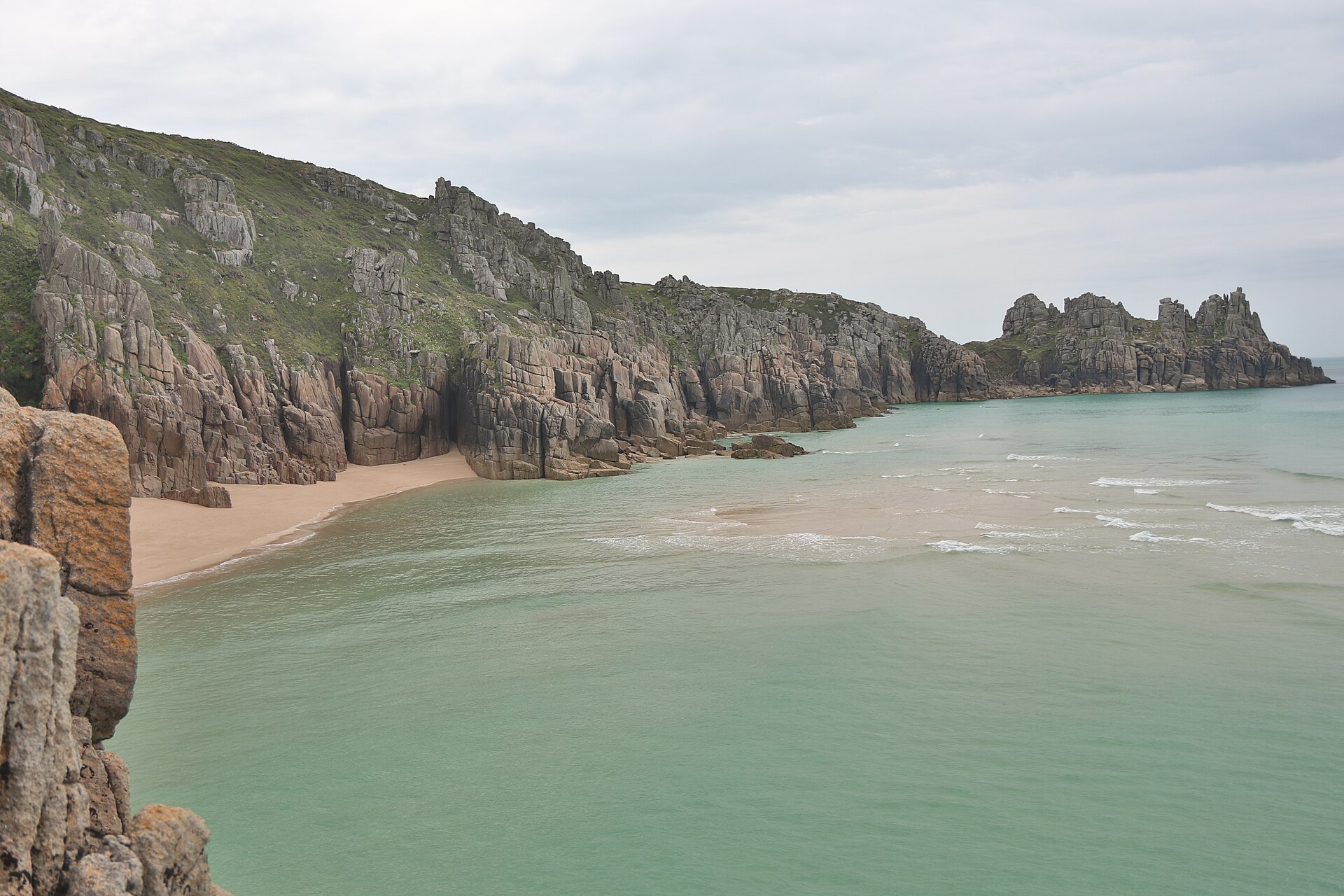
If you’ve seen a photograph of Cornwall that looks like the Caribbean, there’s a good chance it was Pedn Vounder. Just east of Porthcurno, below the cliffs towards the Logan Rock, it only really exists at low tide, when the retreating sea leaves a long sandbar enclosing a shallow lagoon of astonishingly blue water. At high tide it all but disappears.
The honest truth about Pedn Vounder is that the famous view is from the top, and getting to the bottom is not a walk but a scramble. The path from the coast path down to the beach is steep, rocky and eroded, with sections where you’ll need your hands. It’s not suitable for small children, dogs that don’t like climbing, or anyone unsteady on their feet, and it’s far harder going back up. There are no lifeguards, no facilities, and at low water the sandbar can be cut off as the tide turns. It also has a long tradition as a clothing-optional beach, which is worth knowing before you arrive with the family.
For most visitors, the best way to enjoy Pedn Vounder is to walk the coast path east from Porthcurno or west from Treen and admire it from the clifftop, ideally around low tide on a sunny day, when the colours are at their most ridiculous. Our round-up of hidden and secret beaches in Cornwall covers more coves like it.
Logan Rock and Treryn Dinas
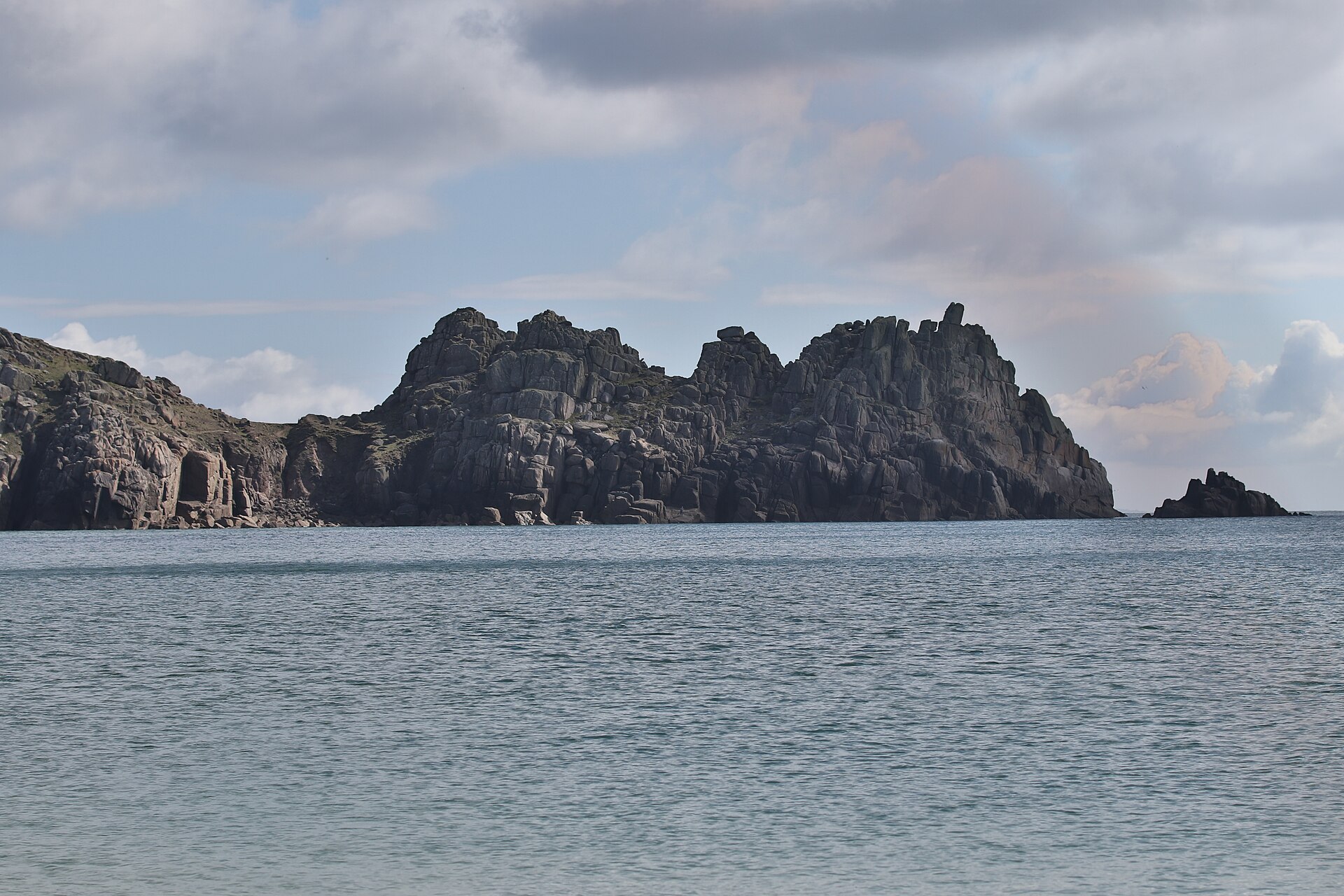
The dramatic headland at the far end of Pedn Vounder is Treryn Dinas, an Iron Age cliff castle whose ramparts are still visible across the neck of the promontory. Balanced among the granite pinnacles is the Logan Rock, a huge rocking stone once so finely poised that a gentle push would set it moving. In 1824 a naval lieutenant, Hugh Goldsmith, and his crew levered it off its perch to disprove the claim that no human force could shift it. The local outcry was such that he was made to put it back at his own expense, which he did with a great deal of effort and borrowed equipment. It has never rocked quite as freely since.
From Porthcurno it’s a walk of around half an hour along the coast path to the headland, past the clifftop above Pedn Vounder. The final scramble onto the rocks themselves is exposed, so take care, and don’t attempt it in wind or wet. The village of Treen, inland from the headland, has the Logan Inn for a pint afterwards and the clifftop campsite at Treen Farm, with views from the Lizard towards Scilly.
The Minack Theatre above the beach
High on the western cliff above the beach is the Minack Theatre, an open-air amphitheatre built into the granite with the sea as its backdrop. It’s the work of Rowena Cade, who bought the headland in the 1920s and built the theatre largely by hand with her gardener, Billy Rawlings, working through the winters for decades. The first production, The Tempest, was staged here in 1932 on a grassy ledge lit by car headlamps.
Today it runs a summer season of plays, musicals and concerts, and when no performance or rehearsal is on, it opens for daytime visits to the auditorium, the subtropical cliff gardens and the exhibition about Rowena Cade. Popular shows sell out well ahead, so book through the Minack’s own website as soon as the season is announced. Our full Minack Theatre guide covers tickets, seating, what to bring and how to plan an evening performance.
You can walk up to the Minack from the beach, but be warned: the path from the sand to the theatre is very steep, climbing the cliff in a series of rough steps. It’s a short climb with a fabulous view, and it will find out exactly how fit you are. If you’re not keen, drive or walk up the lane to the theatre’s entrance instead.

PK Porthcurno: the cove that wired the world
It seems unlikely now, but this tiny cove was once one of the most important communications hubs on the planet. From 1870, Porthcurno was the landing point for the undersea telegraph cable linking Britain to India, and over the following decades more and more cables came ashore here until it was one of the largest cable stations in the world, with messages from across the British Empire passing through the valley. During the Second World War, the operation was moved into tunnels dug into the hillside to protect it from bombing.
PK Porthcurno, the museum in the old cable station buildings, tells the story, including the wartime tunnels, and it’s a genuinely fascinating place to spend a couple of hours, especially on a wet day when the beach is off the menu. Check its current opening days and prices before you go, as they vary through the year.
Porthchapel and St Levan
West of the Minack, a short walk along the coast path, is Porthchapel, a small sandy cove reached down a steep path from the hamlet of St Levan. It’s quieter than Porthcurno, has no lifeguards and no council dog ban, and is lovely at low tide on a calm day. The church at St Levan is worth a look on the way: in the churchyard is a split boulder known as St Levan’s Stone, and local legend says that when the crack is wide enough for a packhorse to ride through, the world will end. It hasn’t happened yet.
When to visit Porthcurno
Early and late, whatever the season. In July and August, arriving before 10am gets you a parking space and a beach with room to spare; by the afternoon, the valley is full. May, June and September are the best months overall: the water is at its clearest, the lifeguards are on duty (the patrol runs until the last weekend of September), and the crowds are far thinner. September has the added bonus of the warmest sea of the year.
Winter has its own appeal. On a clear, cold day with a big swell running, Porthcurno is wild and nearly empty, the waves exploding against the granite. Just keep well back from the water’s edge, because this is a beach where the sea comes up the sand fast.
Where to stay near Porthcurno
Penzance is the obvious base, with the widest choice of B&Bs, restaurants and the main-line railway station; Porthcurno is an easy drive or bus ride away, and our Penzance guide covers the town itself. For something closer and quieter, the villages of the Penwith peninsula — Treen, St Buryan, Sennen and the hamlets in between — have B&Bs, farmhouses and cottages, and staying locally means you can walk down to the beach in the early morning or the long summer evenings, when the day visitors have gone. Book early for July and August and for Minack show nights, when rooms nearby are in short supply.
Porthcurno pairs naturally with other beaches in the far west. If you’re touring the best of the south coast, Kynance Cove on the Lizard, about an hour’s drive east, is the other great turquoise-water cove in this part of Cornwall. For the full round-up, see our guide to the best beaches in Cornwall.
Frequently Asked Questions
Is Porthcurno beach worth visiting?
Yes. It’s one of the most beautiful beaches in Cornwall, with shell sand, turquoise water and the Minack Theatre on the cliff above. Go early or late in summer to avoid the crowds, and combine it with the coast path to Pedn Vounder and the Logan Rock.
How much is parking at Porthcurno?
The car park at the bottom of the valley isn’t run by the National Trust. It uses ANPR cameras and you pay when you leave; tariffs change seasonally, so check the board at the entrance. It fills early in summer, so arrive before mid-morning or come by bus.
Is Porthcurno beach lifeguarded?
Yes, the RNLI patrols the beach from mid-May to the last weekend of September. Swim between the red and yellow flags; the beach shelves steeply and waves can break hard at the shoreline.
Are dogs allowed on Porthcurno beach?
Not between 10am and 6pm from 1 July to 31 August. Outside those hours, and from September to June, dogs are allowed. Nearby Pedn Vounder and Porthchapel have no council dog ban.
How do you get to Pedn Vounder beach?
Walk the coast path east from Porthcurno or west from Treen. The final descent to the sand is a steep, rocky scramble that isn’t suitable for young children or anyone unsteady, and the beach only really appears at low tide. Many visitors enjoy the view from the clifftop instead.
Can you walk from Porthcurno beach to the Minack Theatre?
Yes, a steep path climbs from the beach to the theatre. It’s short but very steep, with rough steps; if that doesn’t appeal, use the lane up to the theatre entrance instead.
Can you get to Porthcurno by bus?
Yes. Buses run from Penzance to Porthcurno, including the seasonal open-top Land’s End Coaster. Check Transport for Cornwall for current routes and times.
Porthcurno is small enough to see in an hour and interesting enough to fill a whole day: a swim in that turquoise water, a climb to the Minack, a walk to the Logan Rock and back, and an evening on the sand once the car park empties. Plan around the crowds and the tide, and it’s as good as Cornwall gets.
Porthcurno is a swimmer’s beach; for surf, head to the north coast. Our Fistral Beach guide covers Cornwall’s most famous surfing beach, from lessons at South Fistral to the big-wave Cribbar.
Round the corner from Land’s End, Sennen Cove is the far west’s best surf beach. Our Sennen Cove and Gwenver guide covers the surf, lifeguards, parking and the clifftop walk to Land’s End.
Photo credits: Pedn Vounder: Pedn Vounder in the winter.jpg by Kernow Skies, CC BY-SA 3.0 (licence). Treryn Dinas and the Logan Rock: Logan Rock Treen Cornwall.jpg by Cyr~commonswiki, CC BY-SA 3.0 (licence).