
Learning to surf in Cornwall is the right way to start surfing in Britain. The county has the best beach breaks in the UK, the largest concentration of accredited surf schools, an established lifeguard infrastructure, and warm enough water in summer that the first lesson doesn’t feel like cold-water exposure therapy. After a decade of pointing guests at lessons and watching them come back grinning, I’ve come to think that the question isn’t whether to learn here but where to learn, when to come, and how to choose between the dozens of schools competing for your business. This learn to surf Cornwall guide is the practical answer.
I’ll cover the seventeen surf schools genuinely worth your money in 2026 with verified prices, the beaches that work for beginners (and the ones that don’t), what to expect in your first lesson, the safety basics that nobody teaches you well, and the surf-and-stay packages that bundle accommodation with a learn-to-surf week. Our wider Cornwall water sports and surfing guide is the parent piece, and our best surfing beaches in Cornwall guide covers the wider beach picture.
Why Cornwall Is the Right Place to Learn to Surf
The simple answer is consistency. Cornwall sits on the south-western tip of England, exposed to the full Atlantic, which means the swell windows are reliable for most of the year. The north coast — from Bude in the north to Sennen in the west — picks up almost every Atlantic groundswell, while the dozens of beaches break in slightly different ways depending on wind direction and tide. There’s always somewhere working.
The deeper answer is infrastructure. Cornwall has been the UK’s surf capital since the 1960s. The British Surfing Association, Surfing England (the national governing body), and the International Surfing Association all operate accreditation schemes that Cornish schools have signed up to. Lifeguards are on the major learner beaches from Easter through to early November. The water is warm enough by July (peaks at sixteen to eighteen degrees in late August) that beginners aren’t fighting hypothermia in their first hour.
And the lessons are properly good. The English school system has produced enough qualified surf coaches that small group lessons run six-to-eight students with one instructor, which is the right ratio for beginners. The two-hour group lesson at around forty pounds per person is one of the best-value introduction-to-a-sport experiences in British tourism.
The Best Beginner Surf Beaches in Cornwall
Polzeath
Possibly the gentlest learner beach in Cornwall. Slow-breaking, rolling waves on a wide sandy bottom, with the bay shelter taking the worst of the swell out of the equation. Lifeguarded in summer. Multiple surf schools run lessons on the sand. The right choice for absolute first-timers and families. The downside is that it’s busy in school holidays.
Harlyn Bay
The Padstow-area learner beach. One of the safest north-coast beaches for beginners — sheltered crescent shape, gentle sand-bottom waves, lifeguarded. Crucially, Harlyn works in offshore easterly and south-easterly wind conditions when most north-coast beaches are blown out, which makes it the right choice in winter and shoulder seasons. Harlyn Surf School has been operating here since 1994 and was named Best Surf School on the North Cornish Coast by the Sunday Times.
South Fistral, Newquay
The sheltered south end of the famous Fistral Beach, separate in character from the steep North Fistral that the experienced surfers ride. South Fistral is forgiving, manageable, busy with surf schools. Mid-tide is the sweet spot. The Cribbar — Newquay’s big-wave reef — sits offshore but only breaks a few days a year on heavy winter swells, so don’t worry about meeting it during a beginner lesson.
Towan Beach, Newquay
The town beach of Newquay, more sheltered than Fistral, with the Island House on its little rock in the middle of the beach. Several surf schools use Towan for absolute-first-time lessons because the wave is so manageable.
Watergate Bay
Two miles of beach four miles north of Newquay. The crowd disperses; the wave is consistent; multiple surf schools operate. Watergate Bay Hotel runs partnership lessons. Excellent for week-long surf holidays where you want a long beach to yourself.
Crantock
Across the Gannel estuary south of Newquay. Quieter than Fistral, gentle sandy bottom, dog-friendly. Watch the rip at the river mouth (heed the signs). One of the better quiet alternatives for nervous first-timers.
Widemouth Bay, Bude
The main learner beach for the north Cornwall coast above Padstow. Sand bottom, lifeguarded, multiple surf schools (Raven Surf School is based here). Slightly bigger waves than Polzeath on average; suits the second or third lesson better than the absolute first.
Summerleaze, Bude
The Bude town beach. Big Blue Surf School runs lessons here. Slightly more sheltered than Widemouth; the Bude Sea Pool sits at the northern end which doubles the beach’s family appeal.
Sennen Cove
The most westerly surf beach on mainland Britain. On smaller days the southern end is gentle enough for beginners; on bigger swells the whole bay can be unsurfable. Sennen Surfing Centre runs lessons.
Gwithian and Godrevy
Long sandy beach west of Hayle. Variable wave size on the same day depending on which break you choose. Gwithian Academy of Surfing has ASI accreditation (one of only three schools in Britain with this) and is the under-the-radar pick for a high-quality lesson.
Perranporth
Three miles of sandy beach with rolling beginner waves. The Watering Hole pub on the sand is the post-lesson lunch. Multiple surf schools operate.
Praa Sands
The south-coast alternative. Mostly flat in summer but works when the wind shifts to north or north-east and the north coast becomes unsurfable. Global Boarders has a base here alongside their main Gwithian operation.
Porthmeor, St Ives
The St Ives surf beach. North-facing, sheltered from prevailing south-westerlies, clean and glassy on small days. Lifeguarded. St Ives Surf School operates here.
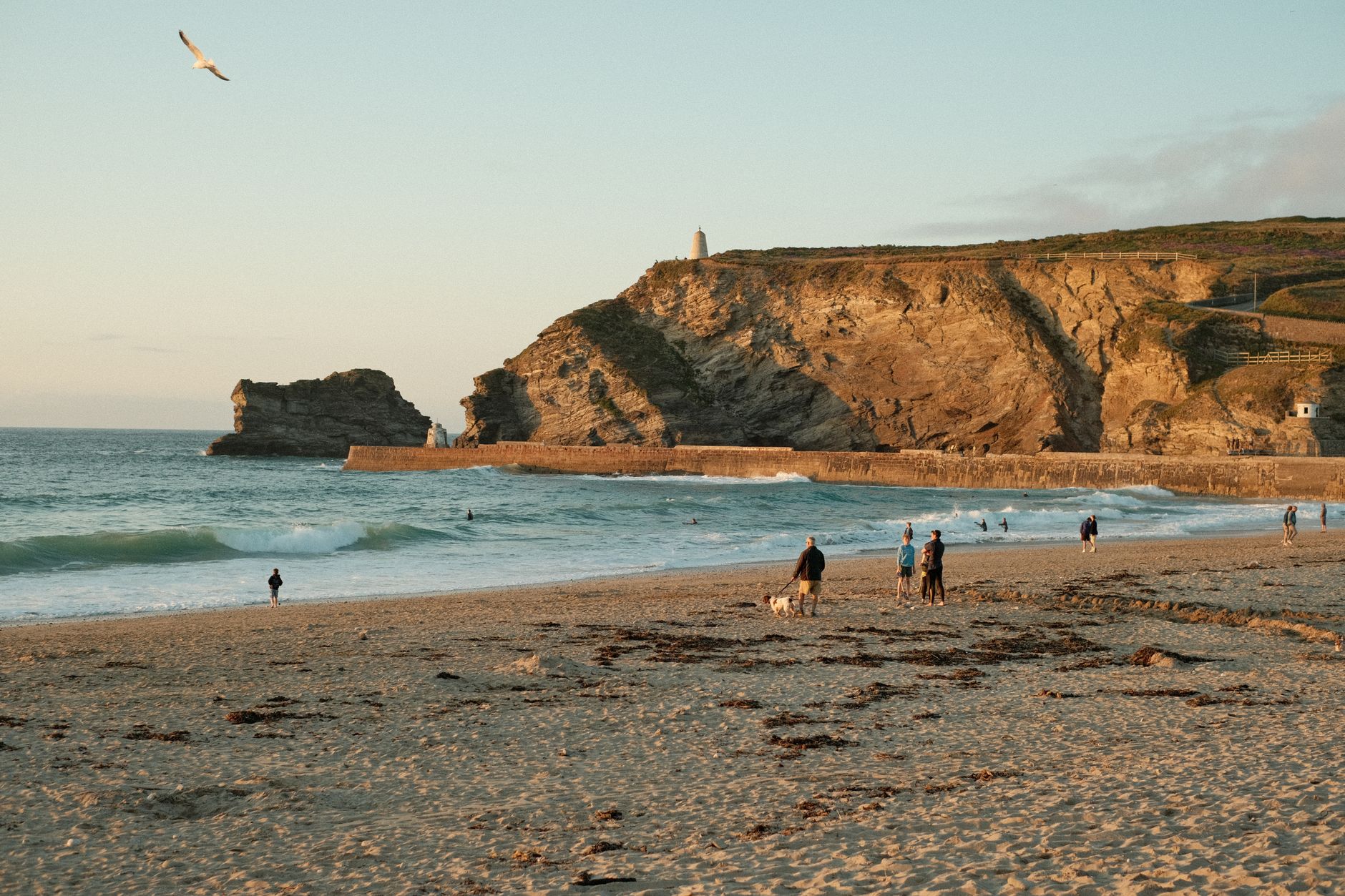
Once you have found your feet, the best surfing beaches in Cornwall covers the whole coast by ability, and Cornwall surfing conditions by season explains when each break actually works.
The Seventeen Surf Schools Genuinely Worth Your Money
The verified 2026 directory. Group lessons are typically two hours including kit (board and wetsuit). Private lessons are one-to-one with rates given as “first person plus per additional person.”
Harlyn Surf School (Harlyn Bay, near Padstow) — Established 1994. Sunday Times Best Surf School on the North Cornish Coast. All instructors lifeguard-qualified. Group lessons from £45, private from £100. Strong winter offer because Harlyn works in offshore easterly winds. harlynsurfschool.co.uk.
Quiksilver Surf School (Fistral, Newquay) — ISA Centre of Excellence. Established 2002. Group from £40, private from £110. Provides full winter kit (gloves, boots, hoods) for cold-water learners.
Escape Surf School (Newquay) — Two ex-professional surfers on the coaching team. Long-running Newquay independent. Group from £40, private from £110. Runs surf-and-stay partnership with St Christopher’s Inn.
Cornish Wave (Towan and Fistral, Newquay) — Established 2012. Group lessons from £40, private from £110, family from £199 (two adults plus two children). Runs surf-and-stay packages May to September.
Fistral Beach Surf School (Fistral, Newquay) — On-beach school at the Fistral Beach Hotel. Group from £35-40, private from £100.
George’s Surf School (Polzeath, Constantine and Harlyn) — ISA Centre of Excellence. Private-only specialists. Private from £100 first person, additional persons at incremental rates.
Big Blue Surf School (Summerleaze, Bude) — Twenty-plus years running, the established Bude operator. Group from £40, private from £100.
Raven Surf School (Widemouth Bay, Bude) — Founded by Mike Raven, former English, British and European Surfing Champion. ASI Level 4 Master Coach. Group from £40, private from £100. The serious-coaching pick if you want to learn properly.
Outdoor Adventure (Bude) — Multi-activity centre including surf. Group from £40, private from £100.
Surf’s Up! Polzeath — Polzeath specialists, twenty-five-plus years running. Group from £40, private from £100.
Wavehunters (Polzeath and Watergate Bay) — Established 2002. One of the UK’s biggest surf school operations. Lessons run at 10am, 12pm, 2pm and 4pm in season. Group from £40, private from £100. Runs official partnership with Watergate Bay Hotel.
Newquay Activity Centre (Newquay) — Multi-activity centre. Transparent 2026 pricing on website. Group lessons within typical bracket.
Smart Surf School (Watergate Bay) — Family-focused. Group from £45, private from £100.
Cornish Surfing (North Cornwall) — Private-lesson specialists. Private from £150 first person plus £35 each additional person. The premium-coaching pick.
Sennen Surfing Centre (Sennen Cove) — Most westerly surf school in Britain. Group from £40, private from £100.
Global Boarders (Praa Sands and Gwithian) — Two-coast operation. Family lessons from £50 per person, private family from £195 (minimum 3). Boys’ and girls’ summer surf camps return for 2026.
Gwithian Academy of Surfing (Gwithian Towans) — ASI-accredited (one of only three in Britain). All coaches are surf coach plus lifeguard plus first-aider qualified. First lesson £45, subsequent lessons stepped down to £40, £35, then £30. Private from £135. The under-the-radar gold standard.
What to Expect in Your First Lesson
The standard two-hour group lesson runs to a familiar pattern. You’ll arrive at the school’s beach base thirty minutes before the lesson start, change into the school’s wetsuit (bring a swimsuit underneath), and meet the instructor on the sand. The first thirty minutes is land-based — beach safety, identifying rip currents, lying on the board, the pop-up movement, basic etiquette.
The next forty-five minutes is in the whitewater — the area between the breaking waves and the shore, where the water is already broken up by the wave further out. The instructor pushes you onto small waves, you try to stand up, you fall off, you try again. Most beginners stand up at least once in their first lesson — sometimes for one second, sometimes for ten. The progression is fast at this stage.
The last thirty minutes is more whitewater practice. The instructor will start to point at small unbroken waves further out and encourage you to try paddling for them. Some students paddle out into the green water. Most stay in the whitewater and refine the pop-up.
You’ll come out cold, exhausted, slightly euphoric, and almost certainly with sand inside your wetsuit. The wetsuit and board go back to the school. Most students do a second lesson within the same week.
Surf Safety You Won’t Get Properly From the Lesson
Most surf schools cover safety in five minutes at the start of the lesson and then move on. The version worth taking home:
Right of way. The surfer closest to the peak of the wave (the highest, breaking part) has priority. Don’t drop in on someone else’s wave. Don’t paddle around people to take priority (“snaking”). Apologise if you cause a collision. The Cornish surf community is mostly relaxed but they punish bad etiquette with serious side-eye.
Rip currents. Strong seaward channels at up to five miles per hour. Spot them via darker patches between waves, fewer breaking waves in a strip, foamy discoloured water moving outward. If you get caught in one, do not swim against it — you’ll exhaust yourself. Swim parallel to the beach until you’re out of the current, then swim back to shore. The RNLI’s “Float to Live” advice is the right backup: lean back, extend arms and legs, float for 60-90 seconds until the cold-shock response passes.
Lifeguarded zones. The RNLI flags the surf-friendly zone (black and white flags) and the swim-only zone (red and yellow flags). Surfers should stay between black and white. Swimmers between red and yellow. Don’t surf the swim zone; don’t swim the surf zone.
Cold water. Even in August, the Cornish sea is sixteen to eighteen degrees. Cold shock is a real risk if you enter water below fifteen degrees without acclimatisation. Wetsuit thickness matters: three-two for summer, four-three for spring and autumn, five-four with boots/gloves/hood for winter.

Read this alongside our Cornwall beach safety guide, which covers rip currents, flags and tide states in far more depth.
What to Wear and Bring
The school provides: a soft-top surfboard (much safer than a hard board for beginners), a wetsuit (typically three-two in summer, four-three shoulder seasons, five-four winter), and a leash that attaches you to the board.
You bring: a swimsuit (women — one-piece or bikini; men — trunks or swim shorts; no underwear, ever). A towel. Drinking water. A snack for after. Sunscreen — waterproof and reef-safe ideally — for the inevitable post-lesson sunburn risk.
Optional but useful: a changing robe (the Dryrobe brand is the obvious one but many cheaper alternatives now exist) for getting out of the wetsuit privately on a busy beach. Flip-flops for the walk to and from the car park.
Schools include board and wetsuit in the lesson price, but once you are going out alone see water sports equipment hire in Cornwall for rental rates and what is worth buying instead.
The Best Months for Beginners
May, June and September are the sweet spots. The waves are smaller and friendlier than the autumn-winter swells; the water is warm enough to be comfortable (May fifteen degrees, June sixteen, September sixteen to seventeen, October still around fifteen); the crowds are thinner than peak summer; and lifeguards are on duty through to the end of September. September often gets cited as the best single month — the water has the summer warmth still locked in, the wave quality picks up as autumn weather systems start pushing groundswells across the Atlantic, and the school-holiday crowds have evaporated.
July and August are still good for absolute first-timers but the waves are smaller (often one-to-two foot only) and the crowds in Newquay and Polzeath are at their peak.
April and October are colder but the waves are better. Suitable for second or third lessons if you’ve already done one in summer.
November to March is winter — five-four wetsuits, boots, gloves, hoods. Only attempt beginner lessons if you’re already comfortable with cold-water immersion. Harlyn is the best winter beginner beach because of its offshore-wind aspect.
Surf-and-Stay Packages
The Cornish surf school scene has produced a strong network of accommodation-plus-lesson packages. The ones worth knowing:
Escape Surf School plus St Christopher’s Inn (Newquay) — Two nights plus two lessons from around £60 per person. The cheap entry-level option.
Cornish Wave — Weekend camps May to September, longer stays in summer. Combines accommodation, lessons, and group meals.
Gwithian Academy of Surfing plus Prosper House campsite — Camping-plus-lessons package on the Gwithian Towans.
Star Surf Camps — Five-day, four-night bell-tent campsite near Newquay with daily surf instruction.
Vellandreath Cornish Cottages (Sennen) — Surfer-focused cottage accommodation in Sennen Cove.
Elemental Surf Lodge — Dedicated surf lodge with on-site instruction.
Watergate Bay Hotel — Partnered with Wavehunters for guest surf lessons.
Fistral Beach Hotel — Quiksilver Surf School is on site.
For our wider take on B&Bs and cottages, see the Cornwall B&B guide.
How Long Does It Take to Learn?
The honest answer: standing on whitewater takes one lesson for most adults. Riding unbroken waves (the green-water surfing that looks like proper surfing in the photographs) takes a season of regular practice — eight to ten lessons or equivalent self-practice days. Reaching intermediate level where you can pick lines and trim across a wave face takes one to two years of regular surfing.
For most holiday visitors, the realistic ambition is two or three lessons across a week, by the end of which you’ll be standing on whitewater consistently and starting to read the wave. That’s enough to feel like you’ve genuinely surfed and enough to make you want to come back.
Surf Etiquette Glossary
The vocabulary worth knowing before your first lesson:
Whitewater — The broken, foamy part of the wave between where it first breaks and the shore. Where beginners surf.
Green water — The unbroken face of the wave. Where intermediate surfers ride.
Pop-up — The standing-up movement from lying on the board to standing on it. The single most important beginner skill.
Drop-in — When someone takes off on a wave that another surfer is already riding. The cardinal sin.
Snaking — Paddling around another surfer to claim priority on a wave. Frowned upon.
Set — A group of larger waves that come through together. Usually three to five waves with a gap between sets.
Line-up — The area where surfers wait for waves, beyond the breaking zone.
Offshore — Wind blowing from land to sea. Holds waves up; produces clean conditions. Cornwall’s north coast wants easterly or south-easterly offshore.
Onshore — Wind from sea to land. Breaks waves up; produces messy, choppy conditions.
Cross-shore — Wind blowing parallel to the beach. Can be workable; not ideal.
Frequently Asked Questions
Is Cornwall good for learning to surf? Yes — the UK’s surf capital, with the largest concentration of accredited surf schools, sheltered learner beaches and lifeguard infrastructure.
How much does a surf lesson cost in Cornwall? Group lessons £30-45 per person; private lessons £100-150 plus per-person extras; family lessons £150-210.
How long does it take to learn to surf? Standing on whitewater within one lesson; riding unbroken waves takes around eight to ten lessons; intermediate level one to two years of regular surfing.
What is the best surf school in Cornwall? Sunday Times named Harlyn Surf School as best on the north coast; ISA Centres of Excellence include Quiksilver and George’s; Gwithian Academy is one of only three ASI-accredited in Britain. Raven Surf School at Widemouth is the serious-coaching pick.
What month is best to learn to surf in Cornwall? May, June and September. September is often the single best month — warm water still, smaller crowds, lifeguards still on duty, autumn wave quality picking up.
Do I need a wetsuit to surf in Cornwall? Yes, year-round. Schools provide one. Summer three-two; spring/autumn four-three; winter five-four with boots, gloves and hood.
What should I wear under a wetsuit? A swimsuit. No underwear (it gets in the way and gets sandy).
Is Fistral Beach good for beginners? South Fistral (the sheltered end) is fine for beginners. North Fistral and the Cribbar break offshore are advanced.
Can children learn to surf in Cornwall? Yes — most schools take from age five upwards, some from age seven. Family lessons and kids’ summer camps are widely available.
Do I need to know how to swim? Yes — schools require beginners to be confident swimmers in open water.
If Newquay is your base, read our Fistral Beach guide before your first lesson. It explains why the sheltered south end suits beginners, how the tides and winds change the bay, and where to park, eat and hire kit.
Cornwall’s surf school scene is mature, well-regulated and genuinely good. Book a two-hour group lesson at Harlyn, Polzeath or Watergate. Come in May, June or September. Bring a swimsuit, a towel and the right attitude. Stand up on a wave at least once. You’ll come back next year wanting to do it properly.