The South West Coast Path is Britain’s longest National Trail at 630 miles, running from Minehead in Somerset round to Poole in Dorset. The Cornish section is the longest part of it, covering more than 300 miles of coastline from Marsland Mouth in the north to Cremyll on the Tamar in the south east. Walking it — in sections, in stages, or end to end — is one of the great long-distance walking experiences in Europe, and one of the very best ways to see Cornwall.
This guide to the South West Coast Path Cornwall covers the entire Cornish coast path: every section, the difficulty grading, the highlights, the accommodation hubs, and the practical advice you need to plan a multi-day or section-walking trip. Whether you have one day, one week, or a full thru-hike in mind, this guide will help you make sense of it.
The South West Coast Path in Numbers
- Total length: 630 miles (1,014 km).
- Cornish section: approximately 300 miles.
- Total ascent of the full path: 35,000 m (more than four times Mount Everest).
- Time to walk Cornwall fully: 25–35 days for an average walker.
- Best months: late April to early October.
- Recommended map series: OS Explorer 102, 103, 104, 105, 106, 107.
How the Cornish Coast Path Is Structured
The official guide divides the SWCP into 52 sections, each roughly a day’s walk. The Cornwall portion runs from approximately section 17 (Marsland Mouth) to section 41 (Cremyll). For practical visitors, it is easier to think of Cornwall in larger regional sections:
1. North Cornwall: Marsland Mouth to Boscastle (35 miles)
Wild, dramatic, and the most challenging part of the entire SWCP. Hartland Quay’s slate-fold cliffs, Bude beaches, Crackington Haven, Boscastle harbour. Multiple steep ups and downs; not for first-timers without preparation.
2. Boscastle to Padstow (40 miles)
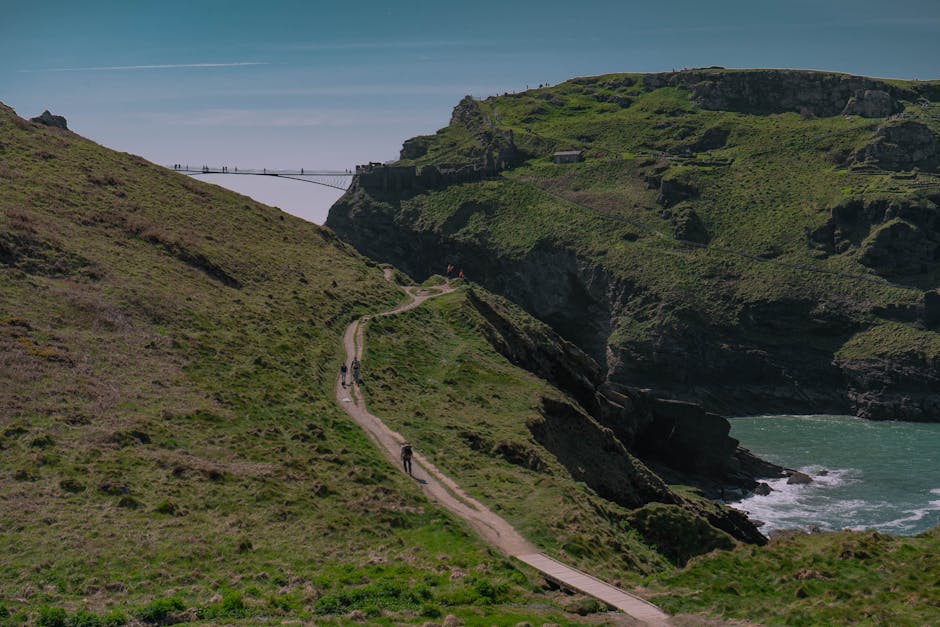
Tintagel Castle, Bossiney and Benoath Coves, Trebarwith Strand, Port Isaac, Pentire Head, Polzeath, the Camel Estuary into Padstow. Dramatic but more manageable than the Devon-border section.
3. Padstow to Newquay (25 miles)
Trevone, Trevose Head lighthouse, Constantine Bay, Bedruthan Steps, Mawgan Porth, Watergate Bay. Rolling coastal walking with frequent cafe stops; one of the friendliest sections.
4. Newquay to St Ives (35 miles)
Crantock, Holywell Bay, Perranporth, St Agnes Head, Chapel Porth, Porthtowan, Portreath, Godrevy, Hayle Towans, into St Ives. Mining heritage and surf beaches; good infrastructure.
5. St Ives to Land’s End to Penzance (35 miles)
The wildest, most remote section of Cornwall’s coast path. St Ives to Zennor (the Coffin Path) is famously demanding. Bosigran Castle, Pendeen Watch, Botallack engine houses, Cape Cornwall, Sennen Cove, Land’s End, Mousehole. Several steep climbs; isolated.
6. Penzance to Lizard Point (45 miles)
Marazion (with St Michael’s Mount across the bay), Praa Sands, Porthleven, Mullion Cove, Kynance Cove, Lizard Point. Mixed terrain; the Lizard’s serpentine cliffs are unique.
7. Lizard Point to Falmouth (40 miles)
Cadgwith, Coverack, the Helford River (with a ferry crossing), Maenporth, Falmouth town. Sheltered south coast; gentler than the north.
8. Falmouth to Polperro (45 miles)
Pendennis Castle, ferry to St Mawes, Roseland Peninsula, Mevagissey, Charlestown, Fowey (with ferry crossing to Polruan), Polperro. Some of Cornwall’s gentlest coast walking.
9. Polperro to Cremyll (Plymouth) (25 miles)
Looe, Whitsand Bay, Rame Head, Mount Edgcumbe, ferry to Plymouth at Cremyll. The final Cornish section; quieter and less famous.
Highlights of the Cornwall Coast Path
For Drama
Hartland Quay’s slate folds, Tintagel Castle, the cliffs at Pentire Point, Bedruthan Steps, the Botallack engine houses, the Lizard cliffs, Kynance Cove.
For Beaches
Sandymouth, Polzeath, Watergate Bay, Bedruthan, Sennen, Porthcurno, Pedn Vounder, Marazion, Kynance, Pendower, Lansallos.
For History
Tintagel Castle, the UNESCO Cornish Mining sites (Botallack, Levant, Geevor), St Michael’s Mount, Pendennis Castle, Charlestown’s preserved harbour.
For Wildlife
Mutton Cove (grey seals), Pentire Head (peregrines), Hayle Estuary (waders), Lizard cliffs (choughs), the dolphins and porpoises commonly visible from headlands.
For Solitude
Marsland Mouth to Crackington Haven, St Ives to Zennor, the Roseland’s smaller bays, the section from Polperro to Looe.
Difficulty: Which Sections Are Hardest?
- Hardest: Marsland Mouth to Bude (Devon border), St Ives to Zennor (the Coffin Path).
- Hard: Bude to Boscastle, Tintagel to Port Isaac, the Lizard’s western cliffs.
- Moderate: Padstow to Newquay, Newquay to Perranporth, Coverack to Helford, Looe to Polperro.
- Easier: Falmouth to Maenporth, Roseland gentler sections, Mount Edgcumbe to Cremyll.
Walking the Cornwall Coast Path: Practical Options
Day Walks
The most common approach for visitors. Pick a section that returns to your starting point or links by bus. Examples:
- Lizard Point to Kynance Cove and back (4 miles, 2 hours).
- St Ives to Zennor and bus back (6 miles, 4 hours).
- Tintagel to Boscastle and bus back (5 miles, 3 hours).
- Polruan to Polperro and ferry back (6 miles, 4 hours).
Multi-Day Walks (3–7 nights)
The classic visitor’s coast path holiday. Recommended segments:
- Padstow to St Ives (5–7 days) — varied, cafe-rich, surf-beach end-to-end.
- Falmouth to Lizard Point (4 days) — quieter, with the Helford ferry highlight.
- St Ives to Penzance (3–4 days) — wild, photogenic, with Sennen and Land’s End in the middle.
End-to-End Cornwall (25–35 days)
Possible from late April to early October. Best done with a self-guided walking holiday operator (Macs Adventure, Contours, Absolute Escapes) for accommodation and luggage transfer, or independently with careful planning.
Self-Guided vs Tour Operator
Operators handle accommodation and luggage transfer for £80–£130 per night per person. Independent planning costs less but requires booking each B&B yourself.
Accommodation on the Cornwall Coast Path
Most coast-path villages have B&Bs and small hotels. Key overnight stops include Bude, Boscastle, Tintagel, Port Isaac, Padstow, Newquay, Perranporth, St Agnes, St Ives, Zennor (the Tinners Arms), Sennen, Land’s End, Mousehole, Penzance, Marazion, Praa Sands, Porthleven, Mullion, Lizard, Cadgwith, Coverack, Helford, Falmouth, St Mawes, Mevagissey, Charlestown, Fowey, Polperro, Looe, Cremyll. Book ahead in summer.
For B&B options, see our Cornwall B&B guide.
Coast Path Logistics
Luggage Transfer
Several Cornish operators (Luggage Transfers Cornwall, the SWCP Association partners) move bags between B&Bs for £10–£15 per bag per day. Worth it for multi-day walks.
Public Transport
The First Kernow A-route buses link many coast-path villages along both coasts. Useful for “walk one way, bus back” days.
Ferries on the Path
The path requires several ferries:
- Padstow to Rock (Camel Estuary).
- Helford to Helford Passage (south coast).
- St Mawes to Falmouth (or onward).
- Fowey to Polruan.
- Cremyll to Plymouth (the eastern terminus).
Most run frequently in summer; check timetables for autumn and winter.
Maps and GPS
OS Explorer 102, 103, 104, 105, 106, 107 cover Cornwall. The OS Maps app or paper Explorer maps are reliable. The official SWCP guidebook has section-by-section descriptions.
What to Pack for the Cornwall Coast Path
- Waterproof jacket and trousers.
- Sturdy walking boots or trail runners.
- Daypack (20–30L for day walks, larger if not using luggage transfer).
- Layers — Cornish weather changes hour to hour.
- Sun cream and a hat (UV is strong on exposed cliffs).
- Water bottle (1L minimum).
- Map and compass (or charged phone with offline maps).
- First-aid kit including blister treatment.
- Walking poles for the steeper sections.
- Swimwear (you will pass at least three places you wish you had it).
See our Cornwall walking packing list.
Best Time of Year for the Cornwall Coast Path
- April–May: wildflowers at peak, fewer crowds, longer days. Cool sea but excellent walking.
- June–early July: warmer, daylight maximised, schools still in.
- Mid-September–October: best mix of warm sea, quieter trails, and stable weather.
- November–March: dramatic, but reduced bus services and B&B closures. Suit experienced walkers.
Common Coast Path Mistakes
- Underestimating the elevation. The cliff-up-and-down pattern is exhausting.
- Walking too far per day. 12 miles in Cornwall is more than 12 miles in flatter terrain.
- Not booking ahead in summer. Coast-path B&Bs sell out months in advance.
- Skipping the maps. GPS phones run out of battery; carry a paper backup.
- Ignoring weather forecasts. Storms can make sections genuinely dangerous.
Where to Stay for Coast Path Holidays
Most B&Bs along the coast welcome walkers and offer drying rooms, packed lunches, and early breakfasts on request. For specific bases, see our coastal sea-view B&Bs guide.
FAQs: South West Coast Path Cornwall
How long does it take to walk the Cornwall coast path?
End-to-end takes 25–35 days for an average walker. Most visitors walk in sections — a long weekend or a 5–7 day segment is realistic.
Is the Cornwall coast path hard?
It is hilly. Daily ascent regularly tops 600m on harder sections. Most fit walkers manage 8–12 miles a day with a packed lunch and rest stops.
Is the South West Coast Path waymarked?
Yes — acorn symbols mark the route at every major junction.
What’s the best section of the Cornwall coast path?
For first-timers: Padstow to Newquay or Lizard Point to Kynance. For drama: Hartland to Bude or Botallack to Sennen. For tranquility: the Roseland Peninsula.
Where can I camp on the Cornwall coast path?
Wild camping is technically not allowed. Designated campsites are spaced along the path; use the SWCP Association website to find them.
Can you walk the Cornwall coast path with a dog?
Yes — and most Cornish B&Bs welcome dogs. Some sections have stiles requiring small dogs to be lifted; many beaches have summer restrictions. See our dog-friendly Cornwall B&Bs guide.
The South West Coast Path is the single greatest asset of a Cornwall holiday for anyone who likes walking. You can dip into it for an hour or commit to a month; both are rewarding. Plan well, pace yourself, and the path will deliver some of the finest coastal walking in the world.