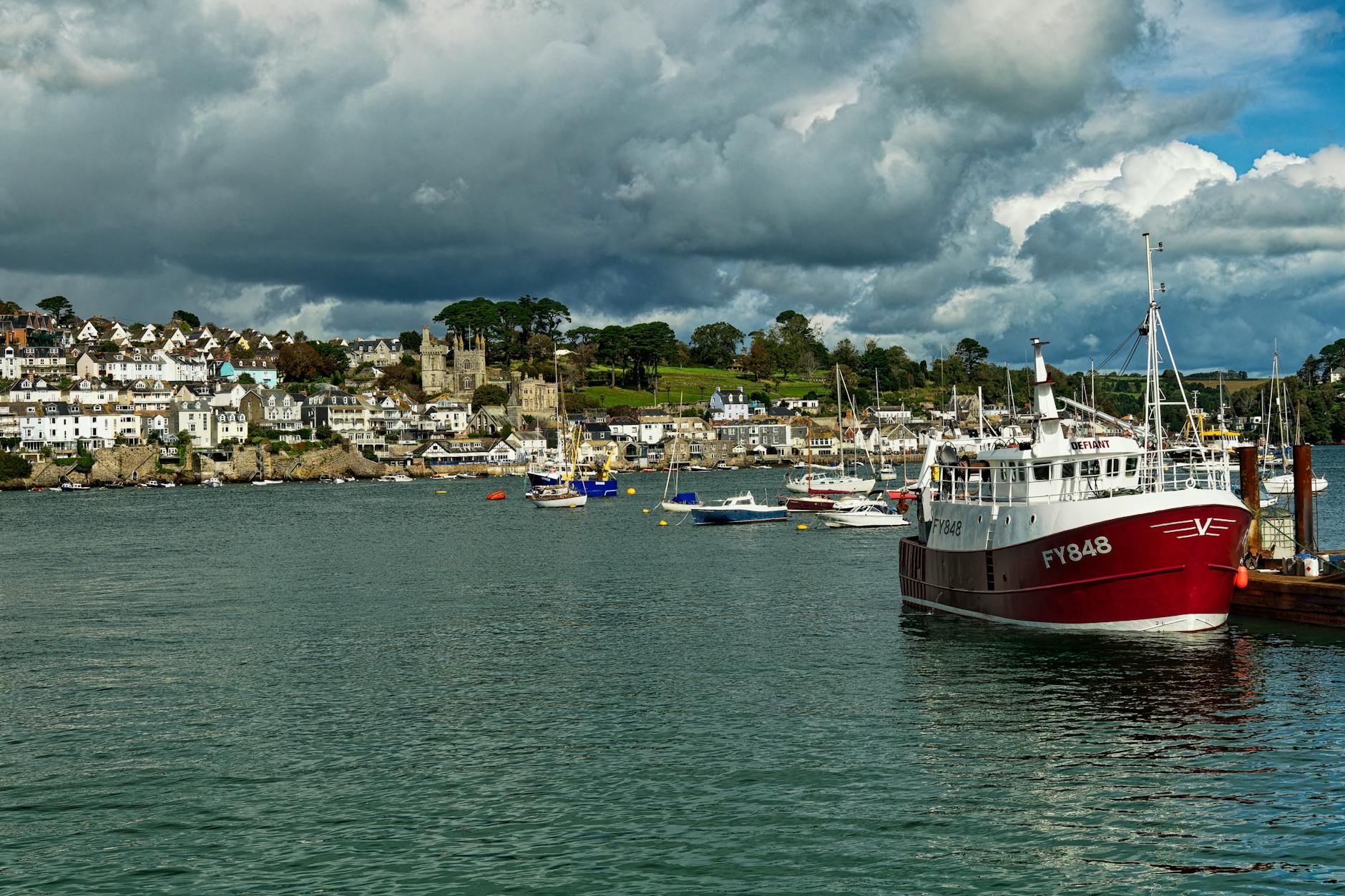
Fowey and the Roseland Peninsula are Cornwall’s secret quarter. They sit on the south coast either side of the Fal estuary, share a sub-tropical microclimate, and have been quietly less visited than the bigger names on the north coast for as long as anyone can remember. The Atlantic-facing crowds that pour into Padstow and St Ives every summer mostly bypass this quieter, gentler stretch of Cornwall — which is its own argument for going. The lanes here run out at water’s edges. The light is softer. The fishing villages are smaller and less polished. The literary heritage is deeper than anywhere else in the county. This Fowey Cornwall guide makes the case for the two-base south-coast trip that almost nobody plans.
Daphne du Maurier lived here for forty years. Fowey was her town; Menabilly, the house she leased from the Rashleigh family from 1943 to 1969, was the inspiration for Manderley in Rebecca. The Hall Walk, the four-mile circular crossing both the Polruan passenger ferry and the Bodinnick chain ferry, is one of the oldest documented visitor walks in Britain — described by Richard Carew in 1585. Across the Fal on the Roseland, Sir John Betjeman called St Just-in-Roseland the most beautiful churchyard on earth. Two Henrician castles, three working ferries, gardens by the dozen, and a fishing-village ratio per square mile that beats most of the north coast. The wider context is in our Cornwall towns and villages guide.
Why Fowey and Roseland Together
This part of Cornwall divides naturally into two halves by a single estuary — the Fal and Carrick Roads — but the character of both halves is the same. Sub-tropical, sheltered, river-and-creek dominated, gentler than the Atlantic coast, with smaller villages and fewer “destinations” in the conventional sense. Both halves reward visitors who slow down and explore by ferry rather than by car.
Fowey sits on the western shore of the Fowey estuary on the south-east-leaning side, eight miles east of St Austell. Polruan is across the water. The Roseland Peninsula sits further south-west, between the Fal estuary and the open Atlantic, more or less an island in terms of how it feels, with St Mawes its main village. The drive between them takes around an hour and a half via the King Harry Ferry across the Fal. The two together make an excellent week-long south-coast Cornish holiday — base in Fowey for the first half, on the Roseland for the second, or vice versa.
Fowey Town: Harbour, Esplanade, Fore Street
Fowey is small and walkable. The town runs along the western shore of the estuary for about half a mile, with Fore Street as the spine — independent shops, no chains, the kind of high street that has barely changed in decades. Fowey Aquarium is on Town Quay, small and independent. Fowey Museum is on Trafalgar Square at the top of town, £1 admission, with Daphne du Maurier exhibits and D-Day material (Fowey was a launch point for American forces in the run-up to D-Day in 1944).
The Esplanade runs south from the harbour with the colourful terraced houses you’ll have seen in photographs. The two main ferry quays — Town Quay and Whitehouse Quay — both depart from the central harbour. Tarquin’s, the Cornish gin distillery, has a tasting room on Fore Street. Bookends of Fowey is the bookshop. Kittows the butchers does the best pasties in town for a quiet morning takeaway.
St Fimbarrus Church, at the top of Fore Street, is one of those overlooked Cornish parish churches that rewards a visit. Built around 1336, rebuilt and extended in 1465 under the Earl of Warwick “the Kingmaker” — the ragged-staff Warwick symbol on the west tower dates from 1471. Saint Fimbarrus is likely St Finnbarr, the Irish missionary and first Bishop of Cork; the church is a reminder that Fowey was once a major maritime link to Ireland and beyond.
Place House, behind the church, has been the Treffry family seat since the thirteenth century. The story to know: in 1456 a French raiding party attacked and burned much of the town. Elizabeth Treffry — whose husband was away — is said to have defended Place by pouring molten lead over the attackers from the battlements. The original fifteenth-century tower still stands. The house is not generally open to the public but the gardens are visible from the street.
Daphne du Maurier’s Fowey
Daphne du Maurier’s connection to Fowey is the deepest literary tie of any Cornish town. She first stayed at Ferryside, the Du Maurier family’s house at Bodinnick on the eastern bank of the estuary, in 1926. Ferryside is still owned by the family (her son Kits still lives there) and remains a private home; you can see the house from the river or from the Bodinnick slipway.
The house that mattered most to her was Menabilly, a few miles west of Fowey on the coast above Polridmouth Cove. Du Maurier first encountered Menabilly by trespassing through the grounds in 1927 — the house was then owned by the Rashleigh family and largely abandoned. She tried for years to lease it and finally succeeded in 1943, living there until 1969. Menabilly inspired Manderley in Rebecca (1938) — the famous opening “Last night I dreamt I went to Manderley again” comes directly from her 1927 trespass and her years-long obsession with the house. My Cousin Rachel (1951) and The King’s General (1946, about the English Civil War defence of the house) are also Menabilly stories.
Menabilly is still privately owned and not open to the public. You cannot visit the house. What you can do is walk the coast path past it — the path runs through the woods below Menabilly between Readymoney Cove and Polridmouth Cove, and on to the Gribbin Head daymark beyond. The trees and the creeks and the views are exactly what Du Maurier knew. Fowey Museum has a small Du Maurier exhibition. The annual Fowey Festival of Arts and Literature (covered below) is in May.
Readymoney Cove and St Catherine’s Castle
Readymoney Cove is the town beach of Fowey. A twenty-minute walk south from the harbour through the streets and along the Esplanade, ending at a small sandy cove with a café, toilets and parking for a handful of cars. The name comes from “Mundy” — mineral house — and the eighteenth-century pilchard cellars built behind the beach. It’s sheltered, family-friendly, and the obvious afternoon swimming spot from Fowey.
From Readymoney, a short walk up through the woods brings you to St Catherine’s Castle, the small Tudor coastal fort built by Thomas Treffry in 1538-40 under Henry VIII’s coastal defence “device” programme. D-shaped, with five gun-ports, the castle was re-used during the Crimean War in 1855 and again in the Second World War. It’s an English Heritage site with free entry. Note: the castle was closed for renovation works as of April 2026 — check the EH website before visiting.
The Ferries: Polruan, Bodinnick, and the Hall Walk
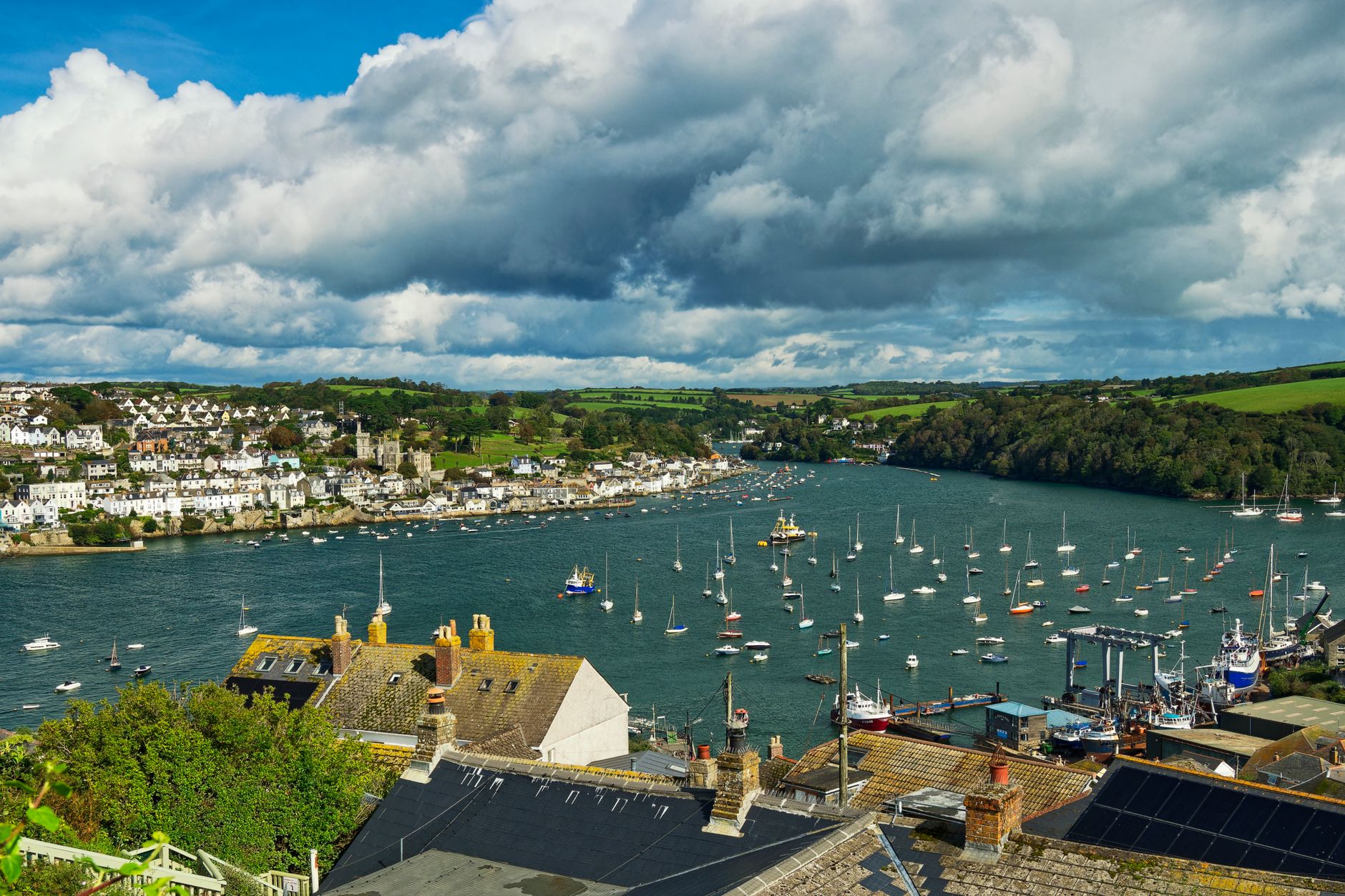
Two ferries cross the Fowey estuary. Both are essential to a Fowey visit and both are operated by the same family firm, C Toms & Son, who have run them for generations.
The Polruan passenger ferry runs every ten to fifteen minutes from Fowey Town Quay or Whitehouse Pier to Polruan Quay on the opposite shore. 2026 fares: £3.20 adult one-way; under 5s free. From May to August the ferry runs late into the evening, up to 23:00. Journey time under five minutes.
The Bodinnick chain car ferry is the only car crossing of the lower Fowey, running 07:00 to 19:00 daily (weekdays 07:05-18:55). The boat is a chain ferry that pulls itself across the river along submerged chains; it carries up to fifteen cars plus motorhomes, bikes and small lorries up to ten tonnes. 2026 fares from £6.20 per car. Operates year-round except 25-26 December and 1 January (with foot-passenger service on Boxing Day and New Year’s Day).
The Hall Walk is the four-mile circular walk that uses both ferries to close the loop. From Fowey: take the Polruan ferry, walk up Polruan Hill, head out along the coast and creek path through Pont Pill, walk through the woods to Bodinnick, take the Bodinnick chain ferry back to Fowey. The path is described by the Cornish historian Richard Carew in 1585, who calls it “cut out in the side of a steepe hill…evenly levelled, to serve for bowling, floored with sand.” That means it’s one of the oldest documented promenade-style visitor walks in Britain. The route was given to the National Trust by the Shackerly family as a memorial to Sir Arthur Quiller-Couch (“Q”, another Fowey literary giant) and the local fallen of the Second World War. Allow three hours including ferry waits.
Coast Walks West: Gribbin Head and Polkerris
From Readymoney Cove, the coast path heads west along the cliffs through Coombe Hawn, past Polridmouth Cove (Du Maurier territory), up to Gribbin Head — capped by the 84-foot red-and-white striped daymark tower built in 1832 to help shipping distinguish Fowey from the more dangerous neighbouring estuaries. The Gribbin daymark is National Trust owned and you can climb to its base for some of the best views on the south Cornish coast.
Continue west and the path drops down to Polkerris, a small sandy cove with the Rashleigh Inn (a proper old Cornish pub on the beach). Around five miles each way from Fowey. The energetic loop is to return via the Saints Way, the inland medieval pilgrim route, making a seven-mile circuit.
Eating in Fowey
Sam’s Fowey on Fore Street is the town’s casual favourite — fish-and-chips, burgers, day-boat seafood, lively atmosphere, no bookings, queue at the door in summer. The Fowey Restaurant at the Old Quay House is the destination-dinner option, with a terrace overlooking the estuary and the kind of careful seafood-led cooking that’s earned it Michelin Guide listings. Havener’s on the harbour is the St Austell Brewery-owned harbour-front restaurant — reliable, scenic, the brewery’s local ale on tap. Samphire, on Esplanade, does modern Cornish with strong fish. North Street Kitchen earned a Michelin Bib Gourmand in 2025 for its seafood-sharing-plates approach. The Galleon Inn, in a four-hundred-year-old warehouse building, is the pub with the best Esplanade-side terrace.
Fowey’s Festivals: Du Maurier and Regatta Week
Two annual events define Fowey’s calendar.
The Fowey Festival of Arts and Literature (commonly known as the Du Maurier Festival) runs 1-9 May 2026. Author talks, walks (including Du Maurier walks to Menabilly’s grounds), music, theatre. The 2026 programme is themed around her After Midnight short story collection.
The Fowey Royal Regatta and Carnival Week runs 16-22 August 2026. Yacht racing, pilot gig racing, the harbour swim, fireworks over the estuary, a classic car parade (20 August), live music. Running since 1819, one of the oldest continuous regattas in Britain.
Crossing to the Roseland
From Fowey, the drive to St Mawes on the Roseland is around an hour and a half via St Austell, Truro and the King Harry Ferry (a small chain car ferry across the Fal that saves a thirty-minute detour). The alternative route via Tregony adds twenty minutes but avoids the King Harry. Either way, the geography changes as you cross. You leave the Fowey side of Cornwall and enter Roseland — flatter, more pastoral, lanes lined with trees and farmhouses, and a settled stillness that the working Fowey side doesn’t quite have.
St Mawes: The Roseland’s Capital
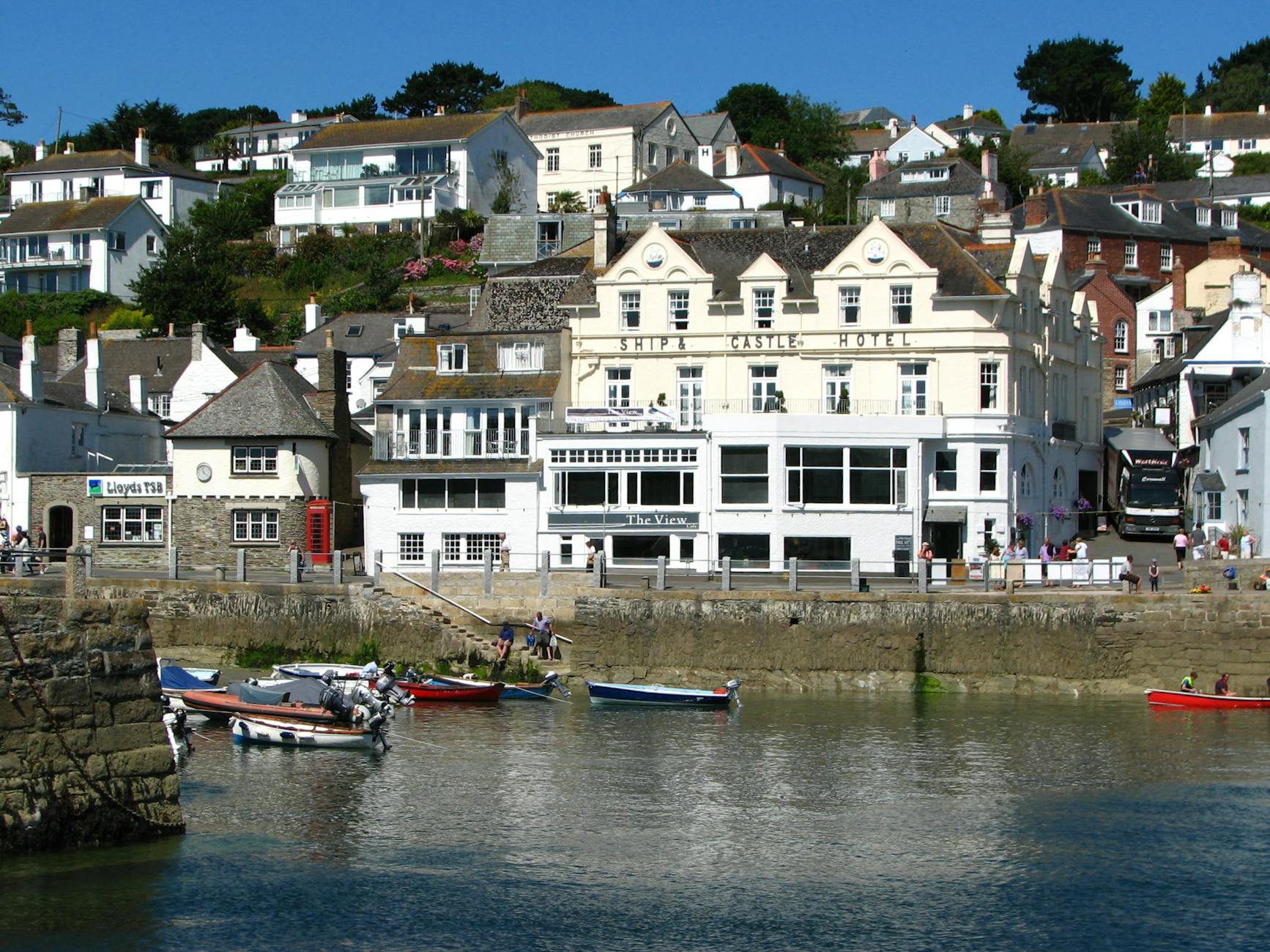
St Mawes sits on the eastern shore of Carrick Roads, looking across at Falmouth and Pendennis Castle a mile across the water. The village is small — a single curve of harbour-front with pastel cottages climbing the slope behind — and intensely beautiful in the gentle way the Roseland is beautiful. Sailing is the dominant local activity; the harbour fills with boats from May through October.
The eating is excellent for a village this size. The Idle Rocks Hotel has an oyster bar and wine terrace overlooking the harbour, the prime sunset spot. St Mawes Seafood Bar is the takeaway option. The Rising Sun is the harbour pub. Hotel Tresanton is the small luxury hotel with a serious restaurant; it’s owned by the Polizzi family and has been a destination since the 1990s. Hotel Tresanton also runs the twenty-five-seat St Mawes Hidden Cinema, a cult attraction screening films most nights.
Lamorran House Gardens, on Upper Castle Road, is the Italianate sub-tropical garden with sea views — small, intense, beautifully kept, open seasonally.
St Mawes Castle
St Mawes Castle, on the headland just outside the village, is Henry VIII’s best-preserved coastal artillery fort. Built between 1540 and 1545 as the sister to Pendennis across the water, it has a unique clover-leaf plan — three rounded bastions arranged around a central tower, with the design optimised for the most efficient possible artillery coverage of the Carrick Roads.
2026 opening: daily 10am-5pm from 28 March to 24 October; 10am-4pm from 25 October to 1 November; closed 2 November to 16 March. Additional opening days on 29-30 March 2026. 2026/27 prices: Super Saver £8.50 adult / £4.25 child (Friday-Saturday shoulder seasons); Saver £9.26 / £4.59 (Sunday-Thursday shoulder, Friday-Saturday peak); Standard £10.79 / £5.35 (Sunday-Thursday 23 May-31 August). English Heritage members free. Allow ninety minutes for a proper visit.
St Mawes Ferries: Three Crossings
St Mawes has its own ferry network. The Falmouth-St Mawes Ferry (covered in detail in our Falmouth guide) is the year-round connection across Carrick Roads. The Place Ferry runs from St Mawes to Place (a tiny landing on the southern tip of the Roseland) seasonally from 1 April to end October. The Place ferry runs up to seven days a week from 09:15 Monday to Saturday, last sailing around 17:45, with a ten-minute crossing. Card only on board; operated by St Mawes Harbour (01326 270553). Weather-dependent.
The Place Ferry is the gateway to St Anthony Head, the southern tip of the Roseland. From Place a short coast path walk leads around the headland to the lighthouse and the National Trust car park (so you can walk in and bus or taxi back). St Anthony Head lighthouse was built in 1835 by James Walker, with a fixed white light marking the entrance to Falmouth harbour. The military history of the headland goes back to 1796 — the first French Wars artillery position — and was rebuilt in 1904 as a coastal fort with two six-inch breech-loading guns over a magazine. The fort was bought by the National Trust in 1959 and has been gradually restored. The Roseland NT website covers the full walks network.
St Just in Roseland: The Most Beautiful Churchyard
St Just in Roseland Church sits on a tidal creek a mile north of St Mawes. The church is thirteenth century. The churchyard is what people come for. Sir John Betjeman, the Poet Laureate, called it “the most beautiful churchyard on earth,” and Betjeman knew his churchyards. The setting is everything — the church sits in a small natural amphitheatre, with sub-tropical planting falling down to the water, palms and tree ferns and bamboo where you’d expect yew and oak. The sub-tropical planting was the work of John Treseder, a nineteenth-century Cornish gardener who brought Australian seeds back including the Western Red Cedars that still grow there.
Free to visit. One of Cornwall’s most visited churches and rightly so. Quieter early morning and late afternoon.
Roseland Coastal Villages: Portloe, Portscatho, Porthcurnick
The east side of the Roseland has a series of small fishing villages and beach coves that are among the most under-visited in Cornwall.
Portloe (covered in our fishing villages guide) is the postcard tiny pilchard cove. The Lugger Hotel is the village’s anchor.
Portscatho sits on Gerrans Bay, east-facing and sheltered, with a small working harbour and a beach café that does crab sandwiches. Galleries and small shops; quieter than St Mawes by miles.
Porthcurnick Beach, just north of Portscatho, is the home of The Hidden Hut — the beach café that has become one of Cornwall’s destination dining experiences. By day it’s a sand-side café doing locally sourced lunches. By evening, on roughly three to four nights a month in summer, it runs Feast Nights — one-pot fire-cooked dishes, BYO plates and cutlery and wine, run by chef Simon Stallard. Tickets release midday on the first of each month via Eventbrite and sell out in minutes. Locals run WhatsApp groups to coordinate the booking hit. Don’t plan a Cornish holiday around a Feast Night until you’ve secured tickets.
Nearby Gardens: Heligan and Caerhays
The Roseland sits within reach of two of Cornwall’s most important spring gardens.
The Lost Gardens of Heligan are around twenty minutes from Fowey via Mevagissey. Open daily from 10am to 6pm in May 2026, with last entry at 4.30pm. The Sleeping Mud Maid sculpture, the Jungle valley, the restored productive vegetable gardens. Pre-book online for the best prices; check current admission rates on the Heligan website before visiting.
Caerhays Castle and Gardens are on the south coast just east of the Roseland. The gardens are strictly seasonal: 2 March to 14 June 2026 only. This is a real trap for visitors — the gardens are world-famous for their spring magnolias, camellias and rhododendrons, but if you arrive in July you’ll find them shut. Castle guided tours run weekdays 2 March to 13 June at 11.30am, 1pm and 2.30pm, lasting 45 minutes. 2026 prices: Castle & Gardens £25 adult / £10 child; Gardens only £13.50 / £5; under-5s free.
Eden Project is about thirty minutes from Fowey via St Austell — covered in its own dedicated guide.
Where to Stay in Fowey and the Roseland
Fowey: The Old Quay House is the most prestigious in-town hotel. The Fowey Hotel sits on the hill above the harbour with the grandest views in town. Cormorant Hotel at Golant, a mile up the river, is the quieter waterside option. B&Bs and small guesthouses on Fore Street and the Esplanade give you walking access to the harbour.
Roseland: Hotel Tresanton in St Mawes is the destination luxury hotel. The Idle Rocks is its main contender. The Lugger Hotel in Portloe is the rural-coastal version. Self-catering cottages across the Roseland are abundant and book up by January for summer.
For more on B&Bs in the area, our Cornwall B&B guide covers the wider region.
Frequently Asked Questions
Is Fowey worth visiting? Yes — particularly if you value literary heritage, quiet harbours and Du Maurier connections.
How long should I spend in Fowey? Two to three days for the town and immediate area; a week if combining with the Roseland.
Can you drive into Fowey town centre? The streets are narrow and most parking is on the outskirts. Paid car parks above the town are the standard option.
How do you get from Fowey to Polruan? The passenger ferry, every 10-15 minutes, £3.20 adult one-way.
How much is the Bodinnick ferry? From £6.20 per car, 07:00-19:00 daily.
What is the Hall Walk in Fowey? A four-mile circular crossing both ferries — Polruan up Polruan Hill, around the coast and creek path to Pont Pill, through woods to Bodinnick, ferry back to Fowey. Three hours allowing for ferry waits.
Where did Daphne du Maurier live in Fowey? Ferryside in Bodinnick (the family house) and Menabilly (the rented house, 1943-1969) which inspired Manderley.
Can you visit Menabilly? No — it’s a private home and not open to the public. You can walk the coast path past it.
Is Fowey or Padstow better? Fowey is quieter, more literary, south coast. Padstow is busier, more food-focused, north coast. Different rather than better.
What is the Roseland Peninsula known for? Quiet sub-tropical beauty, St Mawes Castle, St Just-in-Roseland church, the Hidden Hut feasts.
Where is the most beautiful church in Cornwall? St Just-in-Roseland, per Betjeman.
How do you book the Hidden Hut feast nights? Eventbrite at midday on the first of each month. Sells out in minutes.
When do Caerhays Castle gardens open? 2 March to 14 June 2026 only. Closed the rest of the year.
Fowey and the Roseland are the south-coast secret of Cornwall. Walk the Hall Walk on a Tuesday morning. Sit at the Idle Rocks at sunset. Find Betjeman’s churchyard at St Just. Try for a Hidden Hut feast if the calendar lines up. You’ll have the version of Cornwall the magazines forget to mention.