Penzance is the Cornish town that everyone goes through and that fewer than they should actually stop to know. The Night Riviera from London terminates here. The Scilly Isles ferry leaves from here. The road runs out a few miles further west at Land’s End. For most visitors, Penzance is a fifteen-minute walk between the station and a hire car, and that’s a shame, because the town that gets passed through has Cornwall’s only Art Deco geothermal lido, the canonical collection of the Newlyn School painters, the strangest single street in the West Country, and the best base in Cornwall for a serious explore of the far west. This Penzance Cornwall guide is the case for stopping.
If you’ve been told St Ives is the West Cornwall destination, you’ve been told a partial truth. St Ives is the polished version. Penzance is the working version, less postcard-perfect, much cheaper, and arguably more rewarding for a few days’ base. Condé Nast Traveller called Penzance “Cornwall’s coolest seaside town” a few years back. National Geographic ranked it as one of the best beach towns in the UK. Most visitors arrive expecting to be underwhelmed and leave wondering why they hadn’t stayed here from the start. The wider context is in our Cornwall towns and villages guide.
Why Penzance Gets Overlooked (and Why It Shouldn’t)
The reason Penzance gets overlooked is geographic and historic. The town sits at the western end of the GWR main line, which means anyone arriving by train arrives here and then leaves for somewhere prettier — Marazion for St Michael’s Mount, Mousehole for the Christmas lights, St Ives for the art. The pretty places are all under twenty minutes away by bus or car, and the town itself ends up being treated as the loading bay.
The reason it shouldn’t get overlooked is that Penzance has all the things that would make any other town a destination. The Jubilee Pool, an Art Deco lido from 1935 that added a geothermal heated section in 2020 (the only one of its kind in the UK), sits on Battery Rocks at the eastern edge of the promenade. The Newlyn School painters — Walter Langley from 1882, Stanhope Forbes from 1884, Elizabeth Forbes, Lamorna Birch, Harold and Laura Knight — based themselves in Newlyn next door, and the canonical collection of their work is in the Penlee House Gallery and Museum behind Morrab Gardens. Chapel Street, which runs from the Egyptian House at one end to the Admiral Benbow at the other, is a few hundred yards of architectural eccentricity that you wouldn’t find anywhere else in Britain. And the town is the launchpad for the Scilly Isles, with not one but three different ways to get there.
The other quiet truth about Penzance is that it’s where Cornish culture is at its strongest. Penwith was the last redoubt of the Cornish language in the eighteenth and nineteenth centuries. The Cornish language revival, the Cornish music scene, the Cornish identity politics that has produced the Cornish national flag and the campaign for minority status — much of this is rooted in the Penzance hinterland. “Penzance” is itself Cornish — Pen Sans, the holy headland.
Getting to Penzance
Penzance is the terminus of the Great Western main line, three hundred and twenty-six and a half miles from London Paddington and the southernmost mainline station in Britain. Direct trains run from London Paddington (around five and a half hours daytime; the Night Riviera sleeper takes longer but means you arrive rested at 8am). From Bristol, around four hours. The station sits next to the harbour and the bus station, so onward connections to the rest of West Cornwall are straightforward.
By car, the A30 dual carriageway runs to St Erth just north of Penzance, then the A30 single carriageway continues to the town. Parking in town is straightforward by Cornish standards — the Wharfside multi-storey is the main town-centre car park, with various smaller options around the harbour and the promenade.
The Jubilee Pool: The UK’s Only Geothermal Lido
The Jubilee Pool opened in 1935, a triangular Art Deco lido built into Battery Rocks at the eastern end of Penzance Promenade. It survived decades of decline and a major storm-damage rebuild in 2014. In 2020 it became something genuinely unique in the British Isles: alongside the existing seawater pool, a smaller geothermal pool was added, heated by a borehole drilled into the Cornish granite below the lido. The geothermal water comes up at thirty degrees Celsius and the pool is held at twenty-eight to thirty.
The 2026 season runs from 31 March to 1 November. The geothermal pool is open Tuesday to Sunday 10am-5pm, extending to seven days during the school summer holidays and bank holidays. Sessions are fifty-five minutes long, and you can pre-book online — and you should, because they sell out daily in summer. The sea pool is included in the geothermal ticket. Penzance residents get a 20-40% discount depending on the ticket. This is the rare attraction that genuinely lives up to the photographs — swim in twenty-eight-degree water with the open sea five feet away and the silhouette of St Michael’s Mount across the bay.
Penlee House Gallery and Museum
Penlee House sits in the trees behind Morrab Gardens, a Victorian merchant’s house turned into the town’s main gallery and museum. The permanent collection is the canonical body of work from the Newlyn School painters, including Stanhope Forbes’s Fish Sale on a Cornish Beach, Walter Langley’s elegiac watercolours of Newlyn fisherfolk, Elizabeth Forbes’s School is Out, Norman Garstin’s The Rain it Raineth Every Day, and Lamorna Birch’s later landscapes.
The Newlyn painters worked from around 1882 onwards, taking their cues from the French plein air movement and from the realism of Bastien-Lepage. Stanhope Forbes — who became known as the “father” of the Newlyn School — opened the Forbes School of Painting in Newlyn in 1899, and through it taught the next generation: Alfred Munnings, Harold Knight, Laura Knight, Dod Procter, Ernest Procter. The Newlyn movement parallels the better-known St Ives School in time but pre-dates it; the Newlyn painters were here first. Penlee House is the place to understand that.
Open Monday to Saturday (closed Sundays). Summer hours (1 April-31 October) are 10am-5pm with last admission at 4.30pm; winter hours 10am-4.30pm with last admission at 4pm. Admission is around £6-8 for non-residents; free for Penzance Pass holders, Friends of Penlee House, and Art Fund members. The café in the gardens is a lovely Penzance secret.
Chapel Street: The Strangest Street in the West Country
Chapel Street runs from Market Jew Street at the top of town down to the harbour, and it is the most architecturally eccentric stretch of road in Cornwall. At the top is the Egyptian House at 6-7 Chapel Street, built in 1835 by the architect John Foulston for the mineralogist John Lavin as a museum and shop for his Cornish mineral collection. The façade is Egyptian Revival — lotus columns, scarab carvings, polychrome decoration — and is now a Landmark Trust holiday let. You can’t go inside unless you’re staying, but the façade alone is worth the walk.
A few doors down is the Admiral Benbow, named after the seventeenth-century English admiral and made famous as a setting in Treasure Island. The interior was converted into a museum of smuggling and shipwreck in the 1950s by Roland Morris, with timbers and figureheads from wrecked ships salvaged from Cornish coast. The rooftop has a life-sized statue of a smuggler aiming a musket — visible from the street, easily missed if you don’t look up.
Across the road is the Artist Residence hotel, a thirty-something-room boutique with eclectic decor, art-school furnishings and an excellent Clubhouse restaurant — the cool place to stay in West Cornwall. Chapel House, a few doors further down, is the other boutique option, a Georgian townhouse with a serious dinner offering. Further toward the harbour, the Union Hotel claims (with some justification) to be where the news of Nelson’s victory and death at Trafalgar was first announced in England, the courier having ridden up from Penzance after the ship bringing the news anchored in Mount’s Bay.
You can walk the length of Chapel Street in five minutes. Stand at the Egyptian House. Look at the Benbow’s smuggler. Have a flat white at Artist Residence. Read the Trafalgar plaque at the Union. You will not have walked five minutes anywhere else in Britain with that density of strangeness.
St Michael’s Mount and Marazion
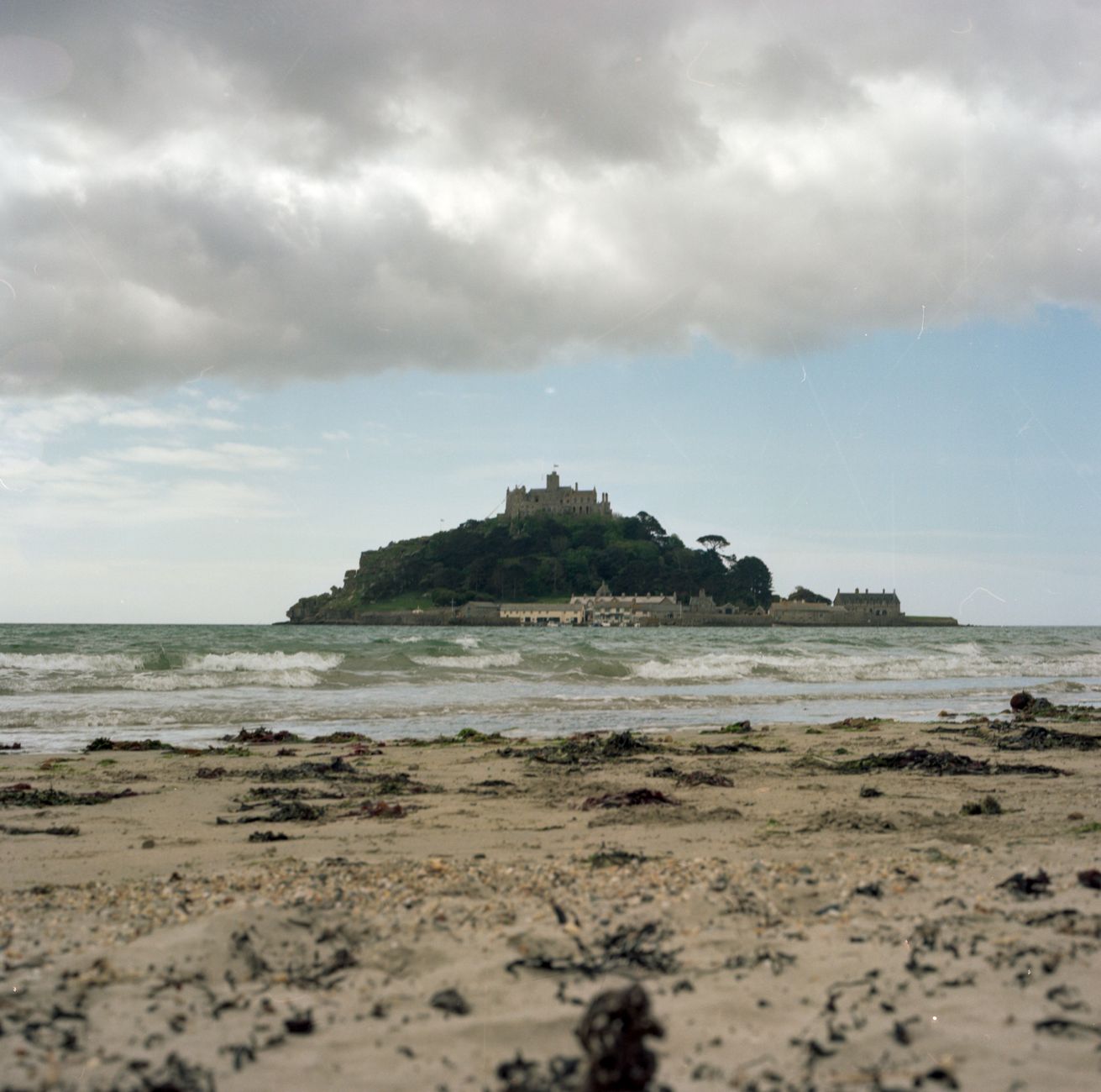
St Michael’s Mount, the tidal-island castle that is the most photographed building in Cornwall, sits three miles east of Penzance in Marazion. It is not technically in Penzance, and the locals will correct you on this. But you can see it from the town, the bus is fifteen minutes, and any Penzance trip should include at least a visit.
The Mount is owned by the St Aubyn family (still resident) and managed in partnership with the National Trust. Access is by foot across the cobbled causeway at low tide or by the small ferry boat from Marazion at high tide. The causeway is exposed for around two and a half hours either side of low tide; check the tide times before you go. The ferry runs from 15 March to 30 October at £3.20 adult and £1.60 child.
For 2026, entry tickets are required from 30 April onwards (with Easter Holidays 2-19 April open and also ticketed). National Trust members get free castle and garden access but need to reserve a timed slot. The climb to the castle is steep and cobbled — not buggy-friendly, not wheelchair-friendly. The castle is the family seat of the St Aubyns since the seventeenth century; the gardens cling to the rocky slope below. Allow three hours for a proper visit, including the walk across and back.
How to Get to the Scilly Isles
Penzance is the only place in Britain where you can choose between three different methods of getting to the same archipelago — by ferry, by helicopter, or by fixed-wing aircraft. This is genuinely unusual.
Scillonian III ferry sails from Penzance harbour. Two hours and forty-five minutes’ crossing. Six sailings a week, Monday to Saturday, departing Penzance at 9.15am. The season runs from late March or early April to October or early November. 2026 day return fares: £35 adult, £17.50 child two-to-fifteen, £10.50 infant, £15 dog. Standard single from £76.25 adult. Operated by Isles of Scilly Travel. The ferry is the cheapest option but the most weather-dependent — the crossing through the open Atlantic can be rough.
Penzance Helicopters fly direct from a heliport just outside town to St Mary’s or Tresco in fifteen minutes. Fares for 2026 are held at 2025 prices, starting from £149 per person return for day-trip or scenic flights. The fleet is being expanded to three helicopters for 2026. This is the most weather-resistant option and the most fun — you fly over the Cornish coast and across the open sea at low altitude.
Skybus fixed-wing aircraft fly from Land’s End (year-round), Newquay (year-round from 2026, up to seven daily flights in summer) and Exeter (seasonal). Sample 2026 fares: Newquay from £79.99, Land’s End from £134.99, Exeter from £269.99. Operated by Isles of Scilly Travel.
For a day trip, the helicopter is the most efficient. For a budget multi-day visit, the ferry. The Skybus from Newquay is the cheapest air option and useful if you’re not staying in Penzance.
Newlyn: The Working Port Next Door
Newlyn sits a mile south of Penzance, walkable along the promenade. It is the UK’s largest fishing port by value of fish landed, and it is genuinely a working port, not a tourist version of one. The fish auction runs from before dawn (visitors don’t attend it, but the morning bustle at the harbour is worth seeing). Newlyn Art Gallery, founded in 1895, is the contemporary art space — sister to The Exchange on Princes Street in Penzance, both managed by the same charity. The Penlee Lifeboat Memorial commemorates the 1981 Solomon Browne tragedy, when the entire crew of the Penlee lifeboat was lost in a storm trying to rescue a stricken coaster. The Newlyn Tidal Observatory, on the harbour wall, defines the UK’s Ordnance Datum — the sea-level reference point for every height measurement in the country.
Eat at the Tolcarne Inn in Newlyn — a Top 50 Gastropub run by Ben Tunnicliffe, with day-boat fish on a regularly changing menu. Mackerel Sky is the seafood tapas bar where you queue at the door because they don’t take bookings; the warm dressed crab and the salt-and-pepper squid are the headline dishes. Duke Street Café is the morning coffee and brunch stop.
Mousehole: Pronounced “Mowzul”
Mousehole, three miles south of Penzance via Newlyn, is one of the prettiest harbours in Cornwall — a fourteenth-century stone breakwater enclosing a tiny working harbour ringed by stone cottages. The bus from Penzance Green Market is fifteen minutes; parking in Mousehole itself is difficult and Park & Ride is essential during the Christmas Lights period.
The Christmas Lights have been a tradition since 1963. Sixty-plus illuminated displays, seven thousand bulbs, lit between mid-December and around 5 January from 5pm to 10pm each evening. The lights make Mousehole the busiest village in Cornwall over Christmas. Tom Bawcock’s Eve on 23 December celebrates the local fisherman who, the legend says, went to sea in a winter storm to save the village from famine — the Ship Inn serves Stargazy Pie (with fish heads sticking out of the pastry) and a lantern procession runs through the village.
Outside the Christmas season, Mousehole is a quiet morning’s walk. 2 Fore Street is the bistro to know. The Ship Inn is the pub. The Rock Pool Café for daytime. The walk from Mousehole to Lamorna Cove (two and a half miles south along the South West Coast Path) is one of the most dramatic short clifftop walks in Cornwall.
Tremenheere Sculpture Gardens
Two miles outside Penzance, in the valley below Castle Horneck, Tremenheere is a sub-tropical garden hung with contemporary sculpture — James Turrell, David Nash, Richard Long, Tim Shaw and others have permanent works in the grounds. Open daily 10.30am-5.30pm with last entry 4.30pm; closes early November to mid-February. Free café, gallery and nursery entry; admission to the gardens themselves. Season tickets £40-80. This is a quieter alternative to Trebah and Glendurgan further east and worth a half day if the weather is good.
Walks From Penzance
The Promenade walk from the Jubilee Pool past Battery Rocks, through Newlyn and on to Mousehole is one of the great easy coastal walks in Cornwall — three miles, flat, paved, sea on your left the whole way, with the Napoleonic-era thirty-pounder gun emplacement at Battery Rocks and views over Mount’s Bay to St Michael’s Mount. Allow an hour to ninety minutes. Lunch at the Tolcarne in Newlyn or 2 Fore Street in Mousehole.
For more serious walking, the South West Coast Path runs through Penzance in both directions. Going west, the coast becomes wilder as you pass through Mousehole and Lamorna toward Land’s End. Going east, the path runs around Mount’s Bay to Marazion and on toward Helford.
Eating and Drinking in Penzance
The Tolcarne Inn at Newlyn and Mackerel Sky at Newlyn are the destination places (covered above). In Penzance itself: Artist Residence Clubhouse on Chapel Street, the boutique-hotel restaurant with a serious chef and a relaxed atmosphere. The Yard, off Chapel Street, an excellent neighbourhood restaurant. Hotel Penzance, with the Bay Restaurant. The Honey Pot for the best afternoon tea. Rowe’s on Causewayhead for the canonical Penzance pasty (the bakery has been there over seventy years). The Crown on Victoria Square for real ale.
For coffee and breakfast: Archie Browns above the health food shop on Bread Street — long-running vegetarian and vegan café, exceptional value, a Penzance institution.
Where to Stay in Penzance
The Artist Residence on Chapel Street is the cool boutique. Chapel House nearby is the more traditionally elegant option. Hotel Penzance and the Queens Hotel are the larger Victorian seafront hotels. The Abbey Hotel is owned by Jean Shrimpton (yes, that Jean Shrimpton, the 1960s model). There is a strong range of B&Bs across the town. Self-catering apartments in the harbour-front buildings give you sea views and walking access to everything.
For more on Penzance accommodation, see our guide to B&Bs in Penzance.
Penzance as a Base for West Cornwall
This is the strongest argument for staying here. Within thirty minutes of Penzance you can reach St Michael’s Mount (3 miles east), Mousehole (3 miles south), Newlyn (1 mile south), Lamorna Cove (5 miles), the Minack Theatre at Porthcurno (8 miles south), Porthcurno itself, Sennen Cove (10 miles west), Land’s End (10 miles west), Botallack and the mining coast (10 miles north-west), Lanyon Quoit (8 miles north), Trengwainton Garden (3 miles north), and (further afield) St Ives (10 miles north). No other Cornish town packs that much into a thirty-minute radius.
The Penzance-based three-day plan I recommend to guests is: day one in town with Jubilee Pool and Penlee House and a Newlyn walk; day two to St Michael’s Mount and Marazion; day three around West Penwith via Mousehole, the Minack and Land’s End. A four-day plan adds the Scilly Isles day trip by helicopter.
Mazey Day and Golowan Festival
The Golowan Festival runs across most of late June in 2026 (19-28 June). The flagship day is Mazey Day on Saturday 27 June 2026, when the town centre is closed to traffic from 6am to 7pm and a procession of huge willow-and-paper effigies — the Penglaz horse, the dragons, the Mazey Eye — winds through the streets with a Cornish brass band. Quay Fair Day follows on Sunday 28 June at the Promenade and Morrab Road, with food, music and craft stalls. The festival celebrates the Cornish midsummer tradition of the Golowan (Cornish for “midsummer”) and is one of the genuine highlights of the Cornish year. If you can plan a Penzance visit around it, do.
Frequently Asked Questions
Is Penzance worth visiting? Yes — particularly as a base for West Cornwall. The town itself rewards two or three days; the wider area rewards a week.
How many days do you need in Penzance? Two for the town, four to five if you’re using it as a base for West Penwith and the Scillies.
What is Penzance famous for? The Pirates of Penzance, the Jubilee Pool, the Scilly Isles ferry, the Newlyn School painters, and the southernmost mainline station in Britain.
Is Penzance or St Ives better? Penzance for value and as a base; St Ives for art and beach concentration.
How do you get to Penzance from London? Direct train from Paddington, around five and a half hours. Night Riviera sleeper available.
How do you get from Penzance to the Isles of Scilly? Scillonian III ferry (2h45m), Penzance Helicopters (15 minutes), or Skybus from Land’s End. Three options is unique in Britain.
How much is the Scillonian ferry from Penzance? Day return £35 adult, £17.50 child in 2026.
Is St Michael’s Mount in Penzance? No — it’s in Marazion, three miles east, but most visitors reach it from Penzance.
Can you walk from Penzance to Mousehole? Yes — three miles along the coastal promenade via Newlyn. Easy, paved, sea-side the whole way.
Is the Jubilee Pool heated? The geothermal section is, at 28-30°C. The main sea pool is unheated.
When does the Jubilee Pool open in 2026? 31 March to 1 November. Pre-booking essential for the geothermal pool.
Penzance is the Cornish town that everyone uses as a transit and that almost nobody understands as a destination. Stay three nights. Swim in the Jubilee Pool. Walk to Newlyn for dinner. Find the smuggler statue on the Admiral Benbow’s roof. Take the helicopter to Tresco for a day. Read Stanhope Forbes at Penlee House. You’ll wonder why anyone bothered with St Ives.