St Ives is the Cornish town that gets put on every shortlist, every “30 best UK seaside” feature, every Sunday-supplement watercolour. I’ve watched a lot of first-time visitors arrive expecting something twee and leave a few days later quietly converted, because it turns out the reality is grittier, prettier and more interesting than the magazines suggest. I run a small B&B that hosts a lot of guests planning their first trip down here, and the questions I get about St Ives Cornwall guide territory are the same every year. This is the proper answer.
I’m going to give you the version that takes practical things seriously. Parking in St Ives is genuinely one of the trickiest puzzles in the county and getting it right will save you hours and a small fortune. The branch line is a piece of public transport that deserves a paragraph on its own. The beaches are not interchangeable. The Tate is not the only gallery in town worth your time. And there is a Hepworth sculpture inside the parish church that, somehow, almost no other guide mentions. If you want the broader picture of where this sits in a Cornwall itinerary, our Cornwall towns and villages guide is the parent piece to this one.
Why St Ives Has the Reputation It Does
The cliché about St Ives is that the light is different. The cliché happens to be true. The town sits on a finger of land that catches reflected sea light from both the north and south sides, which is why a stream of British artists from Whistler onwards came here to paint and never quite left. The Newlyn painters had Newlyn; St Ives had Sickert, Hepworth, Nicholson, Heron, Frost, Lanyon, the Penwith Society, the postwar abstract scene that made the town an international name in the 1950s and 60s. Tate St Ives, opened in 1993 on the site of the old gas works above Porthmeor Beach, is the institutional confirmation that this little pilchard town somehow became part of the international art canon.
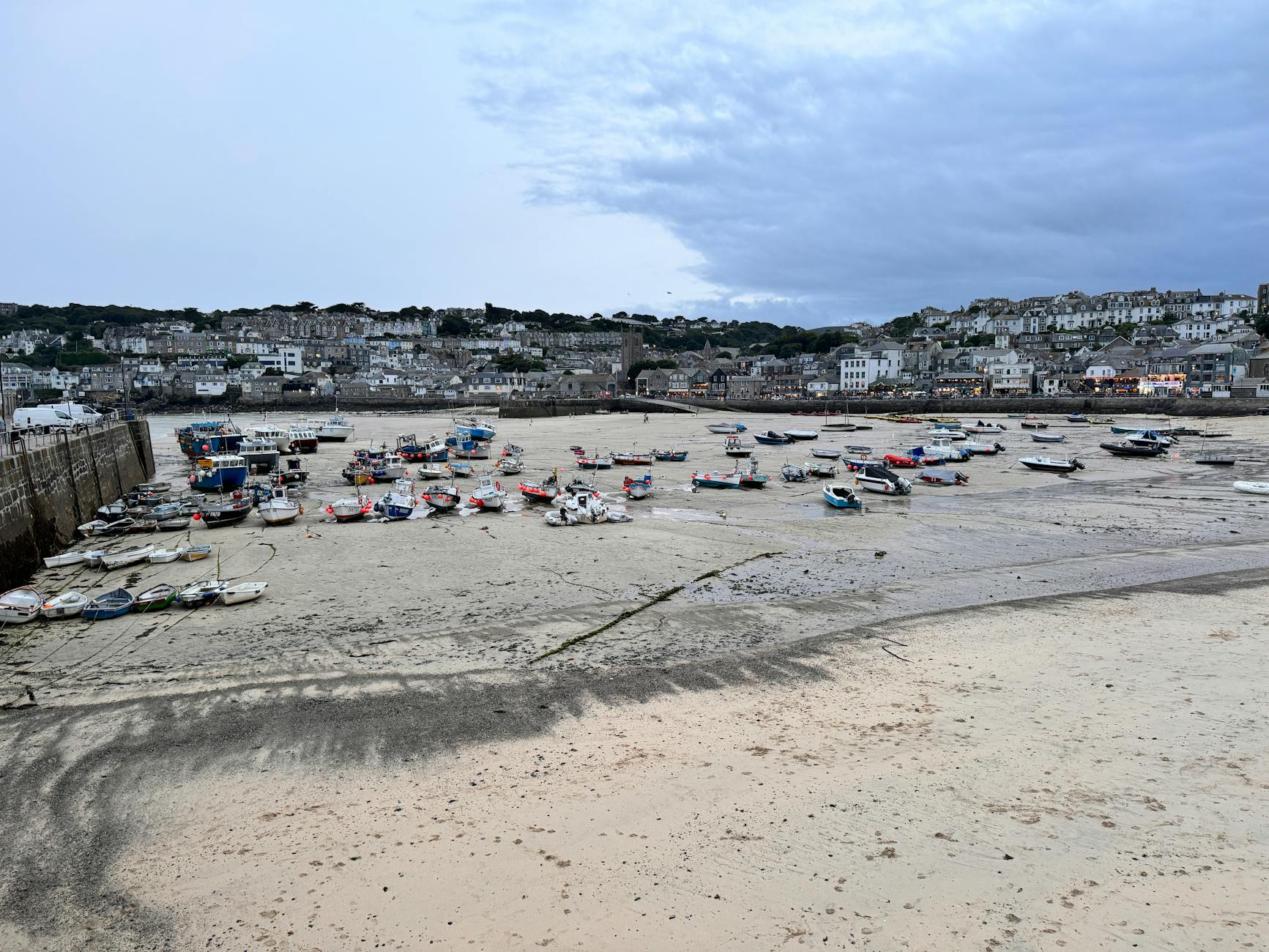
The light is the surface answer. The deeper answer is that St Ives was a fishing town first, an artists’ town second, and a holiday town third, and you can still see all three layers if you know where to look. The narrow lanes of Downalong, the old fishermen’s quarter east of the harbour, were never planned. They were paths between cottages built where the catch was landed. The bigger nineteenth-century houses on the slopes above were summer lets when the railway opened in 1877 and London discovered Cornwall. The town is its own history book, layered up on the hill, the prevailing wind off the sea pushing the buildings into tighter and tighter clusters as you walk down toward the harbour.
Getting to St Ives: Train, Car, and the Branch Line Worth Loving
St Ives is, somewhat improbably, served by its own railway station. There is no direct train from London or anywhere else outside Cornwall. Instead, you take the GWR main line to St Erth, change platforms, and ride one of the loveliest ten-minute branch lines in Britain along the curve of St Ives Bay to a terminus 200 yards from the harbour. From London Paddington it’s about five and a quarter hours total in normal running, with the change at St Erth often quicker than the platform announcement suggests. The Bristol-to-St Ives journey is around four and a quarter hours by train, or roughly three and a half by car if the M5 holds together.
The branch line itself, opened in 1877, is the thing that put St Ives on the holiday map and still shapes a visit. Sit on the right-hand side travelling from St Erth toward St Ives. The track hugs the dunes through Lelant and Carbis Bay, and you’ll spend half the journey looking at sand and water below the window. The Anytime single from St Erth is £3.10, the return £4.20, and there’s a Family Ranger ticket at £10 that covers two adults and up to three children for the day. If you’re combining with other Cornish towns, the Cornwall Ranger at £17 adult or £8.50 child covers a day of unlimited travel across the network. This is the single best-value piece of public transport in the county and is worth using even if you’ve driven down.
For drivers, the bad news is that you should not, ideally, drive into St Ives between Easter and the end of September. The town centre is medieval and the parking situation borders on the absurd. The good news is that the train will solve this for you. Park at the St Erth station Park & Ride (the older Lelant Saltings car park is no longer the official park-and-train site, with the scheme now operating from St Erth) and take the train in. Five hundred spaces, a ten-minute scenic ride, and you bypass the whole car park lottery.
Parking in St Ives: A Survival Guide
If you must drive into town, here is what you need to know. Trenwith is the largest car park in St Ives, with around 760 spaces, sat on the hill above the town. It costs roughly £6.80 for three to four hours and £10.50 for a full 24 hours, with a token rate of £2.10 from 6pm and free overnight between midnight and 9am. A free shuttle bus runs between Trenwith and the town centre between 10am and 11pm in peak season, which means the long downhill walk back up the hill at the end of the day with tired children is genuinely optional. If you’re staying overnight in town, the seven-day rover ticket at around £26 is the best deal going and covers Trenwith plus Station, Park Avenue and the Island car parks.
Smaller and closer car parks fill quickly. Barnoon (behind the Tate, above Porthmeor) is the prime spot for art-day visitors and is full by 10am most days in July and August. Station car park is exactly what it sounds like, right next to Porthminster. Island car park sits next to Porthgwidden, with the Island walk on your doorstep. Smeaton’s Pier and Park Avenue are smaller again. The Rugby Club at the top of town opens for overflow on the busiest days and is a fair walk down but reliable when everything else is showing red on the digital signs.
What you should not do is drive into the heart of town hoping to find a roadside space. The lanes are narrow, the residents’ parking is enforced, and you will end up in a one-way system trying to get out again with the tide of pedestrians making progress impossible.
The Beaches of St Ives: All Seven Plus Carbis Bay
St Ives has the rare distinction of being a town where you can pick a different beach for each day of a week’s holiday and not run out. They each have a different character, different tide patterns, different shelter, and crucially different dog rules during the summer ban months.
Porthmeor
Porthmeor is the surf beach. North-facing, exposed to Atlantic swell, lifeguarded by the RNLI from Easter through to early November between 10am and 6pm. The Tate sits at one end, the old fish cellars (now mostly artist studios) at the other, and the beach itself is a wide, flat half-mile of Blue Flag sand. It’s the beach for surf lessons, for long evenings watching the sun set into the water (which it actually does, from this side of Cornwall), and for the Porthmeor Beach Café when you want to eat with a sea view. Dogs are banned from 15 May to 30 September between 10am and 6pm; outside those hours and dates, they’re welcome.
Porthminster
Porthminster is the family beach. It sits directly below the railway station, faces east into the shelter of St Ives Bay, and is the most accessible beach in town with level promenade access. The Porthminster Beach Café has been doing brilliant Mediterranean and seafood cooking here since the late 1990s and is the kind of place where you can have a proper lunch and then fall asleep on the sand for the afternoon. Two beach wheelchairs are kept at the café on a first-come, first-served basis. Same summer dog ban as Porthmeor.
Porthgwidden
Porthgwidden is the suntrap. A small cove on the seaward side of the Island, with a row of pastel beach huts behind it and a café perched on the sand. It catches the morning sun and stays sheltered all day from the prevailing south-westerlies. This is where you go on a windy day when the rest of the bay is choppy. Dog ban is shorter here: 1 July to 31 August only.
Harbour Beach, Bamaluz, Lambeth Walk and the Breakwater
The harbour itself becomes a beach at low tide, with gigs hauled up on the sand and children jumping off the harbour wall on summer afternoons. From the harbour you can walk along Lambeth Walk and out to Bamaluz, the small beach hidden west of the harbour where dogs are allowed year-round. Behind Smeaton’s Pier is the tiny Breakwater Beach, also dog-friendly all year, only accessible at lower tides. These three are the local secret. They don’t appear on most maps because they’re more cove than beach, but they’re where the locals walk their dogs in summer when the main beaches are off-limits.
Carbis Bay and Porthkidney Sands
Carbis Bay is a one-mile walk along the coast path from St Ives, signposted past Porthminster. It’s owned in part by the Carbis Bay Hotel but the beach itself is public and is, when the tide is right, one of the loveliest white-sand beaches in the county. Beyond Carbis Bay, the coast path continues to Porthkidney Sands at Lelant, a vast, often-empty expanse of sand with the railway running alongside the dunes. Dogs allowed year-round at Porthkidney. The walk all the way from St Ives to Lelant is three miles, almost entirely easy, and gives you four different beaches to choose from on the way.
The Art Scene: More Than Just the Tate
Tate St Ives is the obvious answer to the question of what to do in St Ives on an art day, and it is genuinely a brilliant gallery. The 1993 building (extended in 2017) sits above Porthmeor with a curved façade, a rooftop café and a programme that rotates between the modern British artists who put the town on the map and contemporary international shows. Adult admission is £15.50 with the optional donation, £14 without, with under-18s free and reduced rates for those on Universal Credit or Pension Credit. The combined ticket with the Barbara Hepworth Museum is the best value: under a tenner more than admission to either, and the Hepworth Museum is essential.
The Barbara Hepworth Museum and Sculpture Garden is housed in Trewyn Studio, where Hepworth lived and worked from 1949 until her death in a studio fire in 1975. The garden is small and intense, with major bronzes and stone pieces among the sub-tropical planting she chose herself. It is one of the great artist’s-house museums in Britain, more affecting than the Tate next door for many visitors. Open daily in summer; closed Mondays from November to February. Best visited first thing in the morning when the light through the trees is at its softest.
The detail almost no St Ives guide mentions is that there is a Hepworth carving inside the parish church, St Ia’s, on Fore Street. It’s called Madonna and Child and Hepworth carved it in memory of her son Paul, an RAF pilot killed when his plane was shot down in 1953. The church is free to enter and quiet. It’s a small, deeply affecting work that you’d otherwise need to travel to a major retrospective to see.
Beyond the Tate and Hepworth there is the Leach Pottery on Higher Stennack, founded by Bernard Leach in 1920 and now both a working pottery and a museum of his work. The Penwith Gallery, in the old pilchard-packing factory on Back Road West, is the locals’ alternative to the Tate, showing contemporary work by members of the Penwith Society of Arts. The St Ives Society of Artists Gallery is housed in the old Mariners’ Chapel on Norway Square and has shows changing every fortnight. The Sloop Studios, tucked away behind the Sloop Inn car park, are working artist studios you can often wander through unannounced. The St Ives Museum, in a former pilchard cellar on Wheal Dream, is a small, volunteer-run treasure covering fishing, mining and shipwreck history.
Where to Eat: Locals’ List Versus Tourist Trail
St Ives has more eating places than any town its size should reasonably support, and the quality runs a wide spectrum. The pasty shops on Fore Street are mostly fine but the genuine artisan bakers are tucked into side lanes. Here’s the locals’ shortlist.
The Porthminster Beach Café is the destination restaurant in town. Mediterranean-leaning cooking with strong seafood, run by an Australian-Cornish team for over twenty-five years, and the table you want is the one on the outside terrace at sunset. Book ahead in summer for both lunch and dinner. The sister Porthmeor Beach Café on the other side of town is more relaxed, tapas-style sharing plates, and the place to be on a long evening when Porthmeor is on the surf.
Porthgwidden Beach Café is the third in the family and the most low-key, doing big breakfasts, brunches and casual lunches with a sun-trapped deck. The Hub on Wharf Road has been doing Cornish rare-breed beef burgers in fresh-baked Baker Tom buns since 2003 and is reliably the best fast-ish meal in the harbour. SILCo Searoom, a couple of doors along, does small plates and cocktails into the evening with no reservations and a no-children-after-eight policy.
For pub food, the Sloop Inn on the harbour claims a foundation date of 1312 and has the ales, the wood beams and the working-fisherman regulars to back it up. Blas Burgerworks on the Warren is a small, dedicated burger restaurant using local ingredients with proper attention. The Cornish Deli on Chapel Street is the lunchtime takeaway for sandwiches, pasties and Cornish cheeses to take to the beach. Onzo Pizzeria, West Greek and Talay Thai Kitchen each have a faithful local following for their respective cuisines.
The piece of insider knowledge that almost no guide mentions: the St Ives Farmers’ Market runs at the Guildhall on Thursdays from 9.30am to 2pm, with vegetables, bread, cheese, smoked fish, charcuterie, cider and gin from across West Penwith. Build your Thursday around it. If you’re staying long enough to cook, this is where to shop. If you’re not, you can still have lunch from a half-dozen stalls in the hall. For a wider view of what’s on the food scene across the county, our Cornwall food and drink guide covers the whole picture.
Things to Do Beyond the Beaches and Galleries
The Island, despite the name, is not an island. It’s the promontory at the north end of town, capped by St Nicholas Chapel, a tiny medieval seamen’s chapel. The walk around the Island takes fifteen minutes, gives you panoramic views over both Porthmeor and Porthgwidden, and is the best free thing to do in St Ives. Go up there at sunset and you’ll see why painters keep coming back. Smeaton’s Pier, built by John Smeaton in 1770 and extended in 1888, is the working part of the harbour and the place to watch fishermen unloading the day’s catch in the afternoon.
Boat trips from the harbour run all summer, with the most popular being the Seal Island trip out to the colony of grey seals on the rocks west of town. There are also fishing trips, fast RIB rides and longer wildlife cruises. Most trips run from spring through October, weather dependent, with tickets sold from kiosks on the wharf in the morning.
St Ives is also a working surf town. The major surf schools all base themselves on Porthmeor: lessons run from around £40 for a two-hour group session including board and wetsuit, with all the schools also doing private and family lessons. The waves at Porthmeor are forgiving enough for first-timers and consistent enough that you’ll usually catch a few on a beginner session.
Walks from St Ives
The South West Coast Path runs through the heart of St Ives in both directions and is the reason many visitors choose this end of Cornwall over the milder south coast. Going west, the walk to Zennor is six and a half miles of strenuous, dramatic clifftop, with the granite cliffs of the Land’s End peninsula dropping straight into the Atlantic. Three to four hours one way. The pragmatic plan is to walk out, have lunch at the Tinners Arms in Zennor (a proper Cornish granite pub with a fire in winter), then catch the 16 or 16A bus back to St Ives. Easier and more popular is the one-mile walk to Carbis Bay, mostly paved, and the three-mile continuation to Lelant for the Porthkidney sand and the bird hide on the estuary.
The shorter classic walks are the Island circuit (fifteen minutes), Trencrom Hill (a thirty-minute hike up to a Neolithic hillfort with one of the best panoramas in West Penwith), and St Michael’s Way, the twelve-mile pilgrim route from Lelant across the peninsula to Marazion and St Michael’s Mount. If you have a half day and a car, the B3306 coastal drive from St Ives via Zennor and Pendeen to Land’s End is one of the most spectacular short drives in the UK and gives you a sense of West Penwith’s wildness. Our guide to coastal walks near St Ives covers the routes in more detail with maps.
Day Trips Beyond St Ives
St Ives is a brilliant base for the western half of Cornwall. Mousehole and Newlyn are forty minutes south along the coast, with the harbour of Mousehole genuinely one of the prettiest in the county. Marazion and St Michael’s Mount are twenty-five minutes by car, with the Mount accessible on foot at low tide via the cobbled causeway or by ferry at high tide. Penzance is the regional centre, gateway to the Scilly Isles and home to the geothermal Jubilee Pool. Land’s End is forty minutes west; the Minack Theatre at Porthcurno, half an hour south, is the open-air clifftop theatre that almost everyone who comes to Cornwall ends up visiting at some point. Godrevy and Gwithian, ten minutes east across the bay, have wide surfing sands, a colony of seals at the lighthouse base, and far fewer crowds than the St Ives beaches.
For a longer day trip, you can pair the Tate with a half-hour drive to Truro, Cornwall’s capital, for the Cornwall Museum and the cathedral. Eden Project is an hour and a quarter east. Padstow is ninety minutes north on the other coast. None of these are too far if you have a car and a day to spare.
When to Visit: A Season-by-Season Guide
St Ives is busy. In July and August the town is heaving, the parking is full by 9am, the dog bans are at their tightest, and the wait for tables at the best restaurants stretches into the days. It’s also when the weather is most reliable and when the beaches are at their best. If you can travel with a school-age child, you have no choice; if you can travel outside the school holidays, choose May, June or September.
May and June are the sweet spot. Long days, light evenings, the gardens of West Penwith in bloom, the water warm enough to swim in (just), the St Ives Food & Drink Festival on Porthminster Beach (15–17 May 2026 for the next edition, free entry). September is similar, with the sea at its warmest after the summer heat and the St Ives September Festival (12–26 September 2026) bringing two weeks of music, literature and arts across the town.
Winter is the secret. The crowds are gone, the cottages are at their cheapest, the storms when they come are worth seeing from a window with a fire behind you, and Porthmeor is surfable in conditions that scare off all but the most committed. National Geographic ran a piece a few years ago on why winter is the perfect time to visit, and they were right. The Hurling of the Silver Ball on the first Monday after 3 February (St Ia’s Day) is one of those quietly extraordinary local traditions where a silver ball is thrown around the town and the streets and beaches in a ritual that pre-dates Christian Cornwall.
St Ives with Dogs
St Ives is dog-friendly out of season and complicated during the summer months. The headline is that Porthmeor, Porthminster and Harbour Beach all enforce dog bans between roughly mid-May and the end of September. The good news is that Bamaluz, Lambeth Walk, the Breakwater and Porthkidney Sands at Lelant are open to dogs year-round, so you have walking options even in August. Many of the pubs welcome dogs, with the Sloop Inn being the most reliably dog-friendly spot in town. Several B&Bs and self-catering cottages in St Ives are dog-friendly; check the dog-specific filters when booking. Our guide to dog-friendly B&Bs in Cornwall covers the best options across the county.
St Ives in the Rain
It will rain. Cornwall in summer is wetter than people expect, and you should have a wet-weather plan. The good news is that St Ives has more indoor culture per square mile than almost anywhere comparable in Britain. The Tate, the Hepworth Museum (which is partly outdoors but covered in many sections), the Leach Pottery, the Penwith Gallery, the St Ives Museum, the St Ives Society Gallery, the parish church with the Hepworth carving, the Sloop Inn for a long lunch, the Hub for a burger, the Porthminster Café for a window-seat afternoon. You can fill a wet day comfortably without ever putting on a coat for more than a hundred-yard sprint between buildings.
Where to Stay in St Ives
Accommodation in St Ives sorts into three tiers. The harbour-front hotels and B&Bs are the most expensive but the most convenient, with the Pedn-Olva and the Tregenna Castle being the two big destination hotels. The Tregenna sits above the town in a parkland setting with its own outdoor pool and sea views. The Carbis Bay Hotel a mile along the coast is the luxury option with its own private beach.
The middle tier is the network of small B&Bs and guest houses across the Downalong streets and on the hillsides above the town. This is where most visitors stay and where the best value usually sits. Many of these are walking distance from the harbour and have private parking, which is a significant practical advantage in St Ives. Self-catering cottages in the old fishermen’s quarter are the third option and are where you should aim if you want to feel like a local for a week. They book up for the summer by January, so plan ahead.
If you want a comprehensive look at B&Bs in St Ives, our dedicated guide to the best B&Bs in St Ives covers everything from the harbour-front options to the quieter places up on the hill.
Accessibility in St Ives
St Ives is a Cornish fishing town built on a hill, so honesty matters here. The town centre, harbour and Porthminster promenade are level and paved. The cobbled lanes of Downalong are not wheelchair-friendly. The branch line is fully wheelchair-accessible with ramps at every station, including St Ives itself. Porthminster is the most accessible beach with a level promenade, accessible toilets and two beach wheelchairs at the café. All public car parks have disabled bays, and a hopper bus runs between Trenwith and the town centre for those who can’t manage the walk down the hill.
St Ives or Padstow? Honest Answer
The question I get asked more than any other. The short answer is: St Ives for the art, the light, the bigger town and the bigger beaches; Padstow for the food, the smaller harbour and the easier parking. St Ives is also a longer drive from London but a much better public transport option (the train terminates here; you need to change at Bodmin Parkway and bus the last leg to reach Padstow). If you’re choosing between them for a single trip, the deciding question is whether you’d rather build days around galleries (St Ives) or restaurants (Padstow). If you can spend a week in Cornwall, do both. Our guide to the best B&Bs in Padstow covers the other side of the coin.
Frequently Asked Questions
Is St Ives worth visiting? Yes, unambiguously. It’s busy in peak summer and the parking is hard work, but the combination of beaches, art and town atmosphere is genuinely among the best on the British coast.
What is the best time to visit St Ives? May, June and September. The school holidays are the busiest. Winter is the secret.
How do you get to St Ives without a car? Train to St Erth, change for the branch line. Five and a quarter hours from London, four and a quarter from Bristol.
Where is the best place to park in St Ives? Trenwith for the day, with the free shuttle bus. Or park at the St Erth Park & Ride and take the train.
How much does Tate St Ives cost? £15.50 adult with donation, £14 without. Under-18s free. Combined ticket with the Hepworth Museum is the best value.
Are dogs allowed on St Ives beaches? Year-round on Bamaluz, Lambeth Walk, the Breakwater and Porthkidney. Banned May-Sept on Porthmeor, Porthminster and Harbour Beach during daytime hours.
Is St Ives wheelchair-friendly? The harbour, Porthminster promenade and the branch line all yes. The cobbled streets of Downalong, no.
Where do locals eat in St Ives? Porthminster Beach Café, the Hub, SILCo Searoom, Blas Burgerworks, and the Thursday Farmers’ Market at the Guildhall.
How long is the St Ives to Zennor walk? Six and a half miles, three to four hours, strenuous. Lunch at the Tinners Arms and bus back.
What is there to do in St Ives in the rain? Tate, Hepworth Museum, Leach Pottery, Penwith Gallery, St Ives Museum, the parish church, long lunches in the pubs and cafés.
St Ives rewards visitors who plan a little and slow down a lot. Stay three or four days if you can. Walk the Island at dawn. Eat at the Porthminster Café once. Find the Hepworth in the church. Catch the branch line at least one way. You’ll see why people keep coming back.