Bude is the Cornish town that does the rest of the county a useful favour: it absorbs the visitors who want the Atlantic but don’t want the Padstow prices, the surf without the Newquay crowds, and three miles of beach without queuing for a car parking space. It sits at the very top of the north Cornwall coast — three miles from the Devon border, much further north than Newquay or Padstow, far enough north that some Cornish purists will tell you it’s barely Cornwall at all. That tension is the most interesting thing about Bude, and the reason this Bude Cornwall guide will tell you to come here rather than keep heading south.
Bude is rugged in a way the polished south-coast Cornish towns are not. The Atlantic is fierce here — the wind is harder, the surf is bigger more reliably, the sea pool is a free amenity kept open by volunteers because the town fought to save it. There’s a literary heritage just up the coast at Morwenstow that almost nobody mentions. There’s a Victorian inventor whose lamp lit Parliament. There’s a 1830s Storm Tower that was carefully dismantled and moved a hundred metres inland in 2024 because the cliff edge was disappearing underneath it. For the wider context of where Bude sits in a Cornwall trip, our Cornwall towns and villages guide sets the picture.
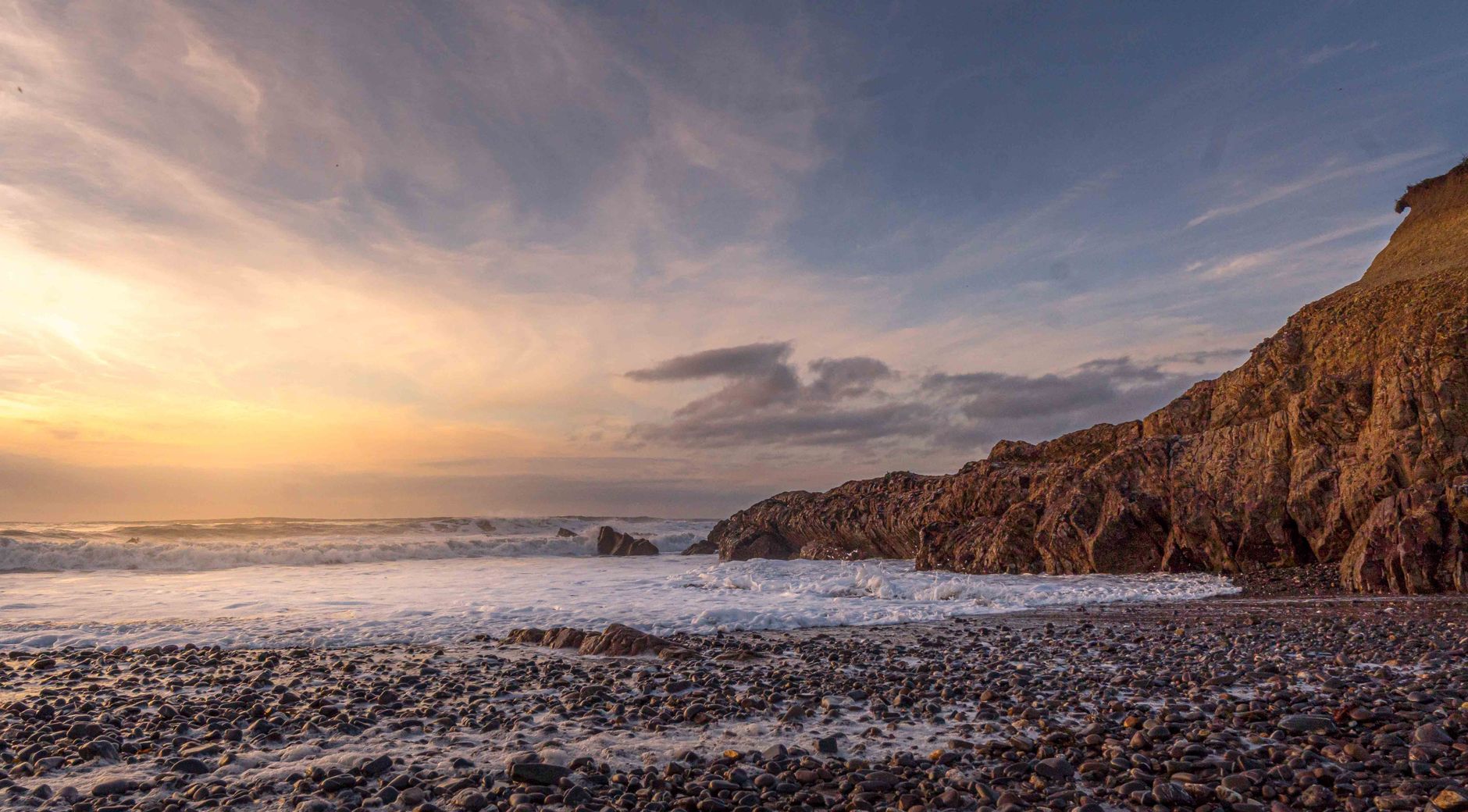
Why Bude Is the North Coast’s Best-Kept Secret
Bude has three Blue Flag beaches within three miles of each other — Summerleaze, Crooklets and Widemouth Bay — an unusual concentration that even Newquay can’t quite match. It has the only free, charity-run tidal sea pool in Cornwall (the other being Penzance’s Jubilee Pool, which has a heated section and charges admission). It has surf that’s good enough for serious surfers but consistent enough for beginners. It has a working Victorian canal that uniquely enters the sea via a sea-lock. It has a town centre that you can walk around without dodging Range Rovers, and prices that are notably lower than anything south of Padstow.
The trade-off is the distance. Bude is about three hours’ drive from Bristol, four and a half from London, and forty minutes north of Padstow. There is no railway station; the nearest is Exeter, fifty-two miles east and connected by Stagecoach bus 6/6A (a two-hour journey). The town is harder to reach than most of Cornwall, which is part of why it has stayed quieter.
The Sunday Times named Bude the “Best beach in the South West” for 2025, which is the kind of validation that confirms what locals have been quietly enjoying for years.
The Bude Sea Pool: A Community Triumph
The sea pool sits below the cliffs at the northern end of Summerleaze Beach. Built in 1930 as a semi-natural tidal pool — concrete walls extended out from a natural rock pool, filling twice a day with the rising tide — it became a fixture of Bude life through the twentieth century. Then in 2010 the local authority withdrew funding, citing safety and maintenance costs, and proposed closure. A group of locals refused to accept the decision, formed the Friends of Bude Sea Pool (FoBSP) charity (registered as #1143156, company #07630060), and took over the pool’s management in 2012.
The pool is now entirely maintained by the volunteer charity. There is no regular council or government funding. Entry is free. Dogs are welcome outside summer season (the main Bude beach dog rules apply during summer). The pool refills daily with each rising tide. It is one of two surviving sea pools in Cornwall and arguably the more remarkable for being free.
The story matters because it tells you something about Bude. The town fought for this amenity, won, and now runs it themselves. If you visit, drop a donation in the box — the pool’s continued existence depends on it.
The Beaches of Bude
Summerleaze, Crooklets and Widemouth Bay are the three Blue Flag beaches. Sandymouth and Northcott Mouth (just north of town) and Black Rock (south) round out the choices.
Summerleaze Beach is the town beach. Half a mile of sand running south from the breakwater and the sea pool, with the canal entering the sea at the southern end. A row of multi-coloured beach huts faces the sand. Lifeguarded in season, family-friendly, calm-ish in onshore winds because the breakwater shelters the northern end. The dog rules: on leads only between 21 May and 30 September; off lead the rest of the year. The Sea Pool is at the northern end.
Crooklets Beach is just north of Summerleaze, separated by a low rocky headland. Bigger surf than Summerleaze, lifeguarded, home to the Bude Surf Life Saving Club (one of the oldest in Britain). Skate park, play area and Rosie’s Kitchen café behind the beach. Dogs allowed only between 1 October and 31 March.
Widemouth Bay sits two miles south of Bude (a quick drive or coastal-path walk). The bay is around a mile and a half of open sand, with the strongest surf in the Bude area and the main learner-surfing beach. Raven Surf School operates here. Cafés behind the beach. Same dog rules as Crooklets (1 October to 31 March only).
Sandymouth is three miles north of Bude, National Trust managed, with a two-mile expanse of sand revealed at low tide and dramatic twisted cliffs behind. Two hundred-space pay-and-display car park (cash exact change or JustPark code 80669); free for NT members and Blue Badge holders. Steep narrow path down to the beach. Dog-friendly all year. The most under-visited of the Bude beaches.
Northcott Mouth, between Crooklets and Sandymouth, is a rockpool-and-pebble beach with one quietly remarkable feature: the wreck of the SS Belem, lost in 1917, becomes partly visible at very low tides — twisted iron ribs sticking out of the sand. Beachcombing here at low spring tides turns up the kind of finds that nowhere else on the coast offers.
Black Rock is south of town, dog-friendly all year, much quieter.
Surfing in Bude
Bude is one of England’s most consistent surf towns, and it has a different feel from Newquay. Less commercial, less crowded, more about getting in the water than being seen doing it. Three main surf schools operate.
Big Blue Surf School works mostly from Summerleaze. Raven Surf School bases at Widemouth Bay. Outdoor Adventure at Widemouth covers the broader adventure programme — coasteering, kayaking, climbing as well as surf. Standard lesson is two hours, group sizes around eight per instructor, all kit included. Prices broadly similar to Newquay; expect £30-40 per person for a group lesson, £60-80 for private. The advantage of Bude lessons is that the beaches are less crowded — your lesson isn’t fighting for space with three other schools.
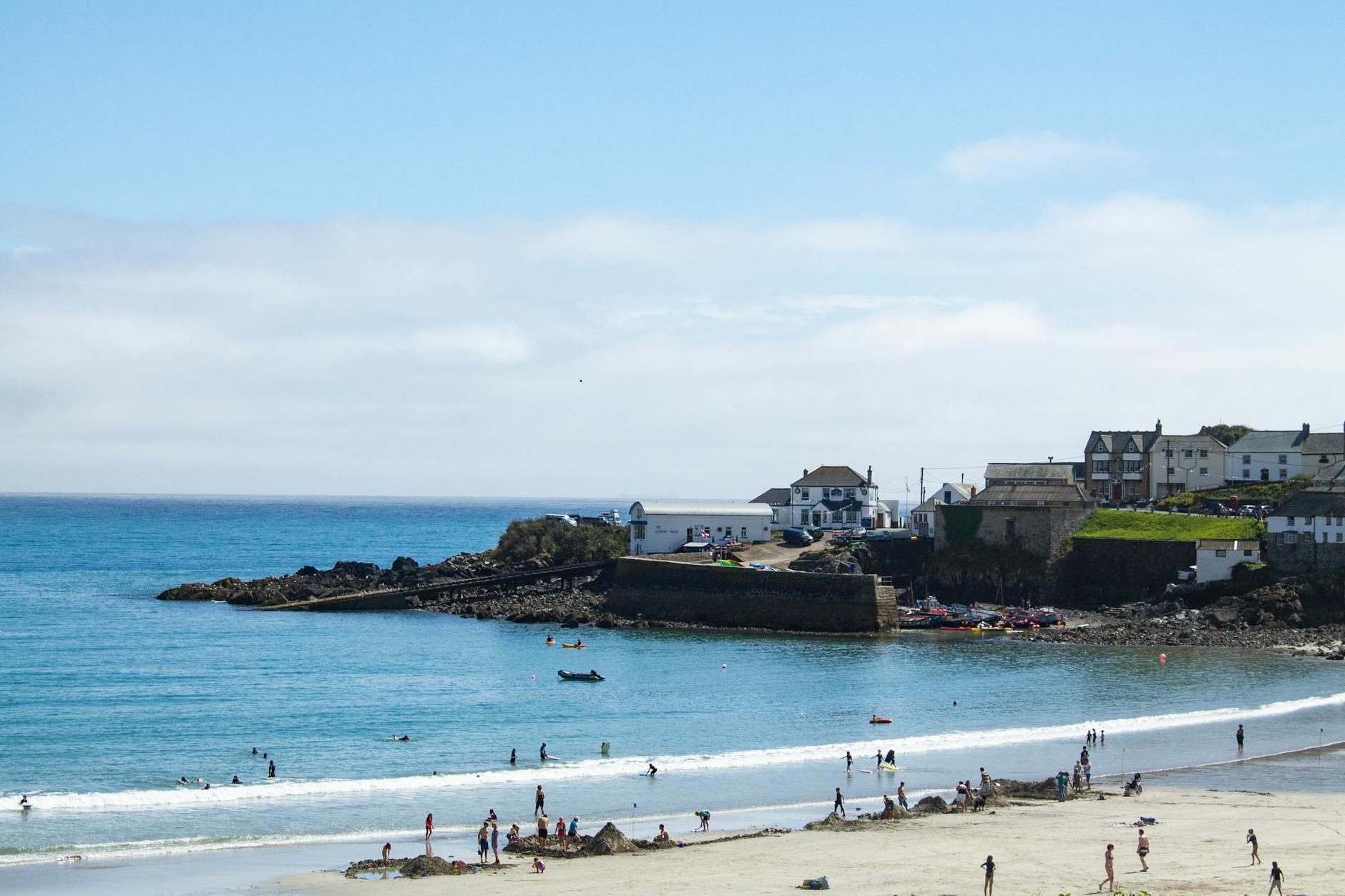
Bude Castle and the Bude Light
Bude Castle, on Castle Lane just back from the canal, was built in 1830 by Sir Goldsworthy Gurney — one of those Victorian Cornish inventors whose name should be more familiar than it is. Gurney was a doctor, chemist, inventor and engineer who pioneered the use of limelight (calcium oxide heated to incandescence), invented the steam jet that became the basis of all later steam locomotive design, built one of the earliest practical steam carriages, and designed the lighting system that illuminated the Houses of Parliament, the Pall Mall clubs and Trafalgar Square for half the nineteenth century. His invention, the Bude Light, used oxyhydrogen-fed limelight to produce extraordinarily bright illumination — and made Bude, briefly, one of the most famous-by-association names in Victorian London.
The castle now houses the Bude Castle Heritage Centre, a small free museum covering Gurney’s life and inventions, local mining and canal history, and Cornish maritime heritage. Open seven days a week, typically 10am-5pm April-October and 10am-4pm October-April. Free admission.
Bude Canal: Britain’s Strangest Working Waterway
The Bude Canal opened in 1825 and was, in its short prime, one of Britain’s most engineering-inventive canal systems. Originally thirty-five and a half miles long, it used tub-boats on inclined planes — small barge-shaped boats hauled up steep ramps between water levels — rather than the conventional canal locks. The system rose 433 feet from sea level using six inclined planes. It was built primarily to carry sea sand (rich in lime) inland to fertilize the acidic farmlands of north Devon and east Cornwall.
Most of the system is gone, but the lower two miles are navigable and the towpath from the sea-lock at Summerleaze through the town and inland to Helebridge is one of the most pleasant easy walks in Cornwall — flat, wheelchair-accessible, sheltered from sea wind, with willows along the towpath. The Devon Aqueduct branch towpath extends a further five miles, the longest single public footpath in Devon.
The sea-lock at Summerleaze, where the canal meets the sea through a lock gate built into the beach breakwater, is unique in Britain — no other canal in the country enters the sea directly in this way.
Compass Point Storm Tower
The Compass Point Storm Tower — locally called the Pepperpot — sits on the cliff at the southern headland of Bude town, designed in 1835 by George Wightwick and modelled on the Tower of the Winds in Athens. Octagonal, two stories, with the eight cardinal directions carved on each face.
The newsworthy detail for 2026 is that the tower was carefully dismantled and moved a hundred metres inland between April 2023 and March 2024 because the cliff it was built on was eroding at approximately one metre per year — at the existing rate, the tower would have fallen into the sea within a generation. The relocation project cost around £450,000 and involved taking the tower apart stone by stone, transporting the stones inland, and rebuilding it on a new safer foundation. The Pepperpot is now back in place, in a slightly different position, with the same views but a more secure cliff under it.
It’s a fifteen-minute walk from the town centre and the views over the beach and the Atlantic are among the best in Bude.
Hawker’s Hut at Morwenstow: A Literary Pilgrimage
Six miles north of Bude, just before the Devon border, sits the village of Morwenstow and one of the strangest, most affecting small literary sites in Britain. Hawker’s Hut, perched on the cliff edge below Higher Sharpnose Point, was built in 1843 by the Rev. Robert Stephen Hawker, the eccentric vicar of Morwenstow from 1834 to 1875.
Hawker built the hut from driftwood — bits of wrecks, ships’ timbers, a door from a vessel that had run aground at Bude — and used it as his writing study and his meditation spot. He wrote poems here (including Song of the Western Men, the unofficial Cornish anthem), saw visions, smoked opium, conducted funeral services for shipwrecked sailors whose bodies washed up on the rocks below, and entertained Lord Tennyson (who visited in 1848) and Charles Kingsley among others.
The hut is the smallest National Trust property in Britain. Free to visit, reached via the South West Coast Path from Morwenstow car park (about a fifteen-minute walk past the church and Stowe Barton). The interior is plain — a bench, the driftwood walls — but the location is extraordinary, perched on a cliff edge with the Atlantic three hundred feet below. Combine with a visit to Hawker’s church at Morwenstow (St Morwenna’s, with the carved figurehead of the wrecked Caledonia in the churchyard) and lunch at the Bush Inn (a 13th-century pub down the lane). This is one of the genuinely under-publicised cultural day trips in the West Country.
Coast Walks From Bude
The South West Coast Path runs through Bude in both directions. North to Sandymouth is three miles of moderate cliff walking. North to Duckpool is five miles. North to Morwenstow is six miles. South to Widemouth is two miles easy; south to Crackington Haven is ten and a quarter miles with 2,119 feet of elevation gain — one of the toughest sections of the entire SWCP, allowing five to six hours, classed as hard.
The Crackington Haven walk is the serious one. The Cornish coast pushes inland and back out so many times along this stretch that the gradient profile looks like a heart-monitor trace. The reward is the cliffs themselves — High Cliff is the highest sheer cliff in Cornwall at 731 feet, and the geology along this stretch (twisted Carboniferous strata, the Strangles Beach with its sea stacks) is some of the most dramatic in southern Britain. The walk is also one of the best in late spring for wildflowers.
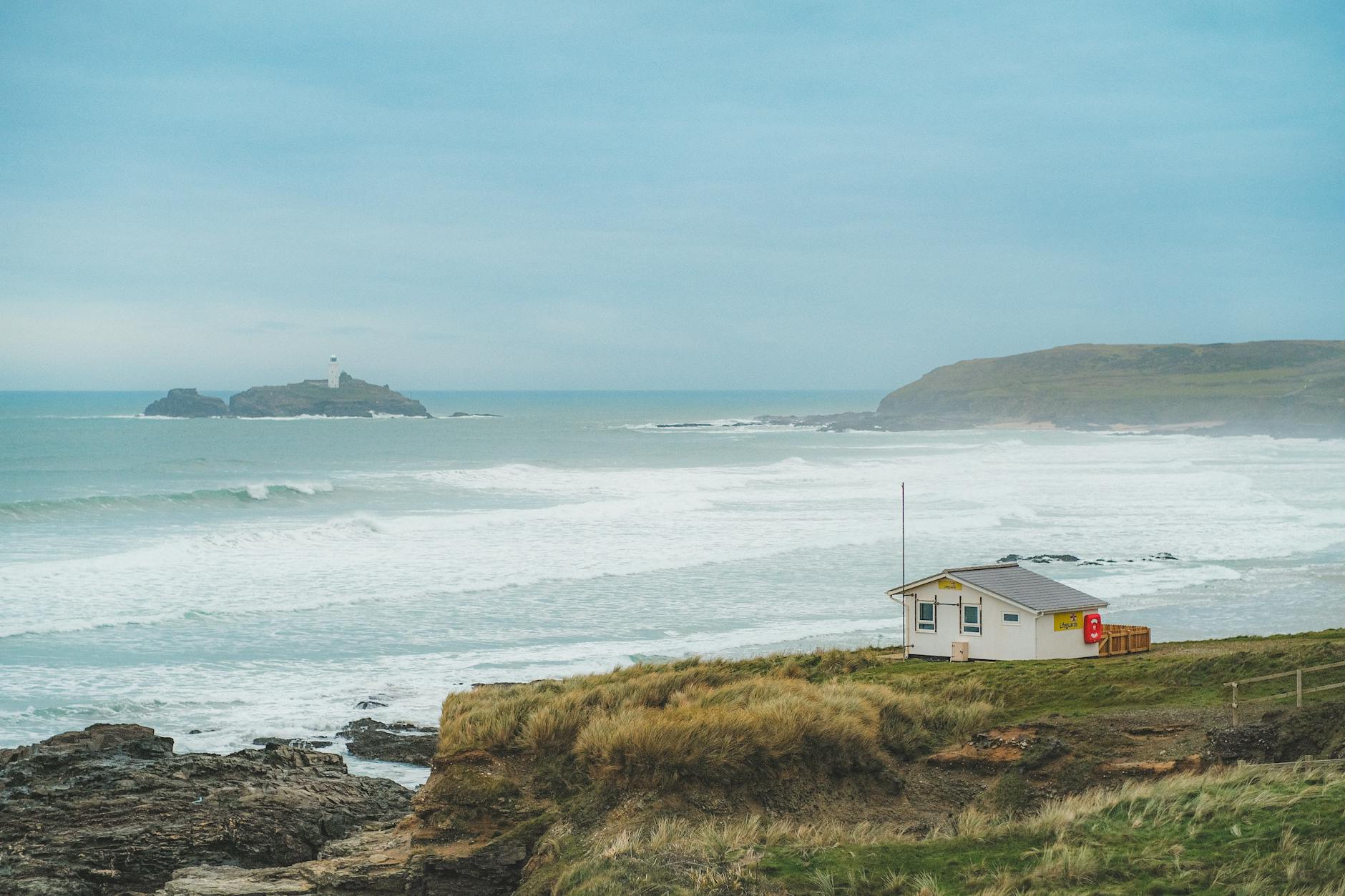
Eating and Drinking in Bude
Bude’s food scene has developed over the past decade. The names to know:
Temple, on the Strand, is the modern Cornish-British restaurant doing the more ambitious end of Bude dining. LAB (Live and Breathe), in the centre, focuses on plant-led cooking and natural wine — fresh, well-considered, more interesting than the average seaside menu. The Olive Tree on Belle Vue is the casual neighbourhood Mediterranean place that everyone recommends and that’s harder to book than the destination places. Life’s a Beach on Summerleaze sand does casual lunches with the best view in town. The Beach at Bude is the all-day café-restaurant on the seafront with cocktails into the evening. The Falcon Hotel is the grand pub by the canal lock — Bude’s oldest pub, with a proper restaurant attached. Castle Restaurant within Bude Castle does daytime food in the heritage building.
Events in Bude
The Bude Jazz Festival runs 1-4 September 2026 — the 37th edition. Around sixty performances by thirty-plus bands across venues including the Falcon Hotel, Bude Castle and various parish halls. Day Stroller and Four-Day Stroller tickets allow access across multiple venues. It’s one of the longest-running jazz festivals in Cornwall and brings a particular crowd of jazz enthusiasts to the town for the long weekend.
The Bude & Stratton Folk Festival runs in May. Smaller, more community-focused, with sessions across the town’s pubs.
Where to Stay in Bude
Bude’s accommodation runs from the Edgcumbe Hotel and the Falcon Hotel (the two grand traditional hotels) down through a network of B&Bs and small guesthouses to self-catering apartments and holiday parks on the outskirts. The town is large enough that you can choose between sea-view options at Summerleaze, town-centre options near the canal, and quieter cottages in the surrounding lanes.
Sands Resort at the southern end of town is the family resort with pool. The Beach at Bude is the central boutique option. For more on B&Bs in the area, our Cornwall B&B guide covers the wider region.
Bude as a Base for North Cornwall
Bude is the natural northern base for exploring this stretch of coast. Within forty minutes you can reach: Boscastle (twenty minutes south, harbour and Witchcraft Museum), Tintagel (thirty minutes, King Arthur and the EH castle), Port Isaac (forty minutes, the Doc Martin village), Morwenstow (fifteen minutes north, Hawker’s Hut), Crackington Haven (twenty minutes south, the dramatic cove). Newquay is over an hour south; Padstow is forty minutes via the A39. The other direction — north into Devon — opens up Hartland, Clovelly and Hartland Point within thirty minutes.
Bude Versus Newquay
This is the comparison most visitors get wrong. Newquay is bigger, busier, has the airport and the surf festivals and the nightlife. Bude is smaller, quieter, cheaper, more rugged, and has comparable Blue Flag beaches with a fraction of the crowds. If you want surf town energy and family attractions, Newquay. If you want an Atlantic-facing town that feels less commercial, choose Bude. The local secret: Bude’s beaches in August are quieter than Newquay’s in May.
Frequently Asked Questions
Is Bude worth visiting? Yes — particularly if you want a wilder, less commercial North Cornwall experience than Newquay or Padstow.
What is Bude Cornwall famous for? The Sea Pool, the surf, Sir Goldsworthy Gurney and the Bude Light, the sea-canal, and three Blue Flag beaches within three miles.
Is Bude better than Newquay? Quieter and cheaper; comparable beaches; smaller everything else. Choose based on what kind of holiday you want.
How many beaches does Bude have? Six within reach: Summerleaze, Crooklets, Widemouth, Sandymouth, Northcott Mouth, Black Rock.
Is Bude Sea Pool free? Yes, free and maintained by the Friends of Bude Sea Pool charity.
Can you swim in Bude Sea Pool all year round? Yes, though water temperatures drop significantly in winter. Tidal — empties and refills with the sea.
Is Bude in Devon or Cornwall? Cornwall — but only just. The Devon border is about three miles north at Welcombe Cross.
How long do you need in Bude? Three or four days for the town and main beaches; a week if exploring the wider north coast.
What is the best beach in Bude? Summerleaze for the sea pool and family; Crooklets for surf-club atmosphere; Widemouth for learner surfing; Sandymouth for quiet.
Are dogs allowed on Bude beaches? Sandymouth, Northcott and Black Rock allowed year-round. Summerleaze on leads in summer. Widemouth and Crooklets only October to March.
Can you surf in Bude as a beginner? Yes — Widemouth Bay is the main learner beach, with Raven Surf School and others.
Is there a train station in Bude? No. Nearest is Exeter, fifty-two miles east, connected by Stagecoach bus (about two hours).
What is the Storm Tower in Bude? The Compass Point Storm Tower, built 1835, modelled on the Tower of the Winds in Athens. Moved 100 metres inland in 2023-2024 because of cliff erosion.
Bude is the Cornish town that visitors keep deciding is too far north and then quietly visit anyway, find an empty beach, fall in love with a sea pool that the locals saved themselves, and book again for next year. Walk to the Storm Tower at sunset. Swim in the Sea Pool whatever the season. Drive up to Hawker’s Hut at Morwenstow with a thermos. The Atlantic version of Cornwall is up here, away from the polished south, and it’s worth the extra drive.